
Sermons
Watch Now
When God Sees Your Heart, Where Do You Run? | Hebrews 4:12-16
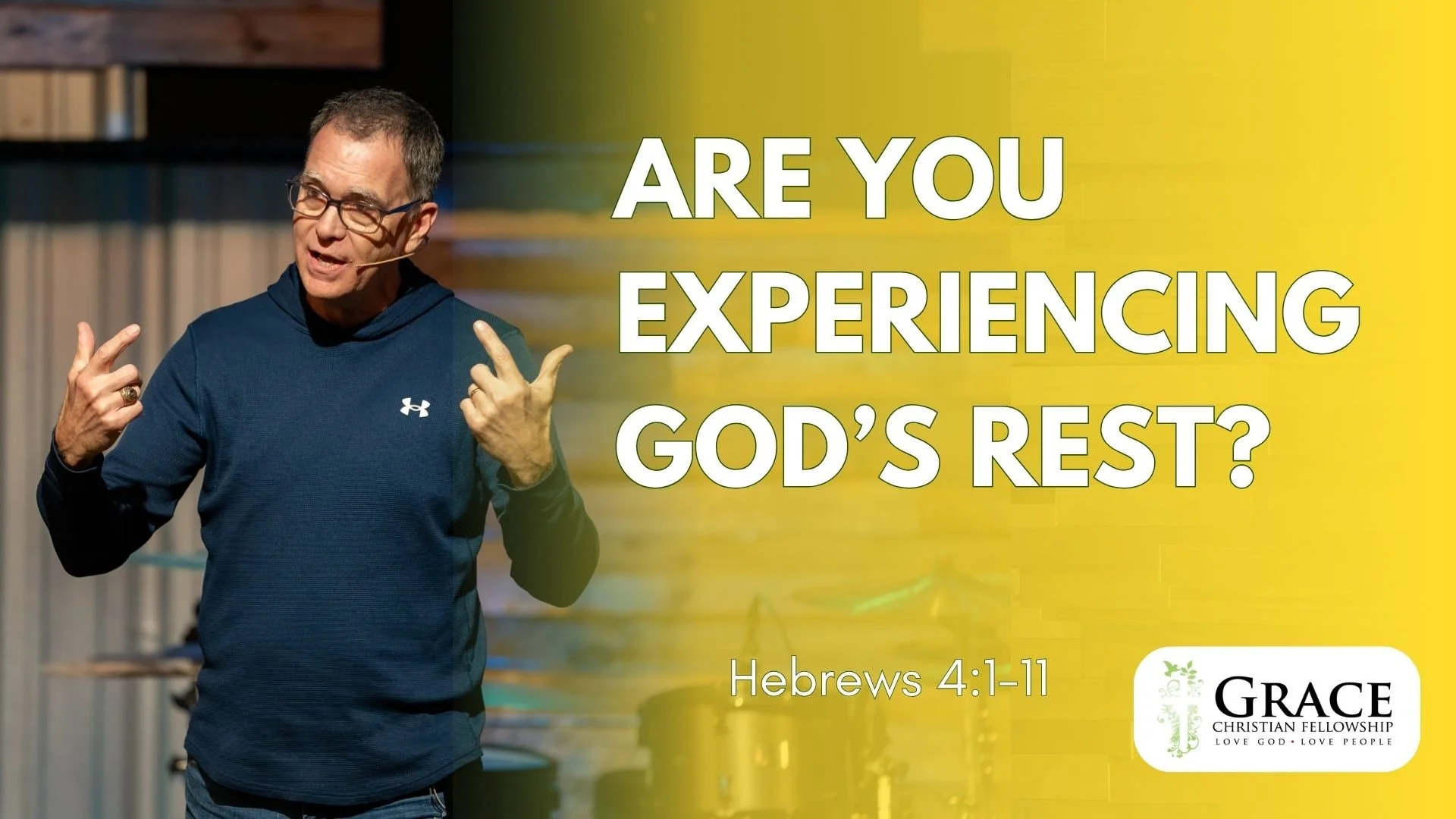
Are You Experiencing God’s Rest? | Hebrews 4:1–11 | Hold Fast
Are you carrying burdens that leave you exhausted, discouraged, or struggling to trust God?
In Hebrews 4:1–11, we’re reminded that God’s promise of rest still stands. But just as the Israelites missed what God had promised because of their unbelief, we can miss the rest he offers when we refuse to trust him.
In this message, Pastor Darien Gabriel of Grace Christian Fellowship explores what God’s rest really means, why unbelief prevents us from experiencing it, and how we can keep trusting God even when our faith is struggling.
Through the stories of Joshua and Caleb, a desperate father who cried, “I do believe; help me overcome my unbelief!”, and missionary Hudson Taylor, we’ll discover that God’s rest doesn’t require a trouble-free life. It requires a heart that keeps trusting him.
Bottom Line: God’s rest is available today to those who keep trusting him.
Scripture: Hebrews 4:1–11 (NIV)
Series: Hold Fast
Grace Christian Fellowship | Summerville, SC
Learn more: https://gracetoday.net
#HoldFast #Hebrews
When God Sees Your Heart, Where Do You Run? | Hebrews 4:12–16 | Hold Fast
God knows everything about us—our thoughts, motives, weaknesses, doubts, and sins. Nothing is hidden from Him. But when God’s Word exposes what’s really in our hearts, how should we respond?
In this message from Hebrews 4:12–16, Pastor Darien Gabriel explains how God’s living Word reveals our hearts and how Jesus, our great high priest, understands our weaknesses and invites us to approach God’s throne with confidence.
We don’t have to hide from God or run away in shame. Because of Jesus, we can draw near and receive the mercy and grace we need.
Bottom Line: When God’s Word exposes our hearts, hold fast to Jesus and draw near to God for mercy and grace.
Join us at Grace Christian Fellowship in Summerville, South Carolina, as we continue our series, Hold Fast: A Study of Hebrews.
Learn more: https://GraceToday.net
#HoldFast #Hebrews
Are You Experiencing God’s Rest? | Hebrews 4:1-11
Are You Experiencing God’s Rest? | Hebrews 4:1–11 | Hold Fast
Are you carrying burdens that leave you exhausted, discouraged, or struggling to trust God?
In Hebrews 4:1–11, we’re reminded that God’s promise of rest still stands. But just as the Israelites missed what God had promised because of their unbelief, we can miss the rest he offers when we refuse to trust him.
In this message, Pastor Darien Gabriel of Grace Christian Fellowship explores what God’s rest really means, why unbelief prevents us from experiencing it, and how we can keep trusting God even when our faith is struggling.
Through the stories of Joshua and Caleb, a desperate father who cried, “I do believe; help me overcome my unbelief!”, and missionary Hudson Taylor, we’ll discover that God’s rest doesn’t require a trouble-free life. It requires a heart that keeps trusting him.
Bottom Line: God’s rest is available today to those who keep trusting him.
Scripture: Hebrews 4:1–11 (NIV)
Series: Hold Fast
Grace Christian Fellowship | Summerville, SC
Learn more: https://gracetoday.net
#HoldFast #Hebrews
Will You Finish Well? | Hebrews 3:7–19 | Hold Fast Series
Don’t just start well. Finish well.
It’s possible to experience God’s goodness, witness His faithfulness, and still allow unbelief to harden our hearts. That’s the sobering warning found in Hebrews 3:7–19.
Drawing from Psalm 95 and Israel’s failure to trust God in the wilderness, Pastor Darien Gabriel challenges us to examine our own hearts. Israel’s problem wasn’t a lack of evidence. It was a lack of faith.
In this message, we’ll explore three essential practices for finishing well:
1. Hear God’s voice today. (Hebrews 3:7–11)
2. Guard your heart every day. (Hebrews 3:12–15)
3. Don’t let unbelief keep you from finishing well. (Hebrews 3:16–19)
Through a personal story about a life-changing medical warning, Darien reminds us that warnings are gifts when they lead us to change course. God’s warning is clear: Don’t harden your heart. Respond to His voice with faith and obedience.
Bottom Line: Finishing well requires a heart that keeps hearing, trusting, and obeying God.
Genuine faith doesn’t merely hear God’s Word. It responds to God’s Word and continues trusting Him.
What do your actions reveal about what you truly believe?
Scripture: Hebrews 3:7–19; Psalm 95
Series: Hold Fast
Speaker: Pastor Darien Gabriel
Church: Grace Christian Fellowship
Learn more: GraceToday.net
Connect with Darien: DarienGabriel.com
#HoldFast #Hebrews

Will You Finish Well? | Hebrews 3:7-19
Can You Trust Jesus with Everything? | Hebrews 1:1–3 | Hold Fast
Can you really trust Jesus with everything—your future, your family, your finances, your plans, your fears, and the things you cannot control?
Hebrews begins by answering two questions that are essential to trust: Can He handle it? And does He care?
Hebrews 1:1–3 gives us a breathtaking picture of Jesus. He is the One through whom God made the universe. He is the radiance of God’s glory, the exact representation of His being, the One who sustains all things by His powerful word, the One who provided purification for our sins, and the King who now reigns.
He has the power to hold everything—and the cross shows us that He loves us enough to give everything.
Hear the Word.
See the Son.
Bow to the King.
Bottom Line: The King who holds everything is the King who gave everything. So, yes, you can trust Him.
Will You Finish Well? | Hebrews 3:7–19 | Hold Fast Series
Don’t just start well. Finish well.
It’s possible to experience God’s goodness, witness His faithfulness, and still allow unbelief to harden our hearts. That’s the sobering warning found in Hebrews 3:7–19.
Drawing from Psalm 95 and Israel’s failure to trust God in the wilderness, Pastor Darien Gabriel challenges us to examine our own hearts. Israel’s problem wasn’t a lack of evidence. It was a lack of faith.
In this message, we’ll explore three essential practices for finishing well:
1. Hear God’s voice today. (Hebrews 3:7–11)
2. Guard your heart every day. (Hebrews 3:12–15)
3. Don’t let unbelief keep you from finishing well. (Hebrews 3:16–19)
Through a personal story about a life-changing medical warning, Darien reminds us that warnings are gifts when they lead us to change course. God’s warning is clear: Don’t harden your heart. Respond to His voice with faith and obedience.
Bottom Line: Finishing well requires a heart that keeps hearing, trusting, and obeying God.
Genuine faith doesn’t merely hear God’s Word. It responds to God’s Word and continues trusting Him.
What do your actions reveal about what you truly believe?
Scripture: Hebrews 3:7–19; Psalm 95
Series: Hold Fast
Speaker: Pastor Darien Gabriel
Church: Grace Christian Fellowship
Learn more: GraceToday.net
Connect with Darien: DarienGabriel.com
#HoldFast #Hebrews

What is So Great about Jesus? | Hebrews 3:1-6
Can You Trust Jesus with Everything? | Hebrews 1:1–3 | Hold Fast
Can you really trust Jesus with everything—your future, your family, your finances, your plans, your fears, and the things you cannot control?
Hebrews begins by answering two questions that are essential to trust: Can He handle it? And does He care?
Hebrews 1:1–3 gives us a breathtaking picture of Jesus. He is the One through whom God made the universe. He is the radiance of God’s glory, the exact representation of His being, the One who sustains all things by His powerful word, the One who provided purification for our sins, and the King who now reigns.
He has the power to hold everything—and the cross shows us that He loves us enough to give everything.
Hear the Word.
See the Son.
Bow to the King.
Bottom Line: The King who holds everything is the King who gave everything. So, yes, you can trust Him.
What is So Great About Jesus? Hebrews 3:1–6
Text: Hebrews 3:1-6
Bottom Line: Jesus came down into our suffering, humanity, and temptation to bring us up to glory.
Grace Christian Fellowship
Drew Nethery
GraceToday.net
DarienGabriel.com
#HoldFast #Hebrews
Why Did Jesus Come Down? | Hebrews 2:10-18
Can You Trust Jesus with Everything? | Hebrews 1:1–3 | Hold Fast
Can you really trust Jesus with everything—your future, your family, your finances, your plans, your fears, and the things you cannot control?
Hebrews begins by answering two questions that are essential to trust: Can He handle it? And does He care?
Hebrews 1:1–3 gives us a breathtaking picture of Jesus. He is the One through whom God made the universe. He is the radiance of God’s glory, the exact representation of His being, the One who sustains all things by His powerful word, the One who provided purification for our sins, and the King who now reigns.
He has the power to hold everything—and the cross shows us that He loves us enough to give everything.
Hear the Word.
See the Son.
Bow to the King.
Bottom Line: The King who holds everything is the King who gave everything. So, yes, you can trust Him.
Why did Jesus come down? Hebrews 2:10–18 tells us that Jesus didn’t remain distant from our brokenness. He entered into our suffering, shared fully in our humanity, faced temptation, and even experienced death. Why? He came down to bring us up.
In this message from our Hold Fast series, Pastor Darien Gabriel explores how Jesus became the pioneer of our salvation, defeated the power of death, freed us from the fear of death, and became our merciful and faithful High Priest who helps us when we are tempted. And because Jesus entered our suffering to bring us to glory, his followers are called to enter the suffering of others and point them toward the hope found in him.
Text: Hebrews 2:10–18
Bottom Line: Jesus came down into our suffering, humanity, and temptation to bring us up to glory.
Grace Christian Fellowship
Pastor Darien Gabriel
GraceToday.net
DarienGabriel.com
#HoldFast #Hebrews
Are You Drifting? | Hebrews 2:1-4
Can You Trust Jesus with Everything? | Hebrews 1:1–3 | Hold Fast
Can you really trust Jesus with everything—your future, your family, your finances, your plans, your fears, and the things you cannot control?
Hebrews begins by answering two questions that are essential to trust: Can He handle it? And does He care?
Hebrews 1:1–3 gives us a breathtaking picture of Jesus. He is the One through whom God made the universe. He is the radiance of God’s glory, the exact representation of His being, the One who sustains all things by His powerful word, the One who provided purification for our sins, and the King who now reigns.
He has the power to hold everything—and the cross shows us that He loves us enough to give everything.
Hear the Word.
See the Son.
Bow to the King.
Bottom Line: The King who holds everything is the King who gave everything. So, yes, you can trust Him.
Are you drifting?
Spiritual drift rarely happens all at once. More often, it happens slowly—through familiarity, distraction, busyness, or simply neglecting to pay careful attention to Jesus.
In Hebrews 2:1–4, we encounter the first major warning in Hebrews: “We must pay the most careful attention, therefore, to what we have heard, so that we do not drift away.”
In this message from our Hold Fast series, Pastor Darien Gabriel considers why the salvation we have received is far too great to neglect—and why we need God’s Word and God’s people to help us stay anchored in Christ.
Series: Hold Fast
Title: Are You Drifting?
Text: Hebrews 2:1–4
Bottom Line: Pay careful attention to Jesus so that you won’t drift away.
Hear the Word. See the Son. Bow to the King.
Grace Christian Fellowship GraceToday.net
#Hebrews #HoldFast
Which Jesus Do You Believe in? | Hebrews 1:4-14
Can You Trust Jesus with Everything? | Hebrews 1:1–3 | Hold Fast
Can you really trust Jesus with everything—your future, your family, your finances, your plans, your fears, and the things you cannot control?
Hebrews begins by answering two questions that are essential to trust: Can He handle it? And does He care?
Hebrews 1:1–3 gives us a breathtaking picture of Jesus. He is the One through whom God made the universe. He is the radiance of God’s glory, the exact representation of His being, the One who sustains all things by His powerful word, the One who provided purification for our sins, and the King who now reigns.
He has the power to hold everything—and the cross shows us that He loves us enough to give everything.
Hear the Word.
See the Son.
Bow to the King.
Bottom Line: The King who holds everything is the King who gave everything. So, yes, you can trust Him.
Which Jesus Do You Believe In? | Hebrews 1:4–14
There are a lot of versions of Jesus out there—the religious Jesus, the cultural Jesus, the political Jesus, even the Jesus we reshape to fit our own preferences. But it’s possible to believe in Jesus and still believe the wrong things about Jesus.
Hebrews 1:4–14 tells us to look again: See the Son.
Jesus is not merely another spiritual being. He is greater than the angels. He is the Son, the King, and the Lord. Angels worship Him. Creation is the work of His hands. His throne lasts forever. Everything else changes, but Jesus remains.
So which Jesus do you believe in?
Bottom Line: See Jesus for who He really is—and hold fast to Him.
When you’re tempted to loosen your grip on Jesus, look again at who you’re holding onto.
Series: Hold Fast
Scripture: Hebrews 1:4–14 NIV
Speaker: Darien Gabriel | DarienGabriel.com
#HoldFast #Hebrews
Can You Trust Jesus With Everything? | Hebrews 1:1-3
Can You Trust Jesus with Everything? | Hebrews 1:1–3 | Hold Fast
Can you really trust Jesus with everything—your future, your family, your finances, your plans, your fears, and the things you cannot control?
Hebrews begins by answering two questions that are essential to trust: Can He handle it? And does He care?
Hebrews 1:1–3 gives us a breathtaking picture of Jesus. He is the One through whom God made the universe. He is the radiance of God’s glory, the exact representation of His being, the One who sustains all things by His powerful word, the One who provided purification for our sins, and the King who now reigns.
He has the power to hold everything—and the cross shows us that He loves us enough to give everything.
Hear the Word.
See the Son.
Bow to the King.
Bottom Line: The King who holds everything is the King who gave everything. So, yes, you can trust Him.
Can You Trust Jesus with Everything? | Hebrews 1:1–3 | Hold Fast
Can you really trust Jesus with everything—your future, your family, your finances, your plans, your fears, and the things you cannot control? Hebrews begins by answering two questions that are essential to trust: Can He handle it? And does He care?
Hebrews 1:1–3 gives us a breathtaking picture of Jesus. He is the One through whom God made the universe. He is the radiance of God’s glory, the exact representation of His being, the One who sustains all things by His powerful word, the One who provided purification for our sins, and the King who now reigns. He has the power to hold everything—and the cross shows us that He loves us enough to give everything.
Hear the Word.
See the Son.
Bow to the King.
Bottom Line: The King who holds everything is the King who gave everything. So, yes, you can trust Him.
#followJesus #acts9
Preached by: Darien Gabriel Grace Christian Fellowship 🌐 https://GraceToday.net 🌐 https://DarienGabriel.com

What Does Jesus Want Us to Do Next? | Acts 9:19b-31
What Does Jesus Want Us to Do Next?
Acts 9:19b–31
When Saul met Jesus on the road to Damascus, everything changed—including the direction of his life. The man who came to Damascus to stop people from proclaiming Jesus soon began proclaiming Jesus himself.
In Acts 9:19b–31, we see what happened next: Saul told others about Jesus, learned to follow Jesus alongside other believers, and became part of a church that was strengthened, encouraged by the Holy Spirit, and growing.
The same question Saul faced is one we need to ask today: What does Jesus want us to do next?
Bottom Line: When Jesus changes your life, He also changes the direction of your life.
Scripture: Acts 9:19b–31 NIV
Series: Acts
Preacher: Darien Gabriel dariengabriel.com
Grace Christian Fellowship GraceToday.net
#followJesus #acts9
What Does Jesus Want Us to Do Next?
Acts 9:19b–31
When Saul met Jesus on the road to Damascus, everything changed—including the direction of his life. The man who came to Damascus to stop people from proclaiming Jesus soon began proclaiming Jesus himself. In Acts 9:19b–31, we see what happened next: Saul told others about Jesus, learned to follow Jesus alongside other believers, and became part of a church that was strengthened, encouraged by the Holy Spirit, and growing. The same question Saul faced is one we need to ask today: What does Jesus want us to do next?
Bottom Line: When Jesus changes your life, He also changes the direction of your life.
Scripture: Acts 9:19b–31 NIV
Series: Acts
Preacher: Darien Gabriel dariengabriel.com
Grace Christian Fellowship GraceToday.net #followJesus #acts9

Don’t Waste the Wait | 2 Peter 3:11-18
2 Peter 3:11-18
Live for What Lasts vv11-13
Wait with Purpose vv 14-15
Grow & Stand firm vv 16-18
Day of God - When Christ returns
Does Scripture show that the holy conduct, godliness, and prayer hasten Christ's return? Peter seems to think so. See also Matt 6:10; 24:14; Acts 3:19-21. Some may feel uneasy because they worry about the understanding of the sovereignty of God being undercut. But God knows in advance what his people will do, say, pray, and think. He even foreordains it (Prov 16:33; Isa 46:6-9; Lam 3:37-38; Amos 4:13; Eph 1:11). It’s okay to live in the tension between God’s divine sovereignty and our human responsibility.
2 Peter 3:11-18
Live for What Lasts v:11-13
Wait with Purpose v:14-15
Grow & Stand firm v:16-18
Day of God - When Christ returns
Does Scripture show that the holy conduct, godliness, and prayer hasten Christ's return? Peter seems to think so. See also Matt 6:10; 24:14; Acts 3:19-21. Some may feel uneasy because they worry about the understanding of the sovereignty of God being undercut. But God knows in advance what his people will do, say, pray, and think. He even foreordains it (Prov 16:33; Isa 46:6-9; Lam 3:37-38; Amos 4:13; Eph 1:11). It’s okay to live in the tension between God’s divine sovereignty and our human responsibility.

What Does God Do With Our Sin? | 2 Peter 2:3-10
Opening story about 2 Peter
3:God has dim view of False Teachers-
Mathew 7:15:Beware of false prophets, who come to you in sheep's clothing but inwardly are ravenous wolves.
Galatians 1:8-9 But even if we or an angel from heaven should preach to you a gospel contrary to the one we preached to you, let him be accursed. 9 As we have said before, so now I say again: If anyone is preaching to you a gospel contrary to the one you received, let him be accursed.
4: I don’t know but that won’t stop me.
Here and Jude references the Book of Enoch
I believe that everything that God wants us to know is in the Bible.
God is just which means he must punish sin. Even the angels are not speared His judgment.
5: Genesis 6:5-6: The Lord saw that the wickedness of man was great in the earth, and that every intention of the thoughts of his heart was only evil continually. 6 And the Lord regretted that he had made man on the earth, and it grieved him to his heart.
Even the most depraved people touch God’s heart. Noah didn’t stop warning and teaching about God’s righteousness.
More than that Jesus died for his enemies Romans 5:10: For if while we were enemies we were reconciled to God by the death of his Son
God’s commands us to witness and leave the results to him.
6-8: Agan we see God’s righteous judgement carried out on the ungodly and his rescuing of the righteous.
God calls Lot righteous, who am I to disagree. Praise God what He calls righteous is righteous.
9: God’s justice will be done.
How does he rescue us from his Justice? By taking on the punishment for our sins Himself.
Car example
God rescues and redeems:
Peter saw this in 3 ways:
Heard stories about it- The prodigal son Luke 15
Saw it happen: The women at the well. John 4
Lived it- Denal and calling.
2 Peter 2:3-10
Opening story about 2 Peter
3:God has dim view of False Teachers-
Mathew 7:15:Beware of false prophets, who come to you in sheep's clothing but inwardly are ravenous wolves.
Galatians 1:8-9 But even if we or an angel from heaven should preach to you a gospel contrary to the one we preached to you, let him be accursed. 9 As we have said before, so now I say again: If anyone is preaching to you a gospel contrary to the one you received, let him be accursed.
4: I don’t know but that won’t stop me.
Here and Jude references the Book of Enoch
I believe that everything that God wants us to know is in the Bible.
God is just which means he must punish sin. Even the angels are not speared His judgment.
5: Genesis 6:5-6: The Lord saw that the wickedness of man was great in the earth, and that every intention of the thoughts of his heart was only evil continually. 6 And the Lord regretted that he had made man on the earth, and it grieved him to his heart.
Even the most depraved people touch God’s heart. Noah didn’t stop warning and teaching about God’s righteousness.
More than that Jesus died for his enemies Romans 5:10: For if while we were enemies we were reconciled to God by the death of his Son
God’s commands us to witness and leave the results to him.
6-8: Agan we see God’s righteous judgement carried out on the ungodly and his rescuing of the righteous.
God calls Lot righteous, who am I to disagree. Praise God what He calls righteous is righteous.
9: God’s justice will be done.
How does he rescue us from his Justice? By taking on the punishment for our sins Himself.
Car example
God rescues and redeems:
Peter saw this in 3 ways:
Heard stories about it- The prodigal son Luke 15
Saw it happen: The women at the well. John 4
Lived it- Denal and calling.

How Can I Spot a False Teacher? | 2 Peter 2:1-3a
How Can I Spot a False Teacher?
2 Peter 2:1-3a
“But there were also false prophets among the people, just as there will be false teachers
among you. They will secretly introduce destructive heresies, even denying the sovereign
Lord who bought them—bringing swift destruction on themselves. 2 Many will follow their
depraved conduct and will bring the way of truth into disrepute. 3 In their greed these teachers
will exploit you with fabricated stories. Their condemnation has long been hanging over them,
and their destruction has not been sleeping.”
- Peter reminded us in Chapter 1 that the apostolic witness and the prophetic word are the
reliable sources for the believers’ confidence in Christ’s coming.
- Chapter 2, Peter shifts his focus to remind believers about the unreliable sources: False
Teachers.
- Peter reminds us that not all prophets are from God – similar language that Jude used.
- The targets are unsuspecting people who at least profess to be part of the community of
faith.

What Do I Need to Know That I Already Know? | 2 Peter 1:12-21
Sermon Title: What Do I Need to Know That I Already Know?
Main Idea/Question: What if your spiritual growth is less about new information and more about obedience to what you already know? We often believe that our growth depends on learning new things. However, true growth may rely less on acquiring new knowledge and more on being obedient to what we already know. In this passage, Peter reminds his audience of truths they have heard before, knowing these reminders are vital to their maturity in Christ.
You tube Description : Message on Growing as a Christian 2 Peter 1:12-21
Sermon Title: What Do I Need to Know that I already Know?
Main Idea/Question: What if your spiritual growth is less about new information and more about obedience to what you already know? We often believe that our growth depends on learning new things. However, true growth may rely less on acquiring new knowledge and more on being obedient to what we already know. In this passage, Peter reminds his audience of truths they have heard before, knowing these reminders are vital to their maturity in Christ.
You tube Description : Message on Growing as a Christian | 2 Peter 1:12-21

Where Do We Grow From Here? | 2 Peter 1:5-11
Intro: 4th of July –
Illustration Pilgrims- Pilgrim’s Progress
Question to Answer: What do I do with what I have received? Grow in your Faith
Context
For this Reason (2 Peter 1:1-4) Take this personally- your sin, your life, claim his promise for you, spend time with him
God has called you out of corruption
God has equipped you to live a godly life
God keeps his good and precious promises
God invites you to himself to share in his divine nature.
Make every Effort (Luke 5:1-11) (Listen to the Master (intake of God’s Word), Put out into deep water (make faith decisions) keep at it or leave and follow Jesus
Add to - Generous and Costly Participation (Theater Patron) – What are you investing in the kingdom of God? Time, Finances, Opportunity Cost
Growth
Growth takes Effort (Generous and Costly Participation
Growth is Gradual (Peter’s Journey, Saved by GRACE)
Growth is effective (you will see evidence)
Faith (Hebrews 11: 1- confidence in what we hope for, assurance of what we do not see)
Faith is the foundation- virtue without it is like a screen door on a submarine (Hebrews 11:6-without faith it is impossible to please God)
Faith is a Gift (2 Peter 1:1)
Faith does not stand alone (verse 5-11)
Goodness (Mark 10: 17-18 No one is Good but God alone)
Let God’s Word be your Moral Authority, Let it come from your faith
Knowledge (Gnosis, Practical Wisdom, Proverbs- the fear of the Lord is the beginning of Wisdom, Listen to Wise Counsel, be Humble, Phone illustration What kind of knowledge do we seek (tree of knowledge of good and evil)
Self Control (1 Peter 2:11 Abstain from desires that wage war) Christian and Faithful in Vanity Fair)
Perseverance (Endurance- Ernest Shackleton, Romans 5:3-5)
Patience- Waiting on Jesus, Suffering-perseverance-Character-hope, God does not waste it. He is the God who sees you (Genesis 16:13) But we are not meant to be alone (Genesis 2:18)
Godliness (godliness- Godliness- Eusebia- piety, holiness, reverence, respect) (1 Peter 2:17)
Mutual Affection (Philadelphia brotherly love, (1 Peter 1:22)
Vulnerability of Being known, power of Christian Community – Outward- love God, love people
Mutual Affection to Love (Agape) The Fathers Bargain
(John 13:35-Love one another)- We are called to love each other in this manner.
Possess these qualities in increasing measure-Growth = increase in size or complexity- one of the traits used to determine if something is alive. Have these and you will be effective and productive (Living things Grow)
Epignosis knowledge of Jesus Personally. To know him.
Near sighted and Blind (blind by way of being near sighted, driving example, you are a danger to others)
Forgetting they have been cleansed (Pilgrim’s Progress , Christian being tempted to turn back- but remembering when his burden fell- The Gospel
Therefore- make every effort (again) to confirm your calling and election
Two Plants- Because Living things grow – If you are growing – it is evidence you are alive in Christ. Consider this. How to confirm- Pursue Jesus. Repent and Believe, Continue to repent and believe
Stumble- What causes people to stumble? This is an eternal type of stumbling block. (lack of faith, perverted good, worldly knowledge, lack of self control, etc.)
Rich Welcome- Arrival at the end of the Journey- take of your pack, put down your burden- Hospitality of Heaven – Worth striving for, waiting For, dying for
2 Peter 3:18 – Read aloud
Gospel Presentation/Communion
Where Do We Grow From Here? | 2 Peter 1:5-11
Sermon Series: Faithful to the End
Intro: 4th of July –
Illustration Pilgrims- Pilgrim’s Progress
Question to Answer: What do I do with what I have received? Grow in your Faith
Context
For this Reason (2 Peter 1:1-4) Take this personally- your sin, your life, claim his promise for you, spend time with him
God has called you out of corruption
God has equipped you to live a godly life
God keeps his good and precious promises
God invites you to himself to share in his divine nature.
Make every Effort (Luke 5:1-11) (Listen to the Master (intake of God’s Word), Put out into deep water (make faith decisions) keep at it or leave and follow Jesus
Add to - Generous and Costly Participation (Theater Patron) – What are you investing in the kingdom of God? Time, Finances, Opportunity Cost
Growth
Growth takes Effort (Generous and Costly Participation
Growth is Gradual (Peter’s Journey, Saved by GRACE)
Growth is effective (you will see evidence)
Faith (Hebrews 11: 1- confidence in what we hope for, assurance of what we do not see)
Faith is the foundation- virtue without it is like a screen door on a submarine (Hebrews 11:6-without faith it is impossible to please God)
Faith is a Gift (2 Peter 1:1)
Faith does not stand alone (verse 5-11)
1. Goodness (Mark 10: 17-18 No one is Good but God alone) | Let God’s Word be your Moral Authority, Let it come from your faith
2. Knowledge (Gnosis, Practical Wisdom, Proverbs- the fear of the Lord is the beginning of Wisdom, Listen to Wise Counsel, be Humble, Phone illustration What kind of knowledge do we seek (tree of knowledge of good and evil)
3.Self Control (1 Peter 2:11 Abstain from desires that wage war) Christian and Faithful in Vanity Fair)
4. Perseverance (Endurance- Ernest Shackleton, Romans 5:3-5)
5.Patience- Waiting on Jesus, Suffering-perseverance-Character-hope, God does not waste it. He is the God who sees you (Genesis 16:13) But we are not meant to be alone (Genesis 2:18)
6.Godliness (godliness- Godliness- Eusebia- piety, holiness, reverence, respect) (1 Peter 2:17)
7. Mutual Affection (Philadelphia brotherly love, (1 Peter 1:22)
Vulnerability of Being known, power of Christian Community – Outward- love God, love people
Mutual Affection to Love (Agape) The Fathers Bargain
(John 13:35-Love one another)- We are called to love each other in this manner.
Possess these qualities in increasing measure-Growth = increase in size or complexity- one of the traits used to determine if something is alive. Have these and you will be effective and productive (Living things Grow)
Epignosis knowledge of Jesus Personally. To know him.
Near sighted and Blind (blind by way of being near sighted, driving example, you are a danger to others)
Forgetting they have been cleansed (Pilgrim’s Progress , Christian being tempted to turn back- but remembering when his burden fell- The Gospel
Therefore- make every effort (again) to confirm your calling and election
Two Plants- Because Living things grow – If you are growing – it is evidence you are alive in Christ. Consider this. How to confirm- Pursue Jesus. Repent and Believe, Continue to repent and believe
Stumble- What causes people to stumble? This is an eternal type of stumbling block. (lack of faith, perverted good, worldly knowledge, lack of self control, etc.)
Rich Welcome- Arrival at the end of the Journey- take of your pack, put down your burden- Hospitality of Heaven – Worth striving for, waiting For, dying for
2 Peter 3:18 – Read aloud
Gospel Presentation/Communion
I

Why Hold On if God Won’t Let Go? | Jude 24-25
Series: Contending for the Faith
Title: “Why Hold on if God Won’t Let Go?”
Scripture: Jude 24-25 NIV
Psalm 37:23-24
Psalm 139:23-24
Proverbs 24:16
John 10:27-30
Romans 8:38-39
Ephesians 1:13-14
Hebrews 13:5
1 John 2:19
1 John 5:13
Bottom line: We hold on because he holds us.
INTRODUCTION
CONTEXT
OUTLINE
CONCLUSION
DISCUSSION QUESTIONS
NOTES
YOUTUBE DESCRIPTION
MAIN REFERENCES USED
My opening prayer: Lord God, help us grow to be and do like Jesus, while abiding in him and leading others to do the same.
OPENING STORY
"He is able to keep..."
Watch a parent walk a small child along the edge of a busy sidewalk. The child is doing real walking — short, wobbly, determined steps, working as hard as little legs can work. And then she trips. Of course she does; her foot catches the curb and she pitches forward. But she doesn’t hit the pavement. She never even gets close. Her hand is wrapped inside a bigger hand, and the instant she goes, that hand lifts and steadies and sets her back on her feet before the fall can finish. She stumbled — but she did not fall.
Jude has spent his whole letter telling us to walk a dangerous edge: in the midst of false and deceptive teachers, contend, build, keep, rescue — right alongside the place where others have already gone over and not come back.
Now, in the last two verses, he shows us the hand. “To him who is able to keep you from stumbling.” Or as the psalmist said it long before: "Though he may stumble, he will not fall, for the LORD upholds him with his hand" (Psalm 37:24).
The missteps still come. The fatal fall never does — because the grip holding you is not your own.
Said another way, we may find ourselves in the ditch along the narrow way...but he's right there pulling us out of the muck and mire back onto the highway of our God.
Too Busy in this life
A traveler once walked more than 700 miles to see Niagara Falls. As he neared his destination, he heard a distant roar and asked a nearby farmer, “Is that Niagara Falls?”
The farmer replied, “I don’t know. It might be.”
Surprised, the traveler asked, “Do you live here?”
“Born and raised here,” the farmer said.
“And you’ve never gone to see the falls?”
“No, stranger. I’ve been too busy looking after my farm.”
What a tragedy—to live within the sound of one of the world’s greatest wonders and never take the time to see it.
And yet many Christians do something similar. We know heaven is coming. We know we will stand in the presence of God’s glory. We hear about it every week. But we become so busy with the things of this world that we lose our appetite for the world to come.
Jude reminds us that God is keeping us for something far greater: to be presented before His glorious presence, blameless and with great joy.
Poem
"Some want to live within the sound
Of church or chapel bell;
I want to run a rescue shop
Within a yard of hell."
CONTEXT
The entire letter begins and ends with God’s keeping power:
Jude 1 — “To those who have been called, who are loved in God the Father and kept for Jesus Christ.”
Jude 21 — “Keep yourselves in God’s love…”
Jude 24 — “To him who is able to keep you from stumbling and to present you…”
Jude 25 — Doxology praising the God who does the keeping.
That creates a beautiful tension:
Kept by God (v.1) → Keep yourselves in God’s love (v.21) → Kept by God (v.24).
The question practically preaches itself:
“If God is holding me, why does Jude tell me to hold on?”
Imagine being swept toward a waterfall.
You know you cannot save yourself.
Then a strong rescuer reaches you and takes hold of your arm.
The question isn’t whether he will hold on.
The question is: Why would you not hold on to him?
That’s the tension in Jude.
God has taken hold of us.
Therefore, we keep ourselves in His love.
Not to earn His rescue.
Not to maintain His rescue.
But because His rescue is already underway.
“Why Hold On If He’s Holding You?”
That raises one of the most important questions in the Christian life:
Is my salvation ultimately dependent on how tightly I hold onto God—or how tightly God holds onto me?
OUTLINE (Help from Shaddix/Akin)
I. God holds/keeps me. (Jude 1, 24) i.e. I am saved and secured by God's power, promise, person, and praise.
A. We are secure because of God’s power
“To him who is able…”
Not merely willing.
Able.
Cross references:
John 10:28-29
Romans 8:38-39
Philippians 1:6
B. We are secure because of God’s promise
If eternal life can be lost, it was never eternal.
Cross references:
John 6:37-40
John 17:12
Hebrews 10:14
C. We are secure because of God’s person
God does not change.
The One who called you is the One who keeps you.
Cross references:
Malachi 3:6
2 Timothy 2:13
Hebrews 13:8
D. We are secure because of God’s praise
Verse 25 is worship.
Jude cannot discuss salvation without ending in doxology.
The doctrine of eternal security is not merely comfort.
It is fuel for worship.
The point is not:
“Look how strong my faith is.”
The point is:
“Look how great my Savior is.”
II. I am to keep hold of God's love. (Jude 21) God keeps me by helping me hold on to him and his love.
Many people have asked:
“If God keeps me, why must I keep myself?”
Answer: Because security is not an excuse for passivity.
Illustrate: A child walking through a crowded airport.
The child holds Dad’s hand.
Dad also holds the child’s hand.
Which grip matters most?
Dad’s.
Yet the child still holds on.
The father may even let go of the child's hand in the airport to give the child a little more freedom and the child may stay close because they know that's where they're secure.
But the human condition is that we are prone to wander from his grip hurting our fellowship with him. Not that we can get away from him and his security, but that we can wander far enough to impact our fellowship and assurance negatively.
Come Thou Fount of Every Blessing
“Prone to wander, Lord, I feel it, Prone to leave the God I love.”
“Here’s my heart, O take and seal it, Seal it for Thy courts above.”
…because relationship requires abiding
John 15.
…because obedience strengthens assurance
Not salvation.
Assurance.
…because spiritual drift is real
The false teachers in Jude prove this.
…because God uses means
Prayer.
Scripture.
Church.
Worship.
Fellowship.
…because the kept become keepers
Verses 22-23.
We rescue others.
…because God’s preserving grace produces perseverance
This is the key theological answer.
The evidence that God is keeping us is that we continue following Him.
God’s sovereignty and human responsibility are friends, not enemies.
You might even summarize:
God’s grip is the cause.
Our grip is the evidence.
CONCLUSION
Bottom line: We hold on because he holds us.
As I've said, we have four daughters. All are married.
As we wait for the music to start--in those few moments where your life flashes before you--before you begin to walk down that aisle before God and all those people--I established a tradition that goes back to the days when selfies were the rage.
It was 2016. Selfies were a new phenomenon. I'm standing there with Samantha and I can tell she's excited, happy, and, well, emotional,m - on the verge of tears.
Now we can't have her makeup running at this moment! So I suggest we do a selfie together as we wait for the thumbs up. It only takes a few seconds. But it gave her a reason to focus on this pic (I'm about to give her away, remember, so I'm emotional too). She leans in with a huge smile and relief and joy swallow us as we take the picture as I miraculously press the right button on the first try. It's an amazing picture.
So, yes, I had the privilege to escort them down the aisle and move their hand from mine to another's. It's a humbling moment.
There’s a moment a father knows well — standing at the back of a sanctuary with his daughter on his arm, about to walk her down the aisle and present her, radiant and whole, to the joy of the whole room. This is a foretaste of the moment when each of us will walk an aisle with our Father and King to meet Jesus in all his glory.
Jude 24 says God will one day “present you before his glorious presence without fault and with great joy.” Notice whose joy that is. Not just ours — His.
The God you’ve been contending for, the One who kept you the whole way, doesn’t grit His teeth at the finish line. He delights to present you.
That’s where this series lands: you held on, yes — but only because He was holding you, and He was glad to do it the entire time. To Him be glory, majesty, power, and authority. Amen.
“without fault and with great joy”
Most Christians believe:
“God will tolerate me in heaven.”
Jude says something entirely different.
God will present you:
without fault
before His glorious presence
with great joy
And I would emphasize:
Whose joy?
Certainly ours.
But also His.
God is not reluctantly dragging His children into heaven.
He delights to present them.
There is a moment a father knows well—standing at the back of a wedding venue with his daughter on his arm, about to walk her down the aisle and present her, radiant and whole, to the joy of the whole room.
Jude says something even greater is coming.
One day God Himself will present His children before His glorious presence without fault and with great joy.
The God who called you.
The God who saved you.
The God who kept you.
Will be the God who presents you.
And when that day comes, you will finally discover what Jude has been teaching all along:
You were able to hold on only because He never let go of you.
Pray
Questions (Write this down) - grab an index card and pen
What is God saying to you right now?
What are you going to do about it?
Write this down on the index card in the seat pockets.
DISCUSSION QUESTIONS
Discovery Bible Study process: https://www.dbsguide.org/
Read the passage together.
Retell the story in your own words.
Discovery the story
What does this story tell me about God?
What does this story tell me about people?
If this is really true, what should I do?
What is God saying to you right now? (Write this down)
What are you going to do about it? (Write this down)
Who am I going to tell about this?
Find our sermons, podcasts, discussion questions and notes at https://www.gracetoday.net/podcast
NOTES
"William Booth was the founder of the Salvation Army. Booth is often credited with saying,
If I had my way, I would not send my workers to four years of college. If I had my way, I would not put them through three years of seminary. If I had my way, I would put all of my workers in hell for five minutes! That would be the best theological training they would ever receive. (Source unknown)" -Shaddix/Akin
Why hold on to God's love?
It's a reminder to you when you doubt that you're his.
It's evidence to others.
It's a testimony of change in your life.
It's a make of obedience which is a mark of your love for God.
It's how we grow to be more like Jesus in practice.
He calls me to! (V. 21)
It's what faith looks like:
Deny self
Take up your cross
Follow Jesus
Cling to the cross
Rest in his arms
Walk the narrow way
Stand firm
Suit up
YOUTUBE DESCRIPTION
MAIN REFERENCES USED
“Jude" by David Helm, Preaching the Word Commentary, Edited by Kent Hughes
Exalting Jesus in Jude, Shaddix & Daniel Akin
“The Bible Knowledge Commentary” by Walvoord, Zuck (BKC)
“The Bible Exposition Commentary” by Warren Wiersbe (BEC)
Outline Bible, D Willmington (OB)
Willmington’s Bible Handbook, D Willmington (WBH)
NIV Study Bible (NIVSB) https://www.biblica.com/resources/scholar-notes/niv-study-bible/
Chronological Life Application Study Bible (NLT)
ESV Study Bible (ESVSB) https://www.esv.org
The Bible Project https://bibleproject.com
“Look at the Book” by John Piper (LATB)
“The Bible in One Year 2023 with Nicky Gumbel” bible reading plan on YouVersion app (BIOY)

How to Walk God’s Way in God’s World
Series: Walking Wisely
Title: "How to Walk God's Way in God's World"
Scripture: Proverbs 3:1-12 NIV
James 1:5-6
Hebrews 11:6 "Without faith [trust] it is impossible to please God, for he who comes to God must believe that He is, and that He rewards those who earnestly seek Him." NIVish
Bottom line: Wisdom is learning to walk in God's way (aka wisely) in God's world.
INTRODUCTION
CONTEXT
OUTLINE
CONCLUSION
DISCUSSION QUESTIONS
NOTES
YOUTUBE DESCRIPTION
MAIN REFERENCES USED
My opening prayer: Lord God, help us grow to be and do like Jesus, while abiding in him and leading others to do the same.
Bottom line: Wisdom is learning to walk in God's way (aka wisely) in God's world.
OPENING STORY
A few years ago, our youth group had Pastor Ed Newton speak to them at camp. They loved him! Well, I at some point started following him on Twitter (back then) but X and had saved this tweet/post in my files. This was his quote:
"God's will? Find where you have been given favor, then follow favor, then be faithful to the place that God gave you favor!"
So this resonated with me. So I posted a question asking him the source of that inspiration. He replied Proverbs 3.
"Over the past several months, we walked through Book of Genesis in our series God’s Promises, Our Journey.
In Genesis, we watched God call imperfect people to trust Him with their future:
Abraham leaving home not knowing where he was going
Isaac learning to trust God’s covenant promises
But that raises an important question:
How do we actually walk that journey day by day?
That is where Book of Proverbs comes in.
If Genesis teaches us to trust God with the big story of our lives, Proverbs teaches us how to walk wisely with God in everyday life.
Proverbs is not primarily a book of random sayings or good advice. It is a father teaching his children how to live skillfully in God’s world.
Wisdom in Proverbs is not merely intelligence, information, or success. Wisdom is learning to see life from God’s perspective and walk in God’s ways.
At the center of Proverbs is this foundational truth:
“The fear of the Lord is the beginning of wisdom.” (Proverbs 1:7)
In other words: true wisdom begins with a right relationship with God.
That is why Proverbs 3:5–6 is one of the most loved and well-known passages in the Bible. It speaks directly into moments of uncertainty, transition, decision-making, and future direction.
And that makes this passage especially fitting today as we celebrate our graduates.
Many of them are standing at a major crossroads:
decisions about school
work
relationships
calling
identity
future direction
And Proverbs reminds all of us — graduates and non-graduates alike — that our greatest need is not simply a good plan, but wholehearted trust in God." -ChatGPT
We just spend 9 weeks learning that our journey is shaped by our belief/unbelief in God's promises. We said that God's promises (rightly believed) shape our journey for good.
Proverbs 3 seems like the next right step.
Why? Because it tells us how to walk God's way in God's world. Our journey.
“Wisdom is where knowledge and love kiss each other.”
“Power is simply operating in Christ’s authority with his resources.”
Father (King Solomon) is discipling his Prince son. Parents, are you paying attention here?
“Genesis showed us God’s promises in the journey. Proverbs teaches us how to walk wisely in that journey.” -ChatGPT
Or
Bottom line: Wisdom is learning to walk in God's way (aka wisely) in God's world.
CONTEXT
What are the key traits of the book of Proverbs?
"Proverbs as wisdom literature" #wisdom #promises
"Solomon/father-to-son framework" #relationships #discipleship
"Fear of the Lord theme"
"Connection to Jesus as wisdom incarnate" #incarnation
-ChatGPT
"We're in Proverbs and that means wisdom literature. Why does that matter? Well, we read wisdom literature differently from other types of literature like narrative or didactic.
Wisdom literature often communicates general patterns.
Gospel and covenant texts often communicate definitive redemptive promises.
In other words, Proverbs teaches us the normal pathways of wisdom. Jesus announces the guaranteed promises of the kingdom."
-ChatGPT
Genesis showed us Abraham learning to trust God's audible voice with the big story of their lives.
Proverbs teaches us how to walk wisely with God's written word in everyday decisions.
“This is generally true now and will always prove true later.” -Daniel Akin
"Proverbs describes the normal moral order of God’s world,
but the fullness of these blessings is ultimately eschatological." -ChatGPT
Bottom line: Wisdom is learning to walk in God's way (aka wisely) in God's world.
OUTLINE (influenced by Danny Akin)
In the early 90s, Anita and I lived in Tampa Florida. Our time included joining Bell Shoals Baptist Church, where I was baptized. This is where I responded to Ministry. This is where I heard the preaching of Danny Akin for the first. I had never heard preaching like this before. It so impressed and influenced me that summer, that I went to the seminar where he was Dean of students. (SEBTS) He's now the president of the seminary. Today's outline is influenced by him and his son's efforts in a commentary I read this past week.
I. We Should Keep the Covenant PROVERBS 3:1,3,5,7,9
The odd verses give the obligations that we are called to live up to if we
are in a covenant relationship with the Lord.
II. God Blesses Covenant-Keepers PROVERBS 3:2,4,6,8,10
The even verses give the divine partner’s obligations.
III. This Is Generally True Now and Will Always Prove True Later
Proverbs 3:11-12
The proverbs are generally true now, but they are always ultimately true.
IV. Jesus Kept the Covenant for You
"The good news is that he represents us before the Father in this covenant relationship. He lived up to our obligations for us, and then
he took the curses of covenant breaking in our place." -Daniel Akin
CONCLUSION
Bottom line: Wisdom is learning to walk in God's way (aka wisely) in God's world.
From ChatGPT:
The Pilot Through the Clouds (Excellent for “straight paths”)
One of the most dangerous moments for a pilot is flying through thick clouds without visual reference points.
Everything in the body starts lying:
up feels down,
left feels right,
motion feels still.
Pilots are trained not to trust their feelings in that moment. They must trust the instruments.
Some pilots have crashed perfectly good airplanes because they trusted their instincts more than the guidance system.
Proverbs 3 says: “Lean not on your own understanding.”
There will be seasons where:
your emotions will mislead you,
your instincts will fail you,
your understanding will be incomplete.
In those moments, wisdom means trusting the Lord more than yourself.
I found the incident you’re referring to, though the pilot’s name appears to have been spelled Vinson Kyle Perdue in newspaper reporting, not “Purdue.” The crash occurred in August 1981 near Dorchester Road in the Summerville area.
What I could verify:
He was a young Air Force pilot from Summerville.
The jet crashed during a routine training mission near Dorchester Road.
The crash happened close to the Kings Grant area you mentioned.
I could not verify from available sources that vertigo/disorientation was officially determined as the cause, though your memory of local reporting may absolutely be correct. Spatial disorientation/vertigo is a well-known factor in military aviation crashes, especially during instrument conditions.
For sermon purposes, I would be careful not to state definitively:
“The crash was officially caused by vertigo…”
unless you locate a direct source confirming that.
But you can still use the illustration powerfully and honestly by framing it like this:
When I was growing up in Summerville, there was a military jet crash near Dorchester Road across from Kings Grant where we lived.
I still remember how sobering that was as a kid.
And one of the things pilots are trained to understand is that when visibility disappears and disorientation sets in, your senses can begin lying to you.
Up can feel down. Motion can feel still. Your instincts can become dangerous.
That’s why pilots are trained to trust their instruments more than their feelings.
Proverbs 3 says something very similar spiritually:
“Lean not on your own understanding.”
There are moments in life where:
your emotions will mislead you,
your instincts will fail you,
your understanding will be incomplete.
Wisdom means learning to trust God more than yourself.
That keeps:
the local authenticity,
the emotional weight,
the aviation imagery,
and the pastoral application—
without overstating what can be historically verified.
And honestly, because this is tied to your own childhood memory in Summerville, it will likely land much harder emotionally than a generic illustration ever could.
From Claude.ai
What Was Found on Vinson Kyle Perdue
The primary verified source is a newspaper clipping from The Greenville News, dated August 26, 1981 — a clipping published in The Greenville News on August 26, 1981, mentioning Vinson Kyle Perdue in Greenville, South Carolina. That confirms the name spelling (Perdue, not Purdue) and the August 1981 date align with newspaper reporting. The Newspapers.com record exists but sits behind a paywall, so the full text of the article wasn’t accessible — which means we can confirm existence of reporting but not the article’s specific content on cause of death.
No publicly accessible official USAF accident investigation report for this specific crash surfaced. The Aviation Archaeological Investigation & Research database (which houses USAF accident reports from that era) exists but didn’t return this specific crash in searches.
Bottom line on the Perdue crash: Name, date, and general location are confirmed by newspaper record. Cause of death (vertigo/spatial disorientation) remains your childhood memory of local reporting — plausible and consistent with the era, but not independently verifiable from open sources right now.
What Was Found on Spatial Disorientation — and Why It Strengthens Your Illustration
This is where the research gets genuinely useful for your sermon. The data on spatial disorientation (SD) as a cause of military aviation fatalities is extensive and striking:
• Spatial disorientation accounted for 11% of all USAF crashes, with a crash fatality rate of 69% — and the SD rate was significantly higher in fighter/attack aircraft and helicopters than in training and transport aircraft. At night, 23% of all crashes were SD-caused.
• Even as overall military aviation accidents per flight hour decreased dramatically from 1958–1992, the rate of SD-caused crashes remained nearly constant — actually increasing as a percentage of all crashes, from 6% in 1958–1971 to 16% in 1972–1992. Technology didn’t solve it. The problem is human physiology.
• Over a 21-year period (FY1993–2013), there were 72 spatial disorientation mishaps in the USAF, resulting in the loss of 101 lives, 65 aircraft, and $2.32 billion.
Spatial disorientation occurs when a pilot’s response to false sensations — of attitude, motion, velocity, acceleration, or position — causes the pilot to misinterpret his or her position in flight relative to the earth or other aircraft. The instruments tell the truth. The pilot’s body lies to him.
How This Serves the Sermon
You don’t need the Perdue crash to be officially documented as an SD case to use SD as the theological hinge of your illustration. Here’s why: the statistics above are so overwhelming that you can say with complete accuracy:
“Spatial disorientation — where a pilot’s senses tell him up is down and motion is stillness — is one of the leading causes of military aviation fatalities. The pilot feels completely confident. His body is lying to him. That’s why pilots are trained to trust their instruments over their instincts.”
Then the transition to Proverbs 3 is natural and devastating: “Lean not on your own understanding” isn’t just piety — it’s survival logic. The human perceptual system is not reliable in conditions of low visibility and high stress. Neither is the unregenerate heart.
The local crash becomes the emotional anchor. The SD research data gives it theological weight that doesn’t depend on what you can or can’t verify about that specific August morning in 1981.
Pray
Questions (Write this down) - grab an index card and pen
What is God saying to you right now?
What are you going to do about it?
Write this down on the index card in the seat pockets.
DISCUSSION QUESTIONS
Discovery Bible Study process: https://www.dbsguide.org/
Read the passage together.
Retell the story in your own words.
Discovery the story
What does this story tell me about God?
What does this story tell me about people?
If this is really true, what should I do?
What is God saying to you right now? (Write this down)
What are you going to do about it? (Write this down)
Who am I going to tell about this?
Find our sermons, podcasts, discussion questions and notes at https://www.gracetoday.net/podcast
NOTES
Proverbs 3:5-6 outline by Stephen Olford, Windows of Wisdom, pp. 17-19
The decision of trust must be foremost in our lives.
Starting point
"All" "to cling to"
Focal - lean NOT on anyone or anything else
The devotion of trust must be fostered in our lives.
We must live in the scriptures (Rom 10:17)
We must lean on the Spirit (Gal 5:22)
Acknowledge = "To consciously know or recognize"
The direction of trust must be followed in our lives.
He makes the best way forward clear by
Removing obstacles
Giving clear instructions/directions
Immediate obedience to his word demonstrates total and focal trust
5 Capitals that we are in charge of stewarding for God's kingdom as disciples of Jesus:
Spiritual Capital
How much spiritual equity do we have to invest?
The currency is wisdom and power.
Relational Capital
How much relational equity do we have to invest?
The currency is family and friends.
Physical Capital
How much time and energy do we have to invest?
The currency is hours and health.
Intellectual Capital
How much creativity and knowledge do we have to invest?
The currency is concepts and ideas.
Financial Capital
How much treasure do we have to invest?
The currency is money.
YOUTUBE DESCRIPTION
MAIN REFERENCES USED
“Proverbs,” by Ray Ortland, Preaching the Word Commentary, Edited by Kent Hughes
Exalting Jesus in Proverbs, Daniel Akin
Windows of Wisdom, Stephen Olford
“The Bible Knowledge Commentary” by Walvoord, Zuck (BKC)
“The Bible Exposition Commentary” by Warren Wiersbe (BEC)
Outline Bible, D Willmington (OB)
Willmington’s Bible Handbook, D Willmington (WBH)
NIV Study Bible (NIVSB) https://www.biblica.com/resources/scholar-notes/niv-study-bible/
Chronological Life Application Study Bible (NLT)
ESV Study Bible (ESVSB) https://www.esv.org
The Bible Project https://bibleproject.com
“Look at the Book” by John Piper (LATB)
“The Bible in One Year 2023 with Nicky Gumbel” bible reading plan on YouVersion app (BIOY)

What Difference Does the Resurrection Make? | John 11:25-26 | Darien Gabriel
Series: Signs & Glory
Title: “What Difference Does the Resurrection Make?"
Scripture: John 11:25-26
John 20:19-22
Bottom line: The resurrection gives us power for today and hope for tomorrow.
INTRODUCTION
CONTEXT
SERMON OUTLINE
CONCLUSION
NOTES
OUTLINES
QUESTIONS TO CONSIDER
DISCUSSION QUESTIONS
MAIN REFERENCES USED
Opening prayer: Lord God, help us grow to be and do like Jesus, while abiding in him and leading others to do the same.
INTRODUCTION
How to Pray with Power by Nicky Gumbel
"I received a call from someone in our church. He wanted me to go and pray for his wife who had suddenly been admitted to hospital for an operation.
As it happened, I myself had an appointment nearby to have an injection in my shoulder. I’d had a ‘frozen shoulder’ for almost two years. However, in the previous couple of days, it had suddenly got better. I explained what had happened to the consultant. He looked at me and said, ‘It’s a miracle!’ I said, ‘Don’t frozen shoulders suddenly get better?’ Over and over again, he repeated, ‘No, it is a miracle.’ Here was a secular doctor trying to persuade a rather faithless pastor that what had happened could only be explained by the supernatural power of God!
I thanked him very much for raising my faith, as I was about to go and pray in the hospital. As I walked through the corridors, I passed a hospital porter who was singing (quite loudly!), ‘Lay your hands on the sick and they will be healed.’ I said, ‘That is exactly what I am about to go and do.’ He looked deeply shocked and surprised. He obviously didn’t think I looked like the sort of person who could possibly believe that!
I went upstairs to pray for the woman and explained why my faith was riding high. She then said she had been reading James 5 (our passage for today), which says, ‘Is any one of you sick? Call the elders of the church to pray over you… And the prayer offered in faith will make you well’ (James 5:14–15). By now the Lord had given (even me!) enough signs to pray in faith. The Holy Spirit came upon her with great power. She was not immediately healed (although she is better now), but it gave me a greater understanding of ‘the prayer of faith’.
Watchman Nee wrote, ‘Our prayers lay the track down which God’s power can come. Like a mighty locomotive, his power is irresistible, but it cannot reach us without rails.’"
Bible in One Year 2020 With Nicky Gumbel: Day 325 • Devotional
Bottom line: The resurrection gives us power for today and hope for tomorrow.
“What Difference Does the Resurrection Make?”
Answer: It gives us power for today and hope for forever.
Big Idea: The resurrection of Jesus isn’t just a belief—it’s power for your real life.
First, Jesus reveals himself further to his disciples by announcing that he is the resurrection and the life.
I. "I am the resurrection and the life" - Jesus says he's life; his power is unstoppable
Jesus isn't just alive--he's life itself.
Death is only defeated by life.
Second, Jesus appears in his resurrection body to the cowering disciples following his resurrection.
He gives them his personal presence to overcome their fear, peace in the midst of chaos, their mission as the broken to the broken, and His Holy Spirit and resurrection power over darkness and evil.
1. Jesus shows up helping them overcome their fear. (John 20:19)
“The doors were locked where the disciples were, for fear of the Jews.”
Context: The disciples were terrified—Jesus was dead, they were next.
But then: Jesus enters locked rooms. Resurrection power doesn’t need your permission—it comes through fear.
Application:
Where are you hiding? What fear is keeping you locked up?
If Jesus can enter that room, He can enter yours—your anxiety, your regret, your trauma.
2. Jesus Gives Peace in the midst of chaos. (John 20:19, 21)
“Jesus said to them, ‘Peace be with you.’”
He doesn’t say “Everything’s fine.” He says, “I’m here.”
Peace is not the absence of trouble—it’s the presence of Jesus.
Application:
What if peace isn’t about getting out of your situation, but inviting Jesus into it?
Resurrection means your circumstances don’t get the last word.
3. Jesus restores their mission as the broken to the broken. (John 20:21)
“As the Father has sent me, even so I am sending you.”
These are the same guys who abandoned Him—but He still calls them.
The resurrection doesn’t just restore life—it restores calling.
Application:
Have you disqualified yourself in your own mind?
Jesus doesn’t just forgive your past—He commissions your future.
4. Jesus Gives You His Spirit and resurrection power over darkness and evil. (John 20:22)
“He breathed on them and said, ‘Receive the Holy Spirit.’”
The same breath that filled Adam with life in Genesis now fills disciples with resurrection power.
Application:
This isn’t about trying harder to live better. It’s about receiving the life only He can give.
The Holy Spirit is resurrection applied—personal, powerful, present.
Conclusion: “Do You Believe This?” (John 11:26)
Back to John 11, Jesus asks Martha, "Do you believe this?"
Jesus asked Martha that question before He raised Lazarus.
He’s asking you the same question today.
Bottom line: The resurrection gives us power for today and hope for tomorrow.
In September 2019 I was in a coaching cohort led by pastor and author Mike Breen. He was challenging us to imitate Peter's last healing (Acts) where he said, "Jesus heals you." (Instead of seeing himself as the healer)
In preparation for that day's cohort, I wrote the following things I think would change in my life if I lived as if the sky had opened up and the resurrection power of God was available to me like it was to Jesus:
I’d teach and preach with more authority given to me by Jesus Messiah
I’d rely more on the Holy Spirit believing that he connects me with heaven.
I’d be more likely to pray for healing over anyone—even a stranger.
I’d be more evangelistically bold. I would assume that God will be putting opportunities in front of me over and over again to lead people to Christ.
I would spend more extended time in prayer early in the morning/late at night.
I would take more mini-retreats.
I would gather with the saints for prayer more often and less formally.
I’d fast and pray more.
I would find myself more in the harvest than I am. Away from the church building and amongst the people. Especially needy people. The least, last and lost.
I would be less concerned with the things of this world. I would live simply and not pursue trivial pursuits.
I would be more about making disciples and less about building the church (though in making disciples I will build the Church).
I would be more kingdom-minded.
I’d constantly be looking for people of peace.
I’d live fearlessly.
I’d walk in truth, wisdom and love.
I’d have a spirit of power, love and self-control. (2 Tim 1:7)
I’d see suffering as an opportunity to fellowship more deeply with Christ instead of the pain that it is.
What about you?
Peter puts it all in perspective in his first sermon:
““Therefore let all Israel be assured of this: God has made this Jesus, whom you crucified, both Lord and Messiah.” When the people heard this, they were cut to the heart and said to Peter and the other apostles, “Brothers, what shall we do?” Peter replied, “Repent and be baptized, every one of you, in the name of Jesus Christ for the forgiveness of your sins. And you will receive the gift of the Holy Spirit. The promise is for you and your children and for all who are far off—for all whom the Lord our God will call.”” Acts 2:36-39 NIV
Invitation
How do we respond? Answer 2 questions:
Take out a card or piece of paper right now. Write down the answer to these questions:
What is God saying to me right now?
What am I going to do about it? Write this down on a sheet of paper.
What I hear you saying, Lord, is ___________________.
[my name] is going to believe/do __________________________________________________ as a result.
Finally, share this with your Home or Mission group this week when you gather as a testimony about what God is doing in your life. You don’t have to get too specific to give him praise.
Lord's Supper, 1 Cor 11:23-26 is good passage.
Also, say something like, "Christ has died, Christ is risen, Christ will come again." (past, present, and future)
Pray
NOTES
"Imitating Peter," Sept 2019, MMQB I wrote
Mike Breen asked us to consider the following in preparation for our huddle tomorrow. Here are my thoughts…
Mike points to Peter’s last healing in scripture in Acts where he says, “Jesus heals you.”
In Mark 15:33- we see the curtain in the temple torn from top to bottom after Jesus dies on the cross. This rending is symbolic of our new, unfettered access to heaven and God. An access that Jesus enjoyed while walking among us.
Jesus had direct access to heaven. If not before, he received it at his baptism when the Holy Spirit descended on him like a dove. (Mark 1:11) There the “sky is torn” demonstrating an opening of access to Jesus that ushered in his earthly and amazing public ministry culminating in the cross and resurrection.
Jesus lived under this open heaven enjoying a supernatural connection to God through his Holy Spirit. This rending of the curtain signified a breaking away from the Old Testament. A New Testament is at hand.
So our access is now open to heaven as well. We now seem to have the same access that Jesus had while on earth.
Is this what Peter is trying to say through Mark in his gospel, Mike Breen asks?
Jesus removes the barrier of the sky and curtain between us and heaven. Therefore, what Jesus experienced uniquely is generally available.
Peter is explaining what Jesus’ practice is all about through Mark’s gospel, he thinks.
This reminded me of Mark 2 and the paralytic. “Which is easier to say…”
Mike can’t leave the question unanswered why does Peter’s last healing does he say, “Jesus Christ heals you”?
Here’s Mike’s sermon question he’s going to preach soon (Luke 3 message at Apex):
“What would it be like if we left today with the actual belief that heaven is open above you and the Holy Spirit is continuously connecting to you?”
So our homework is to wrestle with my ministry practice and teaching and ask what would it look like (my practice and teaching) if I started functioning like Peter was doing? I.e. Imitating Peter in Mark and Acts
So I need to re-read Mark and Acts 1-8.
At first blush, I think I would say the following:
I’d teach and preach with more authority given to me by Jesus Messiah
I’d rely more on the Holy Spirit believing that he connects me with heaven.
I’d be more likely to pray for healing over anyone—even a stranger.
I’d be more evangelistically bold. I would assume that God will be putting opportunities in front of me over and over again to lead people to Christ.
I would spend more extended time in prayer early in the morning/late at night.
I would take more mini-retreats.
I would gather with the saints for prayer more often and less formally.
I’d fast and pray more.
I would find myself more in the harvest than I am. Away from the church building and amongst the people. Especially needy people. The least, last and lost.
I would be less concerned with the things of this world. I would live simply and not pursue trivial pursuits.
I would be more about making disciples and less about building the church (though in making disciples I will build the Church).
I would be more kingdom-minded.
I’d constantly be looking for people of peace.
I’d live fearlessly.
I’d walk in truth, wisdom and love.
I’d have a spirit of power, love and self-control. (2 Tim 1:7)
I’d see suffering as an opportunity to fellowship more deeply with Christ instead of the pain that it is.
OUTLINES
QUESTIONS TO CONSIDER
What do I want them to know?
Why do I want them to know it?
What do I want them to do?
Why do I want them to do it?
How do they do this?
DISCUSSION QUESTIONS
Discovery Bible Study process: https://www.dbsguide.org/
Read the passage together.
Retell the story in your own words.
Discovery the story
What does this story tell me about God?
What does this story tell me about people?
If this is really true, what should I do?
What is God saying to you right now? (Write this down)
What are you going to do about it? (Write this down)
Who am I going to tell about this?
Find our sermons, podcasts, discussion questions and notes at https://www.gracetoday.net/podcast
Alternate Discussion Questions (by Jeff Vanderstelt): Based on this passage:
Who is God?
What has he done/is he doing/is he going to do?
Who am I? (In light of 1 & 2)
What do I do? (In light of who I am)
How do I do it?
Final Questions (Write this down)
What is God saying to you right now?
What are you going to do about it?
MAIN REFERENCES USED
“John,” by R. Kent Hughes, Preaching the Word Commentary, Edited by Kent Hughes
Exalting Jesus in John, by Matt Carter & Josh Wredberg
The Gospels & Epistles of John, FF Bruce
John, RC Sproul
John, Köstenberger
The Gospel According to John, DA Carson
The Light Has Come, Leslie Newbigin
The Visual Word, Patrick Schreiner
“Look at the Book” by John Piper (LATB)
“The Bible Knowledge Commentary” by Walvoord, Zuck (BKC)
“The Bible Exposition Commentary” by Warren Wiersbe (BEC)
Outline Bible, D Willmington (OB)
NIV Study Bible (NIVSB) https://www.biblica.com/resources/scholar-notes/niv-study-bible/
Chronological Life Application Study Bible (NLT)
ESV Study Bible (ESVSB) https://www.esv.org
The Bible Project https://bibleproject.com
Nicky Gumbel bible reading plan app or via YouVersion
ChatGPT
Google Gemini

What Are You Pursuing Most? | 1 Timothy 6:3-10
Series: Guard the Treasure
Title: What are you pursuing most?
Scripture: 1 Timothy 6:3-10; Matthew 6:19-34 NIV
Bottom line: What we pursue most tells us what we really treasure in life. But true contentment is only found in pursuing/treasuring Christ and his community on mission.
INTRODUCTION
CONTEXT
SERMON OUTLINE
CONCLUSION
NOTES
OUTLINES
DISCUSSION QUESTIONS
MAIN REFERENCES USED
INTRODUCTION
Treasure principle
Working for this life instead of the next
“When John D Rockefeller died, his aide was asked how much he left behind. The man wisely answered, ‘He left it all behind.’”
CONTEXT
SERMON OUTLINE (influenced by Willmington)
PAUL'S WORDS TO THE PEOPLE (6:1-10): Paul addresses four types of individuals.
A. The workers (6:1-2): Paul urges Christian servants to render faithful service to their masters, lest the name of God be slandered.
B. The wicked (6:3-5)
1. They deny the faith (6:3-4a).
2. They are conceited and argumentative (6:4b).
3. They cause confusion, envy, and friction (6:4c).
4. They use spiritual things for financial gain (6:5).
C. The wise (6:6-8): They realize that godliness with contentment is great gain.
D. The wealthy (6:9-10)
1. The desire (6:10): "The love of money is at the root of all kinds of evil."
2. The destruction (6:9): This kind of greed, if unchecked, will result in ruin and destruction.
CONCLUSION
“…the story of a king who was suffering from a persistent malady and was advised by his wise men that he would be cured if the shirt of a contented man were brought for him to wear. The search began for a contented man, but none could be found. So emissaries were sent to the edge of the realm, and after a long search a man was found who was truly content. But he had no shirt!“ -Kent Hughes, pp. 157-8
“Contentment is a constant feast, He's richest who requires the least.“ -Barnes
The “treasure principal” says that you can’t take it with you but you can send it ahead. This is Randy Alcorn‘s take on Matthew six versus 19 through 24.
Bottom line: What we pursue most tells us what we really treasure in life. But true contentment is only found in pursuing/treasuring Christ and his community on mission.
What is God saying to me right now?
What am I going to do about it? Write this down on a sheet of paper.
What I hear you saying, Lord, is ___________________.
[my name] is going to believe/do __________________________________________________ as a result.
Finally, share this with your Home or Mission group this week when you gather as a testimony about what God is doing in your life. You don’t have to get too specific to give him praise.
Pray
NOTES
Let’s ask some summary questions:
Q. What do I want them to know?
A.
Q. Why do I want them to know it?
A.
Q. What do I want them to do about it?
A.
Q. Why do I want them to do it?
A.
Q. How can they begin to do this?
A.
OUTLINES
Outline Bible (Willmington)
SECTION OUTLINE SIX (1 TIMOTHY 6)
Paul addresses the workers, the wicked, the wise, and the wealthy.
He closes his letter with some final instructions for Timothy.
I. PAUL'S WORDS TO THE PEOPLE (6:1-10): Paul addresses four types of individuals.
A. The workers (6:1-2): Paul urges Christian servants to render faithful service to their masters, lest the name of God be slandered.
B. The wicked (6:3-5)
1. They deny the faith (6:3-4a).
2. They are conceited and argumentative (6:4b).
3. They cause confusion, envy, and friction (6:4c).
4. They use spiritual things for financial gain (6:5).
C. The wise (6:6-8): They realize that godliness with contentment is great gain.
D. The wealthy (6:9-10)
1. The desire (6:10): "The love of money is at the root of all kinds of evil."
2. The destruction (6:9): This kind of greed, if unchecked, will result in ruin and destruction.
DISCUSSION QUESTIONS
Discovery Bible Study process:
Retell the story in your own words.
Discovery the story
What does this story tell me about God?
What does this story tell me about people?
If this is really God’s word, what changes would I have to make in my life?
What is God saying to you right now? (Write this down)
What are you going to do about it? (Write this down)
Who am I going to tell about this?
Find our sermons, podcasts, discussion questions and notes at https://www.gracetoday.net/podcast
Alternate Discussion Questions: Based on this passage:
Who is God?
What has he done/is he doing/is he going to do?
Who am I? (In light of 1 & 2)
What do I get to do? (In light of who I am)
Final Questions (Write this down)
What is God saying to you right now?
What are you going to do about it?
MAIN REFERENCES USED
“1 - 2 Timothy,” by David Helm, Preaching the Word Commentary, Edited by Kent Hughes
“1 & 2 Timothy” by John Stott
Exalting Jesus in 1 & 2 Timothy & Titus, David Platt, Daniel Akin, Tony Merida
“Look at the Book” by John Piper (LATB)
“The Visual Word,” Patrick Schreiner (VW)
“The Bible Knowledge Commentary” by Walvoord, Zuck (BKC)
“The Bible Exposition Commentary” by Warren Wiersbe (BEC)
Outline Bible, D Willmington (OB)
Willmington’s Bible Handbook, D Willmington (WBH)
NIV Study Bible (NIVSB) https://www.biblica.com/resources/scholar-notes/niv-study-bible/
Chronological Life Application Study Bible (NLT)
ESV Study Bible (ESVSB) https://www.esv.org
“The Bible in One Year 2023 with Nicky Gumbel” bible reading plan on YouVersion app (BIOY)
ChatGPT https://openai.com/blog/chatgpt
“The Treasure Principle” by Randy Alcorn

What the Bible Says About Slavery & Employment | 1 Timothy 6:1-2
Series: Guard the Treasure
Title: What the Bible says about slavery & employment
Scripture: 1 Timothy 6:1-2; Matthew 11:29-30 NIV
Bottom line: Honoring God leads us to honor people. Honoring people blesses them, celebrates his message, and honors God.
INTRODUCTION
CONTEXT
SERMON OUTLINE
CONCLUSION
NOTES
OUTLINES
DISCUSSION QUESTIONS
MAIN REFERENCES USED
INTRODUCTION
Philip Towner tells how when he and his buddies Erving int he military in England became Christians, they let their enthusiasm for Christ overcome their diligence in following the mundane rules about shined boots and clean uniforms. As a result, they quickly got a reputation from their superiors: Christians are sloppy and insubordinate soldiers.
Another true story told by Kent Hughes is about 2 seminary students who seemed to always be standing around talking about God during work hours.
“3 Chapters of John in the John”
The worst though was when he noticed one go to the bathroom for 20 min. When he came out he overheard him tell his fellow-student, “I just had the most wonderful time. I read 3 chapters of the gospel of John.” No wonder he was becoming skeptical of Christians. Hughes, p. 148
Most gospel sharing happens in the workplace. And it makes sense since we spend so much time there. People see us in action. How we work with people matters.
The question we’re answering today is what does the Bible say about slavery, employment & following Christ.
In his book about living out your last days and dying well, Bill Bright, the founder of CCC or Cru as it’s known today, talks about the day when he and his wife decided to fully surrender their lives to Christ. They changed their thinking about their lives and decided to live as a slave to Jesus Christ. They would only obey him. They would only do what he called them to do. And they did that for the rest of their lives launching a missionary ministry that would cover the globe. In 2020, they had 19,000 staff in 190 countries.
CONTEXT
50-60 million slaves in Roman Empire.
About 1/3 of the cities were slaves.
Slavery affected virtually every aspect of the Ephesian church.
Half of all slaves were freed by age 30.
Social status came by association.
Not usually a race thing but an economic and social thing.
Some stayed slaves for security (especially the poorer slaves).
Slaves were cooks, managers, medical workers, and even government workers.
Some sold themselves into slavery so that they could become legal Roman citizens getting those rights.
Slaves could save money, own property, and even own other slaves. They were usually working towards buying their freedom.
Roman slavery was similar but different from antebellum slavery. So when Paul calls slaves following Christ to respect their masters, it’s not like the slavery of the south. While slavery (as commonly understood) is still a sin against God, Paul’s focus is on even more than that. He’s not just thinking about the social evils of his day. He’s thinking on the gospel that speaks to all of those social evils at the same time.
Yoke—typically symbolizes oppression in scripture. And yet Jesus talks about his yoke in Matt 11.
“Take my yoke upon you and learn from me, for I am gentle and humble in heart, and you will find rest for your souls. For my yoke is easy and my burden is light.”“ -Jesus in Matthew 11:29-30 NIV
SERMON OUTLINE (influenced by David Platt’s outline)
How does the Bible speak to slavery (employment)?
Slaves (employees) who follow Christ: Respect your masters (bosses). Why?
Because they are made in God’s image. (Genesis 1:26-27)
So you don’t slander God’s name and teaching. (1 Tim 6:1)
Because, if they are a believer too, they are worthy of even greater service from you as your brother in Christ. (1 tim 6:2)
Not because slavery is legitimate.
Slavery means
We buy and sell you like property
We coerce you to work for our benefit
God is anti-slavery
We’re made in the image of God
Therefore, people are equal in value in God’s eyes (and should be in each others’ eyes)
Slavery today—we should care about this.
About 27 million slaves around the world today (more than ever)
Most are young girls
Much is for sex trade/forced prostitution
Much is happening in the US
Grateful for ministries like IJM, A21 and Doors to Freedom who work to eradicate this wickedness
Slavery is spiritual too.
We are all born into spiritual slavery—we’re born slaves to sin, that’s why we sin.
Christ frees us from slavery to sin and the kingdom of darkness when we believe the good news that he saves us by grace through faith in him alone.
He sets us free to serve him.
If someone saves your life, you don’t mind serving them the rest of the life you almost didn’t have.
We grow in Christ to the extent that we gladly surrender all to him as our King and Lord, Creator and Redeemer who ransomed us and set us free. While we are yoked to Christ (by choice), it’s not your typical slavery:
”Take my yoke upon you and learn from me, for I am gentle and humble in heart, and you will find rest for your souls.“ Matthew 11:29 NIV
”For my yoke is easy and my burden is light.”“ Matthew 11:30 NIV
The Apostles referred to themselves as slaves to Christ (not just Apostles):
Paul introduced himself 3X this way (Philippians, Romans and Titus)
Peter in 2 Peter
Jude in his letter
James in his letter
CONCLUSION
Bottom line: Honoring God leads us to honor people. Honoring people blesses them, celebrates his message, and honors God.
What about me?
Do I consider my boss/teacher worthy of full respect?
Am I thinking about the 27 million (mostly young) people in slavery today?
Have I surrendered my life to Jesus Christ?
Pray
NOTES
From David Platt’s commentary
Slavery in History—4 types
Slaves in Paul’s Day that had trusted Christ. Respect your masters…
Because they are made in God’s image
So you don’t slander God’s name and teaching
Because, if they are a believer too, they are worthy of even greater service from you as your brother in Christ
Not because slavery is legitimate
God is anti-slavery
This parallels how we are to relate to our employers as followers of Christ. We respect them too
Because they are made in God’s image
So we don’t slander God’s name and teaching
Because, if they are a believer too, they are worthy of even greater service from us as their brother in Christ
Slavery today
About 27 million slaves around the world today (more than ever)
Most are young girls
Much is for sex trade/forced prostitution
Much is happening in the US
Grateful for ministries like IJM, A21 and Doors to Freedom who work to eradicate this wickedness
Slavery is spiritual too.
We are all born into spiritual slavery—we’re born slaves to sin, that’s why we sin
Christ frees us from slavery to sin and the kingdom of darkness when we believe the good news that he saves us by grace through faith in him alone.
We grow in Christ to the extent that we gladly surrender all to him as our King and Lord, Creator and Redeemer who ransomed us and set us free.
The Apostles referred to themselves as slaves to Christ (not just Apostles):
Paul introduced himself 3X this way (Philippians, Romans and Titus)
Peter in 2 Peter
Jude in his letter
James in his letter
Let’s ask some summary questions:
Q. What do I want them to know?
A. That how we treat others reflects on God and his message.
Q. Why do I want them to know it?
A. Because we’re all made in his image and therefore are worthy of full respect whether we deserve it or not.
Q. What do I want them to do about it?
A. Consider all people worthy of full respect. Consider God worthy of full allegiance.
Q. Why do I want them to do it?
A. Because God deserves it and created people in his image.
Q. How can they begin to do this?
A. Evaluate how you’re treating those who have authority over you at work or school or home.
OUTLINES
Outline Bible (Willmington)
SECTION OUTLINE SIX (1 TIMOTHY 6)
Paul addresses the workers, the wicked, the wise, and the wealthy.
He closes his letter with some final instructions for Timothy.
I. PAUL'S WORDS TO THE PEOPLE (6:1-10): Paul addresses four types of individuals.
A. The workers (6:1-2): Paul urges Christian servants to render faithful service to their masters, lest the name of God be slandered.
B. The wicked (6:3-5)
1. They deny the faith (6:3-4a).
2. They are conceited and argumentative (6:4b).
3. They cause confusion, envy, and friction (6:4c).
4. They use spiritual things for financial gain (6:5).
C. The wise (6:6-8): They realize that godliness with contentment is great gain.
D. The wealthy (6:9-10)
1. The desire (6:10): "The love of money is at the root of all kinds of evil."
2. The destruction (6:9): This kind of greed, if unchecked, will result in ruin and destruction.
II. PAUL'S WORDS TO THE PASTOR (6:11-21)
A. What Timothy is to do (6:11-14, 17-21)
1. Flee from evil, and follow after good (6:11).
DISCUSSION QUESTIONS
Discovery Bible Study process:
Retell the story in your own words.
Discovery the story
What does this story tell me about God?
What does this story tell me about people?
If this is really God’s word, what changes would I have to make in my life?
Who am I going to tell about this?
Final Questions (optional or in place of above)
What is God saying to you right now?
What are you going to do about it?
Find our sermons, podcasts, discussion questions and notes at https://www.gracetoday.net/podcast
Alternate Discussion Questions: Based on this passage:
Who is God?
What has he done/is he doing/is he going to do?
Who am I? (In light of 1 & 2)
What do I get to do? (In light of who I am)
Final Questions (index cards optional)
What is God saying to you right now?
What are you going to do about it?
MAIN REFERENCES USED
“1 - 2 Timothy,” by David Helm, Preaching the Word Commentary, Edited by Kent Hughes
“1 & 2 Timothy” by John Stott
Exalting Jesus in 1 & 2 Timothy & Titus, David Platt, Daniel Akin, Tony Merida
“Look at the Book” by John Piper (LATB)
“The Visual Word,” Patrick Schreiner (VW)
“The Bible Knowledge Commentary” by Walvoord, Zuck (BKC)
“The Bible Exposition Commentary” by Warren Wiersbe (BEC)
Outline Bible, D Willmington (OB)
Willmington’s Bible Handbook, D Willmington (WBH)
NIV Study Bible (NIVSB) https://www.biblica.com/resources/scholar-notes/niv-study-bible/
Chronological Life Application Study Bible (NLT)
ESV Study Bible (ESVSB) https://www.esv.org
“The Bible in One Year 2023 with Nicky Gumbel” bible reading plan on YouVersion app (BIOY)
ChatGPT https://openai.com/blog/chatgpt
Series: Guard the Treasure
Title: What the Bible Says About Slavery & Employment
Scripture: 1 Timothy 6:1-2; Matthew 11:29-30 NIV
Bottom line: Honoring God leads us to honor people. Honoring people blesses them, celebrates his message, and honors God.
INTRODUCTION
CONTEXT
SERMON OUTLINE
CONCLUSION
NOTES
OUTLINES
DISCUSSION QUESTIONS
MAIN REFERENCES USED
INTRODUCTION
Philip Towner tells how when he and his buddies Erving int he military in England became Christians, they let their enthusiasm for Christ overcome their diligence in following the mundane rules about shined boots and clean uniforms. As a result, they quickly got a reputation from their superiors: Christians are sloppy and insubordinate soldiers.
Another true story told by Kent Hughes is about 2 seminary students who seemed to always be standing around talking about God during work hours.
“3 Chapters of John in the John”
The worst though was when he noticed one go to the bathroom for 20 min. When he came out he overheard him tell his fellow-student, “I just had the most wonderful time. I read 3 chapters of the gospel of John.” No wonder he was becoming skeptical of Christians. Hughes, p. 148
Most gospel sharing happens in the workplace. And it makes sense since we spend so much time there. People see us in action. How we work with people matters.
The question we’re answering today is what does the Bible say about slavery, employment & following Christ.
In his book about living out your last days and dying well, Bill Bright, the founder of CCC or Cru as it’s known today, talks about the day when he and his wife decided to fully surrender their lives to Christ. They changed their thinking about their lives and decided to live as a slave to Jesus Christ. They would only obey him. They would only do what he called them to do. And they did that for the rest of their lives launching a missionary ministry that would cover the globe. In 2020, they had 19,000 staff in 190 countries.
CONTEXT
50-60 million slaves in Roman Empire.
About 1/3 of the cities were slaves.
Slavery affected virtually every aspect of the Ephesian church.
Half of all slaves were freed by age 30.
Social status came by association.
Not usually a race thing but an economic and social thing.
Some stayed slaves for security (especially the poorer slaves).
Slaves were cooks, managers, medical workers, and even government workers.
Some sold themselves into slavery so that they could become legal Roman citizens getting those rights.
Slaves could save money, own property, and even own other slaves. They were usually working towards buying their freedom.
Roman slavery was similar but different from antebellum slavery. So when Paul calls slaves following Christ to respect their masters, it’s not like the slavery of the south. While slavery (as commonly understood) is still a sin against God, Paul’s focus is on even more than that. He’s not just thinking about the social evils of his day. He’s thinking on the gospel that speaks to all of those social evils at the same time.
Yoke—typically symbolizes oppression in scripture. And yet Jesus talks about his yoke in Matt 11.
“Take my yoke upon you and learn from me, for I am gentle and humble in heart, and you will find rest for your souls. For my yoke is easy and my burden is light.”“ -Jesus in Matthew 11:29-30 NIV
SERMON OUTLINE (influenced by David Platt’s outline)
How does the Bible speak to slavery (employment)?
Slaves (employees) who follow Christ: Respect your masters (bosses). Why?
Because they are made in God’s image. (Genesis 1:26-27)
So you don’t slander God’s name and teaching. (1 Tim 6:1)
Because, if they are a believer too, they are worthy of even greater service from you as your brother in Christ. (1 tim 6:2)
Not because slavery is legitimate.
Slavery means
We buy and sell you like property
We coerce you to work for our benefit
God is anti-slavery
We’re made in the image of God
Therefore, people are equal in value in God’s eyes (and should be in each others’ eyes)
Slavery today—we should care about this.
About 27 million slaves around the world today (more than ever)
Most are young girls
Much is for sex trade/forced prostitution
Much is happening in the US
Grateful for ministries like IJM, A21 and Doors to Freedom who work to eradicate this wickedness
Slavery is spiritual too.
We are all born into spiritual slavery—we’re born slaves to sin, that’s why we sin.
Christ frees us from slavery to sin and the kingdom of darkness when we believe the good news that he saves us by grace through faith in him alone.
He sets us free to serve him.
If someone saves your life, you don’t mind serving them the rest of the life you almost didn’t have.
We grow in Christ to the extent that we gladly surrender all to him as our King and Lord, Creator and Redeemer who ransomed us and set us free. While we are yoked to Christ (by choice), it’s not your typical slavery:
”Take my yoke upon you and learn from me, for I am gentle and humble in heart, and you will find rest for your souls.“ Matthew 11:29 NIV
”For my yoke is easy and my burden is light.”“ Matthew 11:30 NIV
The Apostles referred to themselves as slaves to Christ (not just Apostles):
Paul introduced himself 3X this way (Philippians, Romans and Titus)
Peter in 2 Peter
Jude in his letter
James in his letter
CONCLUSION
Bottom line: Honoring God leads us to honor people. Honoring people blesses them, celebrates his message, and honors God.
What about me?
Do I consider my boss/teacher worthy of full respect?
Am I thinking about the 27 million (mostly young) people in slavery today?
Have I surrendered my life to Jesus Christ?
Pray
NOTES
From David Platt’s commentary
Slavery in History—4 types
Slaves in Paul’s Day that had trusted Christ. Respect your masters…
Because they are made in God’s image
So you don’t slander God’s name and teaching
Because, if they are a believer too, they are worthy of even greater service from you as your brother in Christ
Not because slavery is legitimate
God is anti-slavery
This parallels how we are to relate to our employers as followers of Christ. We respect them too
Because they are made in God’s image
So we don’t slander God’s name and teaching
Because, if they are a believer too, they are worthy of even greater service from us as their brother in Christ
Slavery today
About 27 million slaves around the world today (more than ever)
Most are young girls
Much is for sex trade/forced prostitution
Much is happening in the US
Grateful for ministries like IJM, A21 and Doors to Freedom who work to eradicate this wickedness
Slavery is spiritual too.
We are all born into spiritual slavery—we’re born slaves to sin, that’s why we sin
Christ frees us from slavery to sin and the kingdom of darkness when we believe the good news that he saves us by grace through faith in him alone.
We grow in Christ to the extent that we gladly surrender all to him as our King and Lord, Creator and Redeemer who ransomed us and set us free.
The Apostles referred to themselves as slaves to Christ (not just Apostles):
Paul introduced himself 3X this way (Philippians, Romans and Titus)
Peter in 2 Peter
Jude in his letter
James in his letter
Let’s ask some summary questions:
Q. What do I want them to know?
A. That how we treat others reflects on God and his message.
Q. Why do I want them to know it?
A. Because we’re all made in his image and therefore are worthy of full respect whether we deserve it or not.
Q. What do I want them to do about it?
A. Consider all people worthy of full respect. Consider God worthy of full allegiance.
Q. Why do I want them to do it?
A. Because God deserves it and created people in his image.
Q. How can they begin to do this?
A. Evaluate how you’re treating those who have authority over you at work or school or home.
OUTLINES
Outline Bible (Willmington)
SECTION OUTLINE SIX (1 TIMOTHY 6)
Paul addresses the workers, the wicked, the wise, and the wealthy.
He closes his letter with some final instructions for Timothy.
I. PAUL'S WORDS TO THE PEOPLE (6:1-10): Paul addresses four types of individuals.
A. The workers (6:1-2): Paul urges Christian servants to render faithful service to their masters, lest the name of God be slandered.
B. The wicked (6:3-5)
1. They deny the faith (6:3-4a).
2. They are conceited and argumentative (6:4b).
3. They cause confusion, envy, and friction (6:4c).
4. They use spiritual things for financial gain (6:5).
C. The wise (6:6-8): They realize that godliness with contentment is great gain.
D. The wealthy (6:9-10)
1. The desire (6:10): "The love of money is at the root of all kinds of evil."
2. The destruction (6:9): This kind of greed, if unchecked, will result in ruin and destruction.
II. PAUL'S WORDS TO THE PASTOR (6:11-21)
A. What Timothy is to do (6:11-14, 17-21)
1. Flee from evil, and follow after good (6:11).
DISCUSSION QUESTIONS
Discovery Bible Study process:
Retell the story in your own words.
Discovery the story
What does this story tell me about God?
What does this story tell me about people?
If this is really God’s word, what changes would I have to make in my life?
Who am I going to tell about this?
Final Questions (optional or in place of above)
What is God saying to you right now?
What are you going to do about it?
Find our sermons, podcasts, discussion questions and notes at https://www.gracetoday.net/podcast
Alternate Discussion Questions: Based on this passage:
Who is God?
What has he done/is he doing/is he going to do?
Who am I? (In light of 1 & 2)
What do I get to do? (In light of who I am)
Final Questions (index cards optional)
What is God saying to you right now?
What are you going to do about it?
MAIN REFERENCES USED
“1 - 2 Timothy,” by David Helm, Preaching the Word Commentary, Edited by Kent Hughes
“1 & 2 Timothy” by John Stott
Exalting Jesus in 1 & 2 Timothy & Titus, David Platt, Daniel Akin, Tony Merida
“Look at the Book” by John Piper (LATB)
“The Visual Word,” Patrick Schreiner (VW)
“The Bible Knowledge Commentary” by Walvoord, Zuck (BKC)
“The Bible Exposition Commentary” by Warren Wiersbe (BEC)
Outline Bible, D Willmington (OB)
Willmington’s Bible Handbook, D Willmington (WBH)
NIV Study Bible (NIVSB) https://www.biblica.com/resources/scholar-notes/niv-study-bible/
Chronological Life Application Study Bible (NLT)
ESV Study Bible (ESVSB) https://www.esv.org
“The Bible in One Year 2023 with Nicky Gumbel” bible reading plan on YouVersion app (BIOY)
ChatGPT https://openai.com/blog/chatgpt

How to Treat Your Leaders | 1 Timothy 5:17-25
Series: Guard this Treasure
Title: How to treat your leaders
Scripture: 1 Timothy 5:17-25 NIV; 1:3-7
Bottom line: We care for our leaders best through rewards, discipline and wise selection.
INTRODUCTION
CONTEXT
SERMON OUTLINE
CONCLUSION
NOTES
OUTLINES
DISCUSSION QUESTIONS
MAIN REFERENCES USED
INTRODUCTION
Even today, the day after Iran fired over a hundred missiles and drones at Israel, their prime minister is under fire from many calling for his ouster. Among legitimate critiques are character assassination attempts designed to slander or just take down that leader. This, unfortunately, is common for leaders today whether we’re talking the federal government or the local school board.
But what about leaders in the church?
Paul left Timothy in Ephesus on his behalf to confront false teachers and to call out those who are behaving sinfully. He is also to make sure that leaders are rewarded and chosen wisely as well. This is what we will deal with today.
As far as our church is concerned, we are an autonomous, non-denominational church led by a team of 5 elders (aka pastors, both lay and paid). They are the position we’re talking about today. How do we treat them? Let’s see how Paul answers that question.
SERMON OUTLINE (based on the Outline Bible):
SECTION OUTLINE FIVE (1 TIMOTHY 5)
Paul gives advice concerning older and younger men, older and younger women, widows, and church elders.
I. THE PEOPLE (5:1-16): Paul gives advice concerning church members.
II. THE PREACHERS (5:17-25): Paul's advice concerning church elders.
A. Elders in general (5:17-22, 24-25)
1. They are worthy of double honor (5:17-18).
So in summary, "double honor" indicates these faithful elders should receive both material support as well as the utmost respect and appreciation from the church body. This ensures they are properly cared for and esteemed for their service.
2. They must never be unjustly accused (5:19-20, 24-25).
3. They must be impartial (5:21).
4. They must be proven before being ordained (5:22a).
5. They must keep themselves pure (5:22b).
B. Timothy in particular (5:23): "Drink a little wine for the sake of your stomach because you are sick so often."
CONCLUSION
I can tell you there have been plenty of times in the past 18 years when I’ve had contentious conversations with other elders about how we should lead this church. There have been times when I’ve been slandered, misunderstood, and called out. Sometimes legitimately too.
Bottom line: We care for our leaders best through rewards, discipline and wise selection.
I can tell you from personal experience, Paul’s advice here is sound and works. Ultimately, he’s simple giving us God’s words on the subject. We would be foolish to ignore them.
Pray
NOTES
Let’s ask some summary questions:
Q. What do I want them to know?
A. How to reward, discipline and choose your elders.
Q. Why do I want them to know it?
A. Because churches rise and fall on leadership.
Q. What do I want them to do about it?
A. Treat their elders well by
Rewarding them when they do well,
Disciplining them when appropriate,
Choosing them carefully.
Q. Why do I want them to do it?
A. Because they lead the church towards or away from Christ.
Q. How can they begin to do this?
A. They lead the church towards Christ by
Overseeing the flock
Shepherding the flock (lead, feed and protect)
Preaching and teaching the flock
Loving the flock
OUTLINES
Outline Bible (Willmington)
SECTION OUTLINE FIVE (1 TIMOTHY 5)
Paul gives advice concerning older and younger men, older and younger women, widows, and church elders.
I. THE PEOPLE (5:1-16): Paul gives advice concerning church members.
A. In regard to older men (5:1a): Treat them as respected fathers.
B. In regard to younger men (5:1b): Treat them as brothers.
C. In regard to older women (5:2a): Treat them as mothers.
D. In regard to younger women (5:2b): Treat them as sisters.
E. In regard to widows (5:3-16)
1. Older widows (5:3-10, 16)
a. Widows who are over sixty, godly, and have no living chil-dren (5:3, 5, 9-10, 16): These are to be honored and provided for.
b. Widows who have living children and grandchildren (5:4, 8, 16): They are to be cared for by their families.
c. Widows who are carnal and live only for pleasure (5:6-7): They are to receive no help.
2. Younger widows (5:11-15)
a. The rule (5:11-12, 14): Let them remarry and raise children.
b. The reason (5:13, 15): This will keep them from immorality and idle talk.
II. THE PREACHERS (5:17-25): Paul's advice concerning church elders.
A. Elders in general (5:17-22, 24-25)
1. They are worthy of double honor (5:17-18).
2. They must never be unjustly accused (5:19-20, 24-25).
3. They must be impartial (5:21).
4. They must be proven before being ordained (5:22a).
5. They must keep themselves pure (5:22b).
B. Timothy in particular (5:23): "Drink a little wine for the sake of your stomach because you are sick so often."
BKC Outline
I. The Salutation (1:1–2)
II. Instructions concerning False Teachers (1:3–20)
III. Instructions concerning Conduct in the Church (2:1–3:13)
IV. Instructions concerning Guarding the Truth in the Church (3:14–4:16)
A. …
C. Responsibilities of a good minister of Christ (4:6–16)
V. Instructions concerning Various Groups in the Church (5:1–6:10)
A. Concerning various age-groups (5:1–2)
B. Concerning widows (5:3–16)
C. Concerning elders (5:17–25)
D. Concerning slaves and masters (6:1–2)
E. Concerning the heretical and greedy (6:3–10)
VI. Final Charge to Timothy (6:11–21)
A. Exhortation to godliness (6:11–16)
B. Instructions for the rich (6:17–19)
C. Exhortations to remain faithful (6:20–21)
DISCUSSION QUESTIONS
Discovery Bible Study process:
Retell the story in your own words.
Discovery the story
What does this story tell me about God?
What does this story tell me about people?
If this is really God’s word, what changes would I have to make in my life?
Who am I going to tell about this?
Final Questions (optional or in place of above)
What is God saying to you right now?
What are you going to do about it?
Find our sermons, podcasts, discussion questions and notes at https://www.gracetoday.net/podcast
Alternate Discussion Questions: Based on this passage:
Who is God?
What has he done/is he doing/is he going to do?
Who am I? (In light of 1 & 2)
What do I get to do? (In light of who I am)
Final Questions (index cards optional)
What is God saying to you right now?
What are you going to do about it?
MAIN REFERENCES USED
“1 - 2 Timothy,” by David Helm, Preaching the Word Commentary, Edited by Kent Hughes
“1 & 2 Timothy” by John Stott
Exalting Jesus in 1 & 2 Timothy & Titus, David Platt, Daniel Akin, Tony Merida
“Look at the Book” by John Piper (LATB)
“The Visual Word,” Patrick Schreiner (VW)
“The Bible Knowledge Commentary” by Walvoord, Zuck (BKC)
“The Bible Exposition Commentary” by Warren Wiersbe (BEC)
Outline Bible, D Willmington (OB)
Willmington’s Bible Handbook, D Willmington (WBH)
NIV Study Bible (NIVSB) https://www.biblica.com/resources/scholar-notes/niv-study-bible/
Chronological Life Application Study Bible (NLT)
ESV Study Bible (ESVSB) https://www.esv.org
“The Bible in One Year 2023 with Nicky Gumbel” bible reading plan on YouVersion app (BIOY)
ChatGPT https://openai.com/blog/chatgpt