

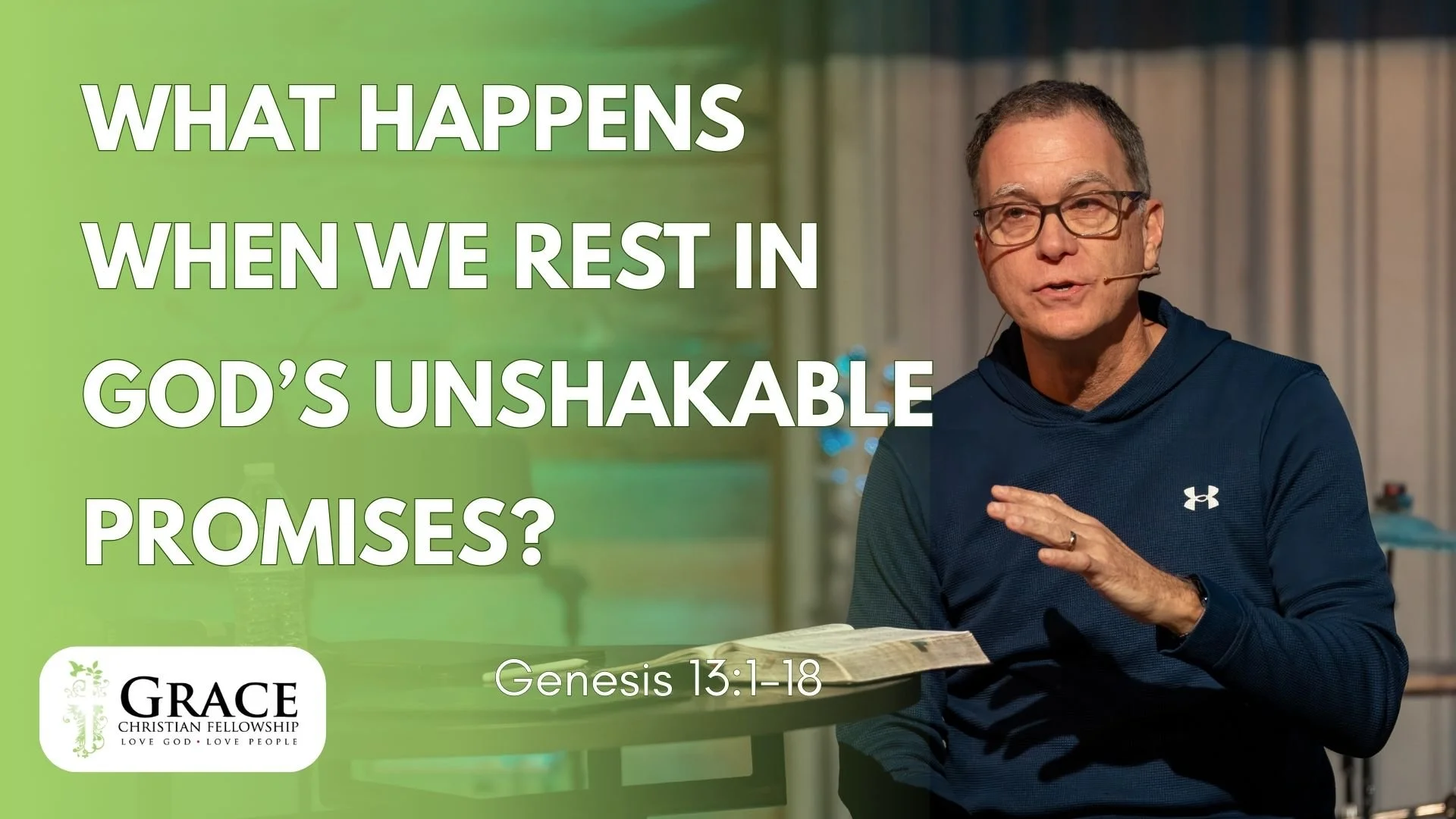
Series: God's Promises, Our Journey
Title: "What happens when we rest in God's unshakable promises?"
Scripture: Genesis 13:1-18 NIV
Matthew 6:33
1 Corinthians 2:14-3:3
2 Corinthians 4:16-18
James 3:13-4:10
2 Peter 2:7-8
Bottom line: When God’s people trust His promises, they can release what they see and rest in what He has said. Or
Faith chooses promise over possession.
INTRODUCTION
CONTEXT
SERMON OUTLINE
CONCLUSION
NOTES
OUTLINES
QUESTIONS TO CONSIDER
DISCUSSION QUESTIONS
MAIN REFERENCES USED
My opening prayer: Lord God, help us grow to be and do like Jesus, while abiding in him and leading others to do the same.
INTRODUCTION
When I was in high school, I was encouraged by my dad to go to a good college to get a good job. A noble endeavor, as I saw it.
In college I chose an engineering degree that would provide for that vision.
I was focusing on what I could see.
I wasn't focused on what I could not see.
When God called me into the ministry, he called me out of a career of engineering. I'd been practicing civil engineering as a consultant for five years, and had finally found my footing and was beginning to be productive in the eyes of the company. I finally felt like I belonged.
God called me out of that into full-time ministry and I never really questioned the money piece. In other words by God's grace, I was able to look past the money to the Ministry that God was calling me too. I was able to walk by Faith instead of my sight.
In this passage today, Genesis 13 we'll see a contrast between Abram and Lot. Lot will choose based on what he sees. Abram chooses based on the promises of God.
When we trust in God's unshakable promises, we will release what we see, and rest in what he has said instead.
What are some of those promises?
God is able
God hears
God sees
God is with us
God cares
God satisfies
God approves
These are just some of the many promises throughout scripture that you and I have to bank on when we rest in him. Let's look at the life and the contrast of Abram and Lot and see how it plays out in chapter 13.
CONTEXT
We've gone from Promises of blessings to failure to rest in those promises to returning to the original promise keeper through repentance and faith.
Abram went down to Egypt but returned to between "House of Bread" and "Ruin". It is here he and Lot part ways. He watches Lot choose what he thinks is best for him and yet outside of God's promised land. No doubt he knows this. He just doesn't believe it or realize it.
Genesis 13 contrasts Abram’s faith-shaped restraint with Lot’s sight-driven ambition—and places both under the canopy of God’s covenant faithfulness.
SERMON
Review from Genesis 12:1-3:
God Is the Initiator of Redemption
God Calls His People to Trust Him Before They Understand Him
God’s Blessing Is Never Merely Personal—It Is Missional
God Promises to Anchor His People in Uncertain Times & Places
God’s People Respond with Obedience, Worship, and Witness
My notes on Gen 13:
God is.../God does...
Merciful / forgives, restores
West, spiritually (10) / Draws his people west, spiritually (10)
Holy, just judge (10) / judges righteously (10)
Permissive / allowed us to make mistakes and even sin
Faithful (14-17) / kept his promise (14-17)
Omnipotent (14-17) / able to deliver on his promise (14-17)
Worthy of our worship (18) / Receives our worship w/ pleasure when by grace through faith (18)
People are.../People do...
Can be faithful, humble (3-4) / repent, return to the Lord (3-4); call on the name of the Lord (4)
Tempted by riches (5, 10-11) / Pursue riches over God and end up in dark places (5, 10-11)
Divided, greedy (6-7) / Quarrelsom (6-7)
A witness to the world (7b) / A good or poor witness (7b)
Gracious; magnanimous (8-9) / yield to the underserving (8-9)
Brothers & sisters of humanity & sometimes in Christ (8) / Care about each other (8) or not
Lost; citizens of this world; born sinners (10-13) / Pursue the things of this world (10-13)
Faithful (at times), blessed (14-17) / Obedient, humble, grateful, faithful, believing (14-17)
Content for, yearn for God's presence (18) / Seek, pursue, rest in the Lord (18)
CONCLUSION
Bottom line: When God’s people trust His promises, they can release what they see and rest in what He has said.
"Fellow believers (Abram's spiritual seed), when we truly believe the promises that are ours in Christ, when we truly understand and believe that we are seated right now in him in the heavenly places, when we understand that all things are ours in Christ, we will cease our grasping. As Alexander Maclaren put it:
The less of our energies are consumed in asserting ourselves, and scrambling for our rights, and cutting in before other people, so as to get the best places for ourselves, the more we shall have to spare for better things; and the more we live in the future, and leave God to order our ways, the more shall our souls be wrapped in perfect peace.'" -Hughes, pp. 200-201
INVITATION
Peter puts it all in perspective in his first sermon:
““Therefore let all Israel be assured of this: God has made this Jesus, whom you crucified, both Lord and Messiah.” When the people heard this, they were cut to the heart and said to Peter and the other apostles, “Brothers, what shall we do?” Peter replied, “Repent and be baptized, every one of you, in the name of Jesus Christ for the forgiveness of your sins. And you will receive the gift of the Holy Spirit. The promise is for you and your children and for all who are far off—for all whom the Lord our God will call.”” Acts 2:36-39 NIV
How do we respond? Answer 2 questions:
Take out a card or piece of paper right now. Write down the answer to these questions:
What is God saying to me right now?
What am I going to do about it? Write this down on a sheet of paper.
What I hear you saying, Lord, is ___________________.
[my name] is going to believe/do __________________________________________________ as a result.
Finally, share this with your Home or Mission group this week when you gather as a testimony about what God is doing in your life. You don’t have to get too specific to give him praise.
Lord's Supper, 1 Cor 11:23-26 is good passage.
Also, say something like, "Christ has died, Christ is risen, Christ will come again." (past, present, and future)
Pray
NOTES
The Apostle Paul talks about 3 kinds of people in the world somewhere in 1 Corinthians I think. Lost people, carnal Christians, and spiritual Christians. I think I read this in a Warren Wiersbe commentary pointing to Lot as a carnal Christian when considering 2 Peter 2:7-8. Does Paul say this?
Short answer by ChatGPT:
Yes, Paul does describe three kinds of people in 1 Corinthians 2–3 — but he does not present them as three permanent classes of Christians.
He contrasts unbelievers with two conditions of believers.
That distinction matters.
Where Paul says this
1 Corinthians 2:14–3:3 (flow of thought)
Paul uses three Greek adjectives:
ψυχικός (psychikos) — natural / unspiritual
πνευματικός (pneumatikos) — spiritual
σάρκινος / σαρκικός (sarkinos / sarkikos) — fleshly / carnal
These form the three categories you’re remembering.
The Three Types Explained
1. Natural person — unbeliever (2:14)
This person:
does not receive the things of the Spirit
considers them foolish
lacks spiritual discernment
This is clearly outside Christ.
Paul is describing someone without the Spirit.
So this one is not debated.
2. Spiritual person — mature believer (2:15–16)
This person:
discerns spiritual realities
has “the mind of Christ”
is walking under the Spirit’s influence
This is what we might call:
mature
Spirit-led
growing
responsive to God
This is Paul’s goal for every believer.
3. Fleshly / carnal believer — immature believer (3:1–3)
This is the key text:
Paul says to the Corinthians (paraphrasing):
I could not speak to you as spiritual people, but as fleshly people, as infants in Christ… you are still fleshly… there is jealousy and strife among you.
Notice carefully:
He still calls them “in Christ.”
So they are:
saved
but immature
behaving like unbelievers
dominated by worldly patterns
This is not a third ontological class — it’s stunted growth.
So what is Paul actually teaching?
Here’s the most accurate way to state it:
Not:
❌ Three fixed types of people
But:
✅ Two groups (unbelievers vs believers), with believers living in two possible conditions (spiritual or fleshly)
In other words:
Category
Spiritual Status
Condition
Natural
Unregenerate
Cannot understand
Carnal
Regenerate
Immature / worldly
Spiritual
Regenerate
Mature / Spirit-led
Where Wiersbe and others get “three kinds of people”
Teachers like Warren W. Wiersbe simplify Paul’s language pedagogically.
It’s a teaching framework, not Paul’s formal taxonomy.
Helpful for preaching.
But not meant as rigid categories.
Your Lot connection (2 Peter 2:7–8)
This is actually a good biblical illustration.
Peter calls Lot:
“righteous”
yet compromised
distressed
living foolishly in Sodom
So:
justified positionally
but practically worldly
That fits the carnal/immature believer concept very well.
So Wiersbe’s use of Lot is pastorally reasonable.
Theologically important clarification
Some traditions mistakenly build a doctrine like:
“There are three kinds of Christians: saved, carnal, and spiritual.”
Paul does not teach that.
His point is corrective:
“You should be spiritual by now — but you’re acting fleshly.”
It’s rebuke, not classification.
He expects growth.
Bottom line
Yes — Paul does describe:
natural people
fleshly believers
spiritual believers
But he is describing spiritual maturity levels, not permanent types.
The “carnal Christian” is:
not a category to settle into
but a condition to repent from.
If you want, we can next:
look at the Greek terms more closely
compare with Romans 8 (flesh vs Spirit)
or explore whether “carnal Christian” is the best phrase theologically (some scholars push back on that wording)
or build a teaching/diagram you could use in a sermon or class
Where would you like to go deeper?
OUTLINES
QUESTIONS TO CONSIDER
What do I want them to know?
Why do I want them to know it?
What do I want them to do?
Why do I want them to do it?
How do they do this?
DISCUSSION QUESTIONS
Discovery Bible Study process: https://www.dbsguide.org/
Read the passage together.
Retell the story in your own words.
Discovery the story
What does this story tell me about God?
What does this story tell me about people?
If this is really true, what should I do?
What is God saying to you right now? (Write this down)
What are you going to do about it? (Write this down)
Who am I going to tell about this?
Find our sermons, podcasts, discussion questions and notes at https://www.gracetoday.net/podcast
Alternate Discussion Questions (by Jeff Vanderstelt): Based on this passage:
Who is God?
What has he done/is he doing/is he going to do?
Who am I? (In light of 1 & 2)
What do I do? (In light of who I am)
How do I do it?
Final Questions (Write this down)
What is God saying to you right now?
What are you going to do about it?
MAIN REFERENCES USED
“Genesis,” by R. Kent Hughes, Preaching the Word Commentary, Edited by Kent Hughes
Exalting Jesus in Genesis, by Bethancourt
The Genesis Record, by Henry Morris
The Genesis Factor, by David Helms & Jon Dennis
“Look at the Book” by John Piper (LATB)
“The Bible Knowledge Commentary” by Walvoord, Zuck (BKC)
“The Bible Exposition Commentary” by Warren Wiersbe (BEC)
"Genesis" by Briscoe (TCC)
Outline Bible, D Willmington (OB)
Willmington’s Bible Handbook, D Willmington (WBH)
NIV Study Bible (NIVSB) https://www.biblica.com/resources/scholar-notes/niv-study-bible/
Chronological Life Application Study Bible (NLT)
ESV Study Bible (ESVSB) https://www.esv.org
The Bible Project https://bibleproject.com
“The Bible in One Year 2023 with Nicky Gumbel” bible reading plan on YouVersion app (BIOY)
Read More