

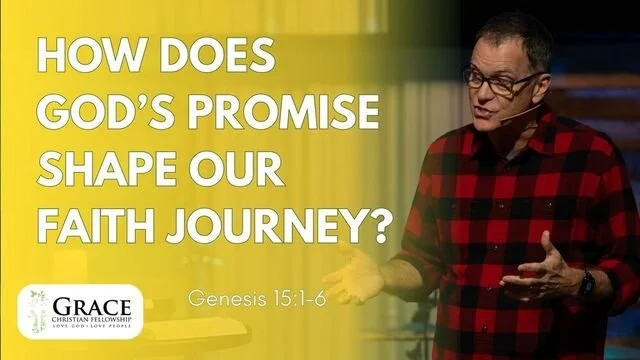
Series: God's Promises, Our Journey
Title: “How Does God’s Promise Shape Our Faith Journey?”
Scripture: Genesis 15:1-6 NIV
Habakkuk 2:4
Luke 2-3
Ephesians 2:8-10
Romans 4:3-5; 20-22
Galatians 3:6-9, 14
James 2:21-23
Bottom Line: When we trust God’s promise, our journey is secure—He makes us right with Him and leads us step by step.
INTRODUCTION
CONTEXT
SERMON OUTLINE
CONCLUSION
NOTES
OUTLINES
QUESTIONS TO CONSIDER
DISCUSSION QUESTIONS
MAIN REFERENCES USED
My opening prayer: Lord God, help us grow to be and do like Jesus, while abiding in him and leading others to do the same.
INTRODUCTION
“The Signed Contract Before the House Exists”
In 2006, we started looking for a house to buy in Summerville. We'd just accepted the position to come to Grace and were excited about what we might move into. But our excitement faded as we saw what we'd care for the money we were bringing from our last house sale. So, in the end, it made more sense for us to build a new house over buying an existing one.
Imagine a young couple buying a home that hasn’t been built yet.
There is:
• No framing
• No roof
• No walls
• Just dirt and a blueprint or rendering
But they sign a contract.
They put down earnest money.
They commit financially.
Why would they do that?
Because they trust:
• The builder’s reputation
• The written promise
• The legal agreement
They are acting today on something they cannot yet see.
That’s Genesis 15.
Abram:
• Has no son
• Has no visible nation
• Has no fulfillment
• Only a word from God
And verse 6 says he signed the contract in his heart.
“Abram believed the LORD…”
Faith is not pretending the house is already standing.
Faith is signing your life to the One who promised to build it.
That sets up:
• Romans 4 — persuaded God will do what He promised
• Galatians 3 — we inherit the same contract by faith
• James 2 — if you signed it, you start living like it
CONTEXT
Genesis 15 comes at a pivotal moment in Abram’s journey. In Genesis 12, God called Abram out of Ur with sweeping promises of land, offspring, and blessing — but Abram still has no child. In Genesis 13, he lets Lot choose the better land and must trust God again for the promise. In Genesis 14, Abram rescues Lot, defeats powerful kings, refuses the riches of Sodom, and is blessed by Melchizedek — demonstrating growing faith and allegiance to God alone. Yet despite spiritual victory, the central promise remains unfulfilled: Abram is aging, Sarai is barren, and the land is still occupied by other nations. Genesis 15 opens in that tension — between promise and fulfillment, between faith and visible reality — and God responds not with rebuke, but with covenant.
OUTLINE (with references):
1. Fear Meets God’s Promise (Genesis 15:1-2): Abraham’s fears—reprisal and no heir—are met by God’s protection and provision.
2. Who God Is in the Journey (Genesis 15:1, 5): Present, protector, provider, sovereign, life-giver—all shaping trust.
3. Faith Receives God’s Promise (Genesis 15:6): Abraham believed, and it was credited as righteousness.
SERMON
Review from Genesis 12:1-3:
God Is the Initiator of Redemption
God Calls His People to Trust Him Before They Understand Him
God’s Blessing Is Never Merely Personal—It Is Missional
God Promises to Anchor His People in Uncertain Times & Places
God’s People Respond with Obedience, Worship, and Witness
1. Fear Meets God’s Promise (Genesis 15:1-2): Abraham’s fears—reprisal and no heir—are met by God’s protection and provision.
2. Who God Is in the Journey (Genesis 15:1, 5): Present, protector, provider, sovereign, life-giver—all shaping trust.
The stars in the sky in Uganda. (Show Chris' pic)
"On a clear night, at most 5,000 individual stars can be seen with the naked eye, as well as objects like the fuzzy outline of the Andromeda Galaxy, with its estimated 100 billion stars, 2.5 million light years away!" -Lennox, p. 113
"ACCORDING TO THE WRITERS of Hebrews and the Genesis record, the link between faith and righteousness was not a New Testament invention, nor was it even a patriarchal innovation. Instead, the dynamic connection between faith and righteousness is rooted in primeval history well before the flood. The lives of three famous pre-diluvians-Abel, Enoch, and Noah— make this very clear.
Of Abel we read, "By faith Abel offered to God a more acceptable sacrifice than Cain, through which he was commended as righteous, God commending him by accepting his gifts. And through his faith, though he died, he still speaks" (Hebrews 11:4). Faith-righteousness was exemplified in earth's first family by the second son of Adam and Eve.
Of Enoch Genesis says, "Enoch walked with God, and he was not, for God took him" (5:24). The metaphor "walked" indicates closest communion and intimacy—a righteous life. Enoch's godly walk grew out of his faith, as Hebrews makes so clear: "By faith Enoch was taken up so that he should not see death, and he was not found, because God had taken him. Now before he was taken he was commended as having pleased God" (11:5). According to verse 6, his God-pleasing faith believed that "God is" (literal translation of the Greek)-that the sovereign God of creation is God. He also believed that God "rewards those who seek him"-that God is positively equitable.
As a result, Jude 14, 15 records that he became a preacher of righteousness, apparently for his entire life, for some three centuries! Enoch's life demonstrated a righteousness based on faith.
Of Noah Genesis says, "Noah was a righteous man, blameless in his generation. Noah walked with God" (6:9). That Noah "walked with God" identifies him with the godly character of Enoch. But even more significant, the statement that "Noah was a righteous man" is the first occurrence of the word righteous tsadiq) in the Bible. Noah's righteousness was not derived from his being perfect or any antecedent righteousness, but because he believed God, as the writer of Hebrews explains: "By faith Noah, being warned by God concerning events as yet unseen, in reverent fear constructed an ark for the saving of his household" (11:7). The biblical doctrine of imputed righteousness (a righteousness from God) began here in primeval history before the flood!" -Hughes, pp. 221-222
3. Faith Receives God’s Promise (Genesis 15:6): Abraham believed, and it was credited as righteousness.
Cross-References for Genesis 15:6 - Faith credited as righteousness. #core
• Romans 4:3-5, 20-22 - Faith credited as righteousness. #standing #position
• Galatians 3:6-9, 14 - Faith connects us to the promise. #family #mission #nations
• James 2:21-23 - Faith is active, not passive. #living #practical #behaviors
Bottom Line: When we trust God’s promise, our journey is secure—He makes us right with Him and leads us step by step.
So How Does God’s Promise Shape Our Faith Journey?
He brings security, confidence and peace because of who he is and what he does as our personally present provider and protector.
More application:
First, when you face fear—whether fear of the future or uncertainty—remind yourself that God is both your protector and provider. Concretely, when you face a major decision, begin by praying for His presence in it.
Second, trust in God’s promise of righteousness—when you feel inadequate or guilty, recall that your standing is secure by faith. For example, when you fail, don’t retreat—confess and continue walking with Him.
Third, active faith leads to action—like Abraham, step forward in obedience. If God’s promise is sure, what step of obedience is He calling you to right now?
Fourth, when considering your connection to God’s larger promise (like in Galatians 3), remember that your faith ties you to a bigger family of faith. Practically, live out that community—extend grace and include others in your faith journey.
Finally, as James 2 emphasizes, ask yourself: How is my faith visible in action this week? Identify one tangible act of service or obedience you’ll do in response to trusting Him.
CONCLUSION
Bottom Line: When we trust God’s promise, our journey is secure—He makes us right with Him and leads us step by step.
“The Shield You Carry vs. The Shield You Trust”
You could return to Genesis 15:1:
“Do not be afraid, Abram. I am your shield…”
In ancient warfare, a shield only works if you trust it enough to stand behind it.
If a soldier:
• Keeps peeking out
• Keeps lowering the shield
• Keeps running forward in panic
The shield cannot protect him.
The issue is not whether the shield works.
The issue is whether he will stand behind it.
Abram’s fear was real:
• Eastern kings
• No heir
• An aging body
God doesn’t say:
“Be brave.”
He says:
“I am your shield.”
And Abram stands behind that promise.
Romans 4 says he was fully persuaded.
Galatians 3 says we now stand in that same promise.
James 2 says if you really trust the shield, you’ll fight differently.
So the question becomes:
Are you standing behind the Shield?
Or are you trying to carry your own?
That lands the plane cleanly on:
• God as protector
• God as provider
• Faith that rests
• Faith that acts
INVITATION
Peter puts it all in perspective in his first sermon:
““Therefore let all Israel be assured of this: God has made this Jesus, whom you crucified, both Lord and Messiah.” When the people heard this, they were cut to the heart and said to Peter and the other apostles, “Brothers, what shall we do?” Peter replied, “Repent and be baptized, every one of you, in the name of Jesus Christ for the forgiveness of your sins. And you will receive the gift of the Holy Spirit. The promise is for you and your children and for all who are far off—for all whom the Lord our God will call.”” Acts 2:36-39 NIV
How do we respond? Answer 2 questions:
Take out a card or piece of paper right now. Write down the answer to these questions:
What is God saying to me right now?
What am I going to do about it? Write this down on a sheet of paper.
What I hear you saying, Lord, is ___________________.
[my name] is going to believe/do __________________________________________________ as a result.
Finally, share this with your Home or Mission group this week when you gather as a testimony about what God is doing in your life. You don’t have to get too specific to give him praise.
Lord's Supper, 1 Cor 11:23-26 is good passage.
Also, say something like, "Christ has died, Christ is risen, Christ will come again." (past, present, and future)
Pray
NOTES
"As Von Rad has said, "But above all, his righteousness is not the result of any accomplishments, whether of sacrifice or acts of obedience.
Rather, it is stated programmatically that belief alone has brought Abraham into a proper relationship to God."
This understanding is revolutionary! Circa 2000 B.C., Abram was declared righteous because of his belief. This declaration was in profound accord with the primeval fathers Abel, Enoch, and Noah. Furthermore, the principle has remained operative through both primeval and patriarchal history and the entire old-covenant era and is the foundation of the new covenant." -Hughes, p. 225
"It has always been the same-in primeval times and patriarchal times. under the old covenant and the new covenant: Faith brings righteousness
and salvation.
So it was for Abel: "By faith Abel offered to God a more acceptable sacrifice than Cain" (Hebrews 11:4). Abel was saved by faith, a faith that was not alone because it produced better works than Cain.
So it was for Enoch: "By faith Enoch was taken up so that he should not see death" (Hebrews 11:5). But Enoch's faith was such that he "walked with God" (Genesis 5:22) before he was no more. His faith was a real faith a faith that worked.
So it was for Noah: "By faith Noah, being warned by God concerning events as yet unseen, in reverent fear constructed an ark for the saving of his household. By this he condemned the world and became an heir of the righteousness that comes by faith" (Hebrews 11:7). Noah's profound faith produced a profound obedience. And his works were monumental: "He did all that God commanded him" (Genesis 6:22; cf. 7:5, 9, 16). His was a faith that worked.
So it was with Abram: "By faith Abraham obeyed when he was called to go out to a place that he was to receive as an inheritance. And he went out, not knowing where he was going" (Hebrews 11:8). "By faith Abraham, when he was tested, offered up Isaac" (v. 17a.). Abraham was saved by faith alone-a faith that was not alone faith that works!
We conclude this study with two penetrating questions. Have you rested your faith on God the Son, Jesus Christ, alone for your salvation? That is the first question. Are you trusting your works or Christ? Now if you answer, I am trusting Christ alone," then the second question is, has your faith produced works? Is your faith real enough that it has changed your life? These are salutary questions because you are saved by faith alone. But if it is true faith, it is faith that is not alone but a faith that works." -Hughes, p. 218
"When someone is called 'a person of faith' it usually means that they are adherents of a particular religious tradition. It does not normally refer to the obvious yet frequently overlooked fact that everyone exercises faith every day in a myriad different ways - just think what would happen if people did not place their faith/trust in maps, traffic lights, electric appliances, or doctors, surgeons, pilots, lawyers and so on. In that important sense, everyone is a person of faith. Faith, as such, is not a religious concept." -Lennox, p. 117
Below is:
1. A refined opening (pastoral tone)
2. A clean covenant pivot
3. A governing Big Idea
4. A simple sermon skeleton that keeps the focus where it belongs
🔹 Big Idea for Genesis 15
Here is a clear, governing sentence you can build the entire sermon around:
Because God alone guarantees His covenant promises, we can trust Him completely — even when fulfillment seems impossible.
Or slightly shorter:
When God makes a promise, He stakes His own reputation on keeping it.
That fits your series theme beautifully.
⸻
🔹 Sermon Skeleton (Text-Driven)
Genesis 15 naturally unfolds in four movements:
1️⃣ God Reassures a Fearful Abram (15:1)
“Do not be afraid… I am your shield.”
• God gives Himself before He gives land.
• The first promise in the chapter is protection, not territory.
• Application: The promise of God’s presence precedes the promise of provision.
⸻
2️⃣ God Counts Abram’s Faith as Righteousness (15:2–6)
Abram asks honest questions.
God responds with stars.
Abram believes.
God credits righteousness.
• This is the theological heart of the chapter.
• Paul builds justification by faith on this verse (Romans 4, Galatians 3).
The land promise sits inside a gospel promise.
⸻
3️⃣ God Formalizes the Covenant (15:7–17)
• Animals cut in two.
• Normally both parties walk through.
• Only the smoking firepot and blazing torch (symbolizing God) pass between the pieces.
Meaning:
“If this covenant fails, may I be torn apart.”
Abram contributes nothing to the covenant’s guarantee.
This is grace before Sinai.
⸻
4️⃣ God Defines the Land (15:18–21)
Yes — boundaries are named.
Yes — geography matters.
But notice the order:
Faith → Righteousness → Covenant → Land.
The land is downstream of relationship.
The promise of place flows out of the promise of belonging.
⸻
🔹 Pastoral Landing for GCF
Given your church’s mission —
“To love God and love people by making disciples of Jesus Christ…” —
Genesis 15 reminds us:
We are not sustained by what we secure.
We are sustained by what God guarantees.
Abram does not conquer land in this chapter.
He trusts a promise.
And every disciple-making movement begins the same way:
Not with control.
Not with strategy.
But with confidence in a covenant-keeping God.
QUESTIONS TO CONSIDER
What do I want them to know?
Why do I want them to know it?
What do I want them to do?
Why do I want them to do it?
How do they do this?
DISCUSSION QUESTIONS
Discovery Bible Study process: https://www.dbsguide.org/
Read the passage together.
Retell the story in your own words.
Discovery the story
What does this story tell me about God?
What does this story tell me about people?
If this is really true, what should I do?
What is God saying to you right now? (Write this down)
What are you going to do about it? (Write this down)
Who am I going to tell about this?
Find our sermons, podcasts, discussion questions and notes at https://www.gracetoday.net/podcast
Alternate Discussion Questions (by Jeff Vanderstelt): Based on this passage:
Who is God?
What has he done/is he doing/is he going to do?
Who am I? (In light of 1 & 2)
What do I do? (In light of who I am)
How do I do it?
Final Questions (Write this down)
What is God saying to you right now?
What are you going to do about it?
YOUTUBE DESCRIPTION
Here’s the revised YouTube description, with the preacher and links cleanly integrated and placed where viewers expect them:
Series: God’s Promises, Our Journey
Message Title: What Are the Key Ingredients to the Life God Calls Us to Live?
Scripture: Genesis 14:1–24 (NIV); Hebrews 7
Preacher: Darien Gabriel
What does it look like to live the life God calls us to live—especially when we’re surrounded by temptation, fear, and competing allegiances?
In Genesis 14, Abram steps into the first recorded battle in Scripture to rescue his nephew Lot. But the real battle isn’t fought with swords—it’s fought in the heart. Upon returning victorious, Abram is met by two kings and faced with two radically different offers. One tempts him with visible reward and fleeting gain. The other blesses him in the name of El Elyon—God Most High.
This mysterious priest-king, Melchizedek, brings bread and wine, speaks blessing, and points Abram back to the promises of God. Hebrews 7 later reveals that Melchizedek is not just a historical figure—but a powerful signpost pointing forward to Jesus Christ, our eternal King and Priest.
In this message, we explore:
Why resting in what God has said is essential to faithful living
How righteousness, peace, and blessing flow from wholehearted allegiance to God
The contrast between living by sight (Lot) and living by faith (Abram)
Why Jesus is the better Melchizedek—our ultimate rescuer and eternal intercessor
Bottom Line:
When we rest in what God has said, we walk in His key ingredients—righteousness, peace, and blessing—so that we might be a blessing to the nations, just as He created us to be.
If you’re feeling torn between what you can see and what God has promised, this message invites you to lift your eyes—and your allegiance—to the King who is also our Priest.
🔗 Learn more about the preacher:
Darien Gabriel — https://dariengabriel.com
⛪ Grace Christian Fellowship:
📖 Scripture References: Genesis 14; Hebrews 7
🙏 Prayer Focus: Growing to be and do like Jesus, while abiding in Him and leading others to do the same
If this message encouraged you, consider liking, sharing, or subscribing to help others follow the journey of God’s promises together.
Read More