
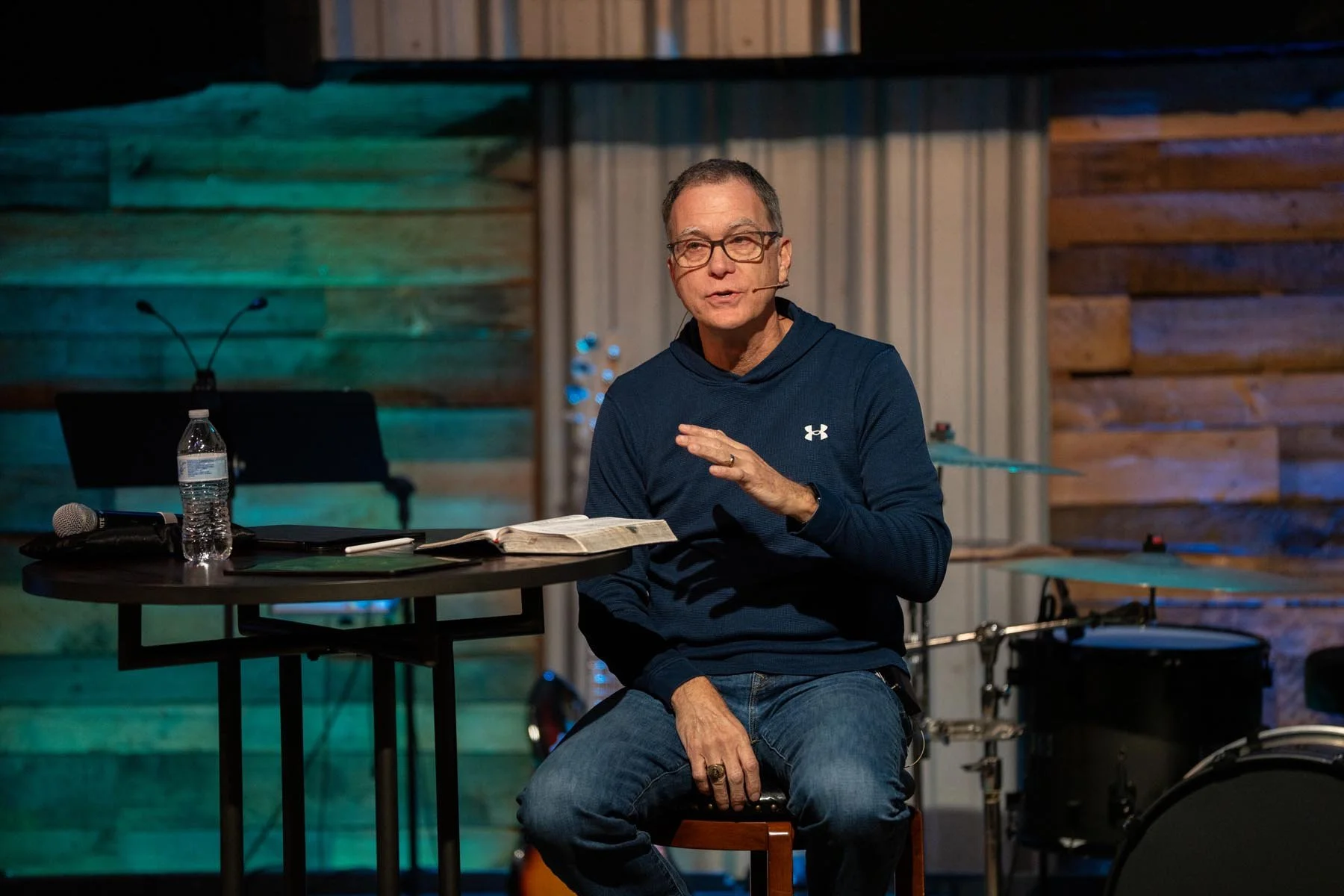
Sermons
Watch Now

Transformed to Transform | Luke 1:57-80
Bottom line: God’s great mercy leads to radiant joy and praise that transforms lives Transformation is visible. Transformation is dramatic. Transformation is life-changing. I was transformed the first time I saw the Atlantic Ocean as a kid. When we talk about transforming lives, that’s exactly what we are going for. We want a life that is so transformed that maybe the most dramatic comparison is the difference between a corpse and a person fully alive and healthy. (Eph 2:1-9). Join us as Pastor Darien teaches on Luke 1.
Last week: whether you believe it or not, Jesus is coming back and that’s the point. Are you ready?
Bottom line: God’s great mercy leads to radiant joy and praise that transforms lives.
Transformation is visible.
Transformation is dramatic.
Transformation is life-changing.
I was transformed the first time I saw the Atlantic Ocean as a kid...
Transformers movie
I can still remember the first time I saw the first Transformers movie in the theater with my friends. I can honestly say it transformed the way I saw CGI in movies. It was basically like an animator drew a cartoon movie so realistic and believable that I couldn’t believe my eyes that it wasn’t real.
When we talk about transforming lives, that’s exactly what we are going for. We want a life that is so transformed that maybe the most dramatic comparison is the difference between a corpse and a person fully alive and healthy. (Eph 2:1-9)
That is dramatic enough on its own but now make it spiritual. Think of someone dead in their sins Hellbound for all eternity being transformed into life abundant and eternal. It’s like a shadow going reverse negative and becoming a light. That would be dramatic a shadow becoming a reflection of light.
My Fair Lady...another movie of transformation
From caterpillar to butterfly
As we wait…
as we wait we live knowing that not only did Jesus come (advent, Christmas) but that he’s coming again. And the tension is living as if he was coming back today...or in another 1,000 years.
As we wait for Jesus—his second coming; his return from heaven—to finish what he started, my prayer is that he will find me full of joy and praise that is so alive and so transformative that it leads others in transformation as well. That my faith would publicly inspire others to be open enough to receive and believe the truth and hope that the good news of the kingdom of God is near and athat the King is on his way back!
Building on what we talked about last week, we once again look at the lives of Zack and Lizzie and how God‘s great mercy transformed them through joy and praise so dramatically that it couldn’t help but shape and influence and impact the entire region around them. They truly were the best neighbors ever throughout Judea and their day.
Let’s look at their lives and learn from them how we can be transformed to transform.
Article (TGC)
Like a prison cell
The most reassuring message of the season is that the existence of hope does not depend on us. It does not rely on our virtue or wisdom. It is a delivery from elsewhere.
The German theologian Dietrich Bonhoeffer compared Advent to a prison cell “in which one waits and hopes and does various unessential things . . . but is completely dependent on the fact that the door of freedom has to be opened from the outside.”
The Advent narratives are filled with waiting people: Mary, Zechariah, Elizabeth, Simeon, Anna. They lived in patient expectation and were receptive to the Good News when it arrived. Their hope did not come as the result of a battle. It came like a seed planted in the ground. Like the sun rising in defiance of night. Like a child growing within his mother.
We are not the heroes of the story. Our contribution is to be watchful and open. But hope arrives in awesome humility. God is with us. Jesus is with us. This is everything.
I. God’s great mercy leads to joy and praise that transforms lives through... (1:57-67, 80)
It transformed E
Through pregnancy and birth - like only motherhood could do; no more shame
Through Holy Spirit
Through joy
It transformed Z
Through disciplined - silence, solitude, prayer, confession, repentance, and faith
Through praise
Through Holy Spirit
It transformed J
He was prepared through birth, browsing up, and relationship with parents
He was prepared through Holy Spirit
He was prepared through his wilderness
It transformed their neighbors
It transformed their world
II. Z’s prophecy of praise explains how God’s great mercy is God’s great salvation (1:67-79)
4 parts - notice he’s filled with HS; God’s all over this. It’s prophetic and it’s been in part fulfilled already.
The Plan of salvation (1:68-73)
Plan prophesied in OT - “The entire bible—from nAbraham to the prophets down to King David—is about this one thing: salvation. The Bible has one story: God visiting or coming to get his people. That was and is his plan.” -Thabiti Anyabwile
Plan was through the line of David
Plan was for Israel and those they would bless
Plan is one of strength
Plan was to save Israel from her enemies
Plan seen in the covenant promises to Abraham 3500 years ago
The Purpose of salvation (1:72-75)
Physical freedom
Main goal: freedom to worship the Lord. “God saves so that we might worship him. Freedom is a good goal, but it’s not the ultimate goal...Just as Zechariah worshipped God when God mercifully opened his mouth and ears, so all Israel is to praise and glorify God for the salvation he brings.”
NT version of what God told Moses to tell Pharaoh: “Let my people go, so that they may worship me.” (Exodus 7:16)
Religious liberty or freedom in our country is the freedom to do this. Just like Pharaoh severely limited Israel in this when they were enslaved in Egypt, we’re headed that way too. The difference is that they didn’t have a temple where God dwelt. As Christians, we are that temple so no body can keep us from worshiping the Lord. Nobody.
The Prophet of salvation (1:76-77)
Zach prophesies about John now.
John will be great
And a prophet of God.
He will be unique in that he will be a forerunner. He will soften the ground and till the soil of Israel’s heart (think Parable of the soils, Luke 8).
He will not be the Savior but will make things ready for the Savior by teaching the people how they are to be saved.
He will be a “giant index finger” (Thabiti Anyabwile) pointing the way to God’s great mercy.
Zach’s prophecy “defines John’s life in relationship to Jesus’ life and mission.” Imagine if we all did this? He must increase and I must decrease. (John 3:30)
Th of salvation (1:77-79) - 3 Effects of this transforming salvation on people
This salvation is ultimately spiritual and personal. We need his forgiveness of sins. (77)
Why do we need this?
Because it is an offense against our creator God, who is holy, holy, holy.
God will punish sin. He must to remain holy and just.
But he is also merciful. This is why his mercy is so great. He can mercifully forgive us because he took our punishment out on someone else. (On Jesus at the cross)
What or who do we need to be saved from? The answer may surprise you.
We need to be saved from God.l
This salvation is by God’s mercy. (78) says, “because of our God’s merciful compassion.”
We can’t earn it.
We can’t demand it.
We can’t deserve it.
We can’t deal for it.
It only comes by grace through faith. Free and undeserved.
Ask for it. Beg for mercy. Confess your sin and he is faithful...(1 John 1:9)
This salvation brings light. (78-79) Transformational is usually dramatically visible to others.
Through the mercy of God we receive light.
Jesus is our sunrise (sonrise).
In our sin, we sit in a dark, locked prison dungeon.
Hanukkah is festival of life and it’s Hanukkah right now. Connection?
Christ comes bringing light and blows them door off.
By definition, darkness cannot standup to light. It has to flee by law.
Lock-ins - up all night; can’t wait for daylight when they go home.
All-nighters.7
Death is defeated and brings peace.
Peace with God
Peace with humanity
Peace with ourselves
Do you have this peace? Let the light of Christ blow the doors off your dungeon prison and free you from death ☠️ to peace ☮️.
Conclusion
Transformation like the beast in Beauty and the Beast.
Notes
Zechariah’s first words were praising God.
Yes, a new son
Yes, on the heels of 9 months of silence (mute and deaf). Talk about a crash course on silence and solitude. Even Jesus was only alone in the wilderness 40 days.
A righteous and blameless man like Z would also have been teachable and the perfect father to raise a son able and prepared to make ready and prepare God’s people for their Messiah.
Result was “all the neighbors were filled with awe.” We say we want to be the “best neighbor ever...”. This would qualify Z, wouldn’t it?
What did he do?
He nurtured a Christ-like character.
He served faithfully as a priest.
He didn’t believe God’s word and was disciplined for it.
He grew during this time in the wilderness of discipline. Ever think about your wilderness time as a time of disciplining that would strengthen you?
He responded with praise and obedience as a result of God’s mercy and discipline.
He did so publicly.
His neighbors were awed by God and began spreading the good news. (Changed his neighbors and neighborhood).
Better Question: Have you let your disobedience and discipline cause you to flourish or flounder?
As he waited...for this first coming of Jesus,
he encountered God’s messenger,
disbelieved his message,
Lived in the wilderness of his discipline for a season,
let God nurture and teach him through that season,
received an amazing blessing/mercy,
received an incredible responsibility (the one to prepare the one to prepare the way...),
impacted his own neighborhood nad nation for the glory of God...and the nations (67-80).
“For the Lord’s hand was with him.” (V. 66)
This reminds me of Joseph over his 13 years in prison. His unjust imprisonments and deliverance foreshadowed both Israel’s enslavement and deliverance, as well as, our enslavement and deliverance from sin to freedom in Christ.
Z’s song
He was filled with the Holy Spirit (like Elizabeth and son were) as he composed this song. This means God was fully involved.
“Praise be...” (he starts here (appropriately). Who God is...
“Because” - the reason he’s moved to praise God—rescue/redemption of Israel (future faith spoken in past as if done deal)
Looks ahead to coming salvation with confidence
To show mercy
Remembers his covenant with Abraham
Rescue/salvation is the reason for praise (mercy)
To enable/empower the nation to serve him without fear
New section begins in v. 76 (note change in tense)
J the B a prophet of God
Prepare the way for the Lord (God incarnate)
To give knowledge (experiencing salvation) that leads to the change (repentance) required to be prepared. No repentance, no forgiveness—knowledge of precious truth salvation escape
Again, mercy (not getting what they deserve)
Light shines because thats’ what light does. It can’t help it. To reveal to those in darkness their current reality and their way of escape. Jesus is that light directly and later indirectly through his people.
This path of hope leads from sin and death, shame and guilt, and hell itself to...peace. Jesus is the prince of peace. His kingdom is a kingdom of peace.
J the B was raised by this man—this father—alongside an equally glorious mother Elizabeth. He grew in spirit (the Holy Spirit?).
Lived in the wilderness until he appeared publicly to Israel to begin his ministry.
Apparently, Z’s discipline shaped him profoundly. He now valued silence and solitude enough to pass it on. J the B took it to another level foreshadowing Jesus’ time of temptation in the wilderness where Jesus was prepared and shaped for his public ministry. Remember, the HS drove Jesus to the wilderness right after his baptism.
I wonder if Jesus and J the B ever interacted in the wilderness...
Notes from New American Commentary, Luke by Stein starting on p. 96.
Lots of parallels to Jesus’ birth narrative.
3 parts
Birth
Circumcision
Hymn of praise
Praise to God
Prophecy of J the B
“The function of the Benedictus is clear. Luke wanted his readers to understand this as Z’s divinely inspired hymn praising God for fulfilling his promises to his people and describing the roles of J the B and especially the Messiah.”
Cycle -
Sin/disobedience of child of God
Discipline and mercy
Repentance and growth on new path
Deliverance from discipline
Praise and worship and joy
Apparently is was unusual to name a son after his father because he would then be called Zechariah son of Zechariah or Zechariah Bar Zechariah. But they still named after family members.
Z was both deaf and mute.
Writing tablet was plank of wood covered in wax
Z being able to speak immediately after naming him John amplifies the miraculous nature of this event. As a result, the neighbors (who were not aware of Elizabeth’s pregnancy) realized this work of God.
Z was a model believer.
Starting with his character (1:6)
His first words after being disciplined were praise
He is filled with the Holy Spirit after trusting and obeying Gabriel’s command to name him John
He starts his song with praise
Awe or literally fear. The proper reverent attitude which those who witness a heavenly intervention or manifestation of divine power should express. It may begin as a terrifying fear of judgment or wrath, but it progresses to a holy awe of God and a recognition of his otherness, which leads to “glorifying and praising God”.
“What then is this child going to be?” What instead of Who emphasizes J the B’s role as the one who will go before his superiors to prepare the way.
Salvation is described as a past event in vv. 68-75 even though it’s describing a future event. This is because there is so much confidence in this happening it’s sung as as good as done. This is true for us as well as we think about the hope we have in Christ and our glorification.
In going from, v. 75 to 76, there is a change in tense and focus.
The focus is now on J the B until it returns to Christ at the end.
J the B is seen as great because of God and Christ—not because of anything he’s going to do or because of Z. Same for us.
“Sun” most likely refers to Jesus.
Truths
We can trust God’s word because God’s word is true.
God’s mercy leads to joy (for E) and praise (for Z).
God’s mercy leads to awe, fear and transforming neighbors.
God shows us mercy when he gives us less wrath/judgment than we deserve.
Circumcision was a sign of God’s faithful covenant relationship with Israel.
Applications
Trust God’s word.
Receive children as a mercy and blessing from God. Receive them with the joy E received J. No matter what the circumstances. (Even rape; even if poor)
Embrace God’s sanctifying discipline and affliction as a spiritual promotion. (JC Ryle)
“The sorrow that humbles us, and drives us nearer to God, is a blessing, and a downright gain.”
The wave that dashes us against the rock of God’s glory is a mercy indeed.
Are you handling your suffering by allowing God to grow you better or bitter? Is your heart towards God growing warmer or colder?
Everyone knew that God was at work among them with this child. (66)
What does that look like? Spiritual strength
Enter the Wilderness to prepare - When God’s hand is on our children, they grow and become strong—not just in body but more importantly, in spirit. (Ex. Silence, solitude, Fasting)
There’s a connection between John’s spiritual strength and his growth in the wilderness. (Silence, solitude, fasting) Wilderness is where prophets are prepared for the hardship of public ministry.
Doesn’t the first part of v. 80 make you want the last part of v. 66?
JC Ryle quote below.
Joseph in Genesis.
God waits to be asked. Are you asking? Praying? Seeking?
God’s mercy means joy and praise for E and Z. It means the same for us if we receive it.
Benedictus Doninus = blessed be the Lord God
Ben·e·dic·tus
/ˌbenəˈdiktəs/
noun
CHRISTIAN CHURCH
1.
an invocation beginning Benedictus qui venit in nomine Domini (Blessed is he who comes in the name of the Lord) forming a set part of the Mass.
2.
a canticle beginning Benedictus Dominus Deus (Blessed be the Lord God) from Luke 1:68–79.

Believe It Or Not, Jesus Is Coming | Luke 1:5-38
Bottom line: whether you believe God’s word or not, Jesus is coming...again.
Whether you believe God’s word or not, it will come to pass. Even when you fail to believe, God’s mercy is there for you. He disciplines his children when they fail to trust him. But he brings them back into fellowship as well. Just ask Zechariah. You can please God when you take him at his word. Just ask Mary. (Cf. Heb 11:3). Make sure you don’t miss the point for the pointer. The point is that God wants to walk in fellowship with you. He sent Jesus to restore our fellowship with him. That’s why he came the first time. The second time he’s coming to finish what he started. A re you ready?
Believe it or not, Jesus is coming
Series: As We Wait (for His Second Coming) #Advent
Scripture: Luke 1:5-38
Bottom line: whether you believe God’s word or not, Jesus is coming...again.
A dog and the point
“If you try to point out something to a dog, the dog will often look at your finger instead of at the object you’re trying to point out. This is frustrating, but it illustrates a natural mistake we all make from time to time. It’s the mistake many people make when reading the Christmas story in Luke’s Gospel: focusing on the manger—the Christmas crib. The most famous animal feeding-trough in all history. To concentrate on the manger and to forget why it was mentioned in the first place is like the dog looking at the finger rather than the object.
The point Luke is making is clear. The birth of this little boy is the beginning of a confrontation between the kingdom of God and the kingdoms of the world. (Caesar) Augustus never heard of Jesus of Nazareth. But within a century or so his successors in Rome had not only heard of him; they were taking steps to obliterate his followers. Just over three centuries later, a Roman emperor became a Christian.
Luke’s narrative reminds us not to stop at the manger but to see the explosive truth it’s pointing to.”
-NT Wright, Luke: 26 studies for individuals and groups, p. 23
Advent wreaths
I grew up with advent wreaths...
Advent = Coming
1st advent = 1st coming of Jesus (as a baby/Christmas/incarnation)
2nd advent = 2nd coming of Jesus (as a warrior-king/consummation of his earthly reign)
Luke 1:5-38
Compare and contrast 2 faith responses to God’s word (truth).
Applications
Whether you believe God’s word or not, it will come to pass.
Even when you fail to believe, God’s mercy is there for you. He disciplines his children when they fail to trust him. But he brings them back into fellowship as well. Just ask Zechariah.
You can please God when you take him at his word. Just ask Mary. (Cf. Heb 11:3)
Make sure you don’t miss the point for the pointer. The point is that God wants to walk in fellowship with you. He sent Jesus to restore our fellowship with him. That’s why he came the first time. The second time he’s coming to finish what he started. Are you ready?
Cross-reference
I want to be “confident and unashamed” at Jesus’ return. 1 John 2:28
Illustration
We're all waiting for something, but the Christian hope is the difference between waiting impatiently and waiting expectantly. Waiting for time to heal wounds is an exercise in futility. We sit impatient while growing both more agitated and more numb. But waiting expectantly means we hope in the healing that God promises, while expecting the world we live in to continue in its brokenness. In the hope of Advent, we’re not surprised by the darkness, but we’re not consumed by it either.
This is not a fine and theological distinction that has no bearing on life today. In fact, I would suggest this is the only way to make sense of your life today. Hoping in Jesus’ return is the only way to look at the brokenness of reality and maintain hope despite it all. And this takes practice. Just like our waiting impatiently is a learned practice reinforced through daily habits of expecting news and notifications and clicks to make us feel better, so waiting expectantly is a learned practice reinforced through communal spiritual disciplines of reading, praying and carefully directed longing.
-Justin Early, email

Be Prepared To Answer | 1 Peter 3:15-16
Bottom line: Doing good means always being prepared to give an answer to everyone who asks you why you have hope and to do so w/ gentleness, respect, and a clear conscience. That includes your enemies and your persecutors. Be prepared & ready to share with anyone why you have hope.
In the Old Testament, the tabernacle (and later the temple) was the place where people went to meet with God. This was God’s home as we see in our Old Testament passage for today (Ezekiel 43:5).
The message of our New Testament passage though is that the glory and presence of God is to be found supremely in Jesus. It is at the very moment that Jesus is rejected and crucified that God’s presence among people is finally and fully realized. From that point on there is no need for a physical temple. The only church building the New Testament speaks about is a building made of people (Ephesians 2:20–22), founded and built upon Jesus, the chief cornerstone. The holy temple in the New Testament is one made of ‘living stones’ (1 Peter 2:5) – in other words, people like you and me. This is God’s new home.
Scripture: 1 Peter 3:15-16
Title: Be Prepared to Answer
Bottom line: Doing good means always being prepared to give an answer to everyone who asks you why you have hope and to do so w/ gentleness, respect, and a clear conscience. That includes your enemies and your persecutors.
Be prepared & ready to share with anyone why you have hope.
Open with motto of the Boy Scouts: Be prepared. I tried and gave up after 2 months.
Prepared for tests?
I walked into physics class one year after spring break fresh and rested from no studying. But I wasn’t ready or prepared for the test they handed out unexpectedly (to me) that day. I promptly left to withdraw from the class.
I was ready but not necessarily prepared for my first SAT test. We didn’t study for them back in my day. So taking the test was really a way to answer the question, “Am I ready for college?”
Where is God?
Elie Wiesel was born into a Jewish family in Romania. He was only a teenager when he and his family were rounded up by the Nazis and taken first to Auschwitz, and then to Buchenwald. In his book, Night, he gives a terrifying and intimate account of the increasing horrors he endured – the death of his parents and eight-year-old sister, and the loss of his innocence by barbaric hands.
In the foreword to the book, François Mauriac writes of his encounter with Elie Wiesel: ‘On that most horrible day, even among all those other bad days, when the child witnessed the hanging (yes!) of another child who, he tells us, had the face of a sad angel, he heard someone behind him groan: “For God’s sake, where is God?” And from within me, I heard a voice answer: “Where He is? This is where – hanging here from this gallows.”’
...His words point to the most profound answer to the question, ‘Where is God?’ God is in Christ. He was on the cross bearing our sins in his body. Now the crucified is among his people. Not only has he suffered for you, but he now suffers with you. (Bible in One Year 2020 With Nicky Gumbel: Day 327 • Devotional)
Peter exhorts the early church to be prepared to give an answer for the hope they carried in Christ. He knew, however, that he was writing to a suffering people. The time was one of persecution and opposition. From family, friends, religious institutions, philosophical discussions, employers and, of course, the government.
He wants them to do good (like Titus) but he accounts for their suffering.
We just finished Paul’s letter to Titus where we emphasized the principle that good deeds/works flow from good doctrine taught and lived in a community united in Christ.
Here we see Peter also talking about “doing good.” More specifically, he talks about suffering for doing good.
Thanksgiving is a time when family, food, politics and religion collide for a few hours resulting in a wide range of reactions. Maybe you experienced that this year. 2020 is the year of disruption and as a result we’re all not at our best. Things have been amplified and accelerated—good and bad things. As a result, our cultural norms have changed quickly.
Ex. We now have a cancel culture where people are much quicker to write someone off for something they said even long ago with no second chance.
Ex. We are much more polarized than in the past.
Ex. So much has been politicized too. Your views on race, immigration, borders, guns, marijuana, sexual orientation, religious affiliation, and police move people to make assumptions about you and put you into stereo-typed groups so that they can label you for or against them. Tribes are becoming our new identities.
As a result, people are quicker to condemn, criticize and cancel you. We are often guilty by perceived association whether it’s true or not.
But the biggest one we’re going to be dealing with in the months ahead is where you are religiously.
Like it or not, if you are a Christian who is committed to the Bible in that you believe it and live it and share it, you will be stereo-typed and labeled horrible things. Things that aren’t even true about you. And gradually, as it becomes more socially acceptable, you will be persecuted.
What can you do this about this? I have a few suggestions:
Decide who you really are? Where do you really stand? What’s your story? How does it fit in God’s epic story?
Prepare yourself and your family for the coming storm; for persecution. We’ve been saying for years it’s coming. COVID accelerated everything. It’s here. Prepare for suffering.
Decide how you are going to respond to this personally?
Will you push back? Demand to be understood? For you will be misunderstood. Jesus was and he never once defended himself.
Or will you lean in? Bless instead of curse. Return good to your tormentors? Will you reinforce their stereotypes or will you show them a better story?
Do you have hope? What or who is it in? Why? Know the answers to these questions.
The Apostle Peter spoke to early Christians about this very thing in 1 Peter 3:8-22. It is there I believe God led me to this week to share before we head into the Christmas season of sermons. It seems extremely fitting and timely.
Many of us are experiencing a crisis of faith. Do we really believe this Bible is really a word from God? If so, then let’s prepare together. If not, then it will be extremely hard for you to move forward with other believers. This is why people are leaving churches in droves. This is why churches are closing all over America.
Caution for new persecution
“In the first two chapters Peter referred to “all kinds of trials” (1:6), accusations of “doing wrong” (2:12), “the ignorant talk of foolish men” (2:15), and “the pain of unjust suffering” (2:19). All these persecutions seem to have resulted from the natural reactions of a pagan society against Christians who faithfully obeyed Jesus Christ.
Peter then warned that a time of more severe persecution and suffering was close at hand. He cautioned Christians to keep clear consciences when facing injustice, to endure the inevitable suffering with Christlike courage.” (BKC)
I. Overcoming Injustice in the coming days
1 Peter 3:8–12 (BKC): “Peter used both Christ and Noah to illustrate the principle that in times of rising persecution the right response to injustice results in blessing.“
“Finally” introduces a new section.
“Peter now addressed all his readers (all of you) and gave practical principles for living peacefully in a hostile pagan culture. First Peter 3:8–9 is Peter’s exposition of Psalm 34:12–16, which he then quoted (1 Peter 3:10–12). Peter constructed his thoughts around the three exhortations in the psalm.”
A. A Compassionate Conduct - 1 Peter 3:8-12 - 3 practical exhortations from Peter from David:
Keep from speaking evil. This includes what you say to someone AND what you type/write to someone via text, email or social media. (10)
Turn from evil and do good. (11a) “Turn the other cheek” -Jesus (Matt 5:39)
Seek and pursue peace with God and man. (11b) Respond to insult with blessing. Start with what you say then with what you (or refrain from).
B. A Clear Conscience - 1 Peter 3:13-22
“Persecution occurred, however, in spite of believers’ desires to live peacefully and their eagerness to do good. Peter encouraged his readers with the fact that the right response to undeserved suffering results in blessing. He presented the principle in verses 13–17 and provided examples in verses 18–22.”
Who is going to hurt you? (13-14) Blessed here means “highly favored”, not feel delighted.
Fear God over men. Isaiah 8:12 (ESV): “Do not call conspiracy all that this people calls conspiracy, and do not fear what they fear, nor be in dread” (14)
Overcoming fear requires us exalting Christ as Lord (15)
Reason = apologia or defense for why you believe what you believe about Christ Jesus.
1 Peter 3:15 (BKC): As a result Christians should always be prepared (hetoimoi, “ready”; cf. 1:5) to give … the reason (apologian, the “defense” which a defendant makes before a judge; cf. Acts 22:1; 25:16) for their hope in Christ. Such an oral defense should be consistent with one’s “set-apart” conduct.
There’s the posture of prepared.
There’s the work of prepared.
There’s the willingness of prepared.
Give your reason in a way that honors Christ. How you do this matters. (16)
Perhaps Peter is recalling how he did not do this when confronted 3 times after Jesus’ arrest. (Mark 14:66-72)
Yet it may be God’s will for you to suffer for doing good. (17)
Illustrations on the above principles (18-22)
Jesus is our supreme example. He suffered greatly for doing nothing but good. (Healing, miracles, preaching, serving, and the cross) Great summary: “1 Peter 3:18 (BKC): In verses 18–22 Peter illustrated the principles given in verses 13–17. Once again Christ provided the perfect example. He suffered for doing what was right (2:14). His sinless life provoked the unjust hostilities of evil men. However, He did not fear men but trusted Himself to God. Christ clearly stated His purpose and committed Himself to a course of action. He died in mankind’s place, keeping His conscience clear (cf. 2:23). As a result He received tremendous blessing and reward in His own resurrection and exultation.” (18) Maybe the greatest summary of the gospel in one verse in the Bible.
Christ (anointed one) suffered once for sins (fully sufficient sacrifice for all sin)
the righteous for the unrighteous (our substitute)
to bring you to God (to reconcile us to God)
Put to death in the body (cross)
Made alive in the Spirit
Through whom he preached to the spirits in prison (19-20)
Noah kept hammering and preaching to encourage others to repent and believe despite incredible oppositions and hostility. So must we.
Noah feared God over men.
Noah’s reward was salvation for he and his family.
Water (21)
Baptism represents a complete break from the past.
1 Peter 3:21 (BKC): He exhorted them to have the courage to commit themselves to a course of action by taking a public stand for Christ through baptism. The act of public baptism would “save” them from the temptation to sacrifice their good consciences in order to avoid persecution. For a first-century Christian, baptism meant he was following through on his commitment to Christ, regardless of the consequences.
Baptism doesn’t save you from sin but from a bad conscience.
Notes
WW notes
Preparing for the Best (3:8-17)
Peter is preparing believers for the fiery trials of persecution that were coming. But preparing for the best, not the worst. Hope-filled words!
III. God’s grace in suffering
A. Cultivate Christian Love (8-12)
B. Practice the Lordship of Christ (13-15)
C. Maintain a good conscience (16-17)
Bible in One Year 2020 With Nicky Gumbel: Day 327 • Devotional
Where is God?
Elie Wiesel was born into a Jewish family in Romania. He was only a teenager when he and his family were rounded up by the Nazis and taken first to Auschwitz, and then to Buchenwald. In his book, Night, he gives a terrifying and intimate account of the increasing horrors he endured – the death of his parents and eight-year-old sister, and the loss of his innocence by barbaric hands.
In the foreword to the book, François Mauriac writes of his encounter with Elie Wiesel: ‘On that most horrible day, even among all those other bad days, when the child witnessed the hanging (yes!) of another child who, he tells us, had the face of a sad angel, he heard someone behind him groan: “For God’s sake, where is God?” And from within me, I heard a voice answer: “Where He is? This is where – hanging here from this gallows.”’
François Mauriac goes on, ‘And I, who believe that God is love, what answer was there to give my young interlocutor... What did I say to him? Did I speak to him of that other Jew, this crucified brother who perhaps resembled him and whose cross conquered the world?
‘Did I explain to him that what had been a stumbling block for his faith had become a cornerstone for mine? And that the connection between the cross and human suffering remains, in my view, the key to the unfathomable mystery in which the faith of his childhood was lost... That is what I should have said to the Jewish child. But all I could do was embrace him and weep.’
His words point to the most profound answer to the question, ‘Where is God?’ God is in Christ. He was on the cross bearing our sins in his body. Now the crucified is among his people. Not only has he suffered for you, but he now suffers with you.
In the Old Testament, the tabernacle (and later the temple) was the place where people went to meet with God. This was God’s home as we see in our Old Testament passage for today (Ezekiel 43:5).
The message of our New Testament passage though is that the glory and presence of God is to be found supremely in Jesus. It is at the very moment that Jesus is rejected and crucified that God’s presence among people is finally and fully realised. From that point on there is no need for a physical temple. The only church building the New Testament speaks about is a building made of people (Ephesians 2:20–22), founded and built upon Jesus, the chief cornerstone. The holy temple in the New Testament is one made of ‘living stones’ (1 Peter 2:5) – in other words, people like you and me. This is God’s new home.

Church Discipline is Essential for doing Good together | Titus 3:9-15
Bottom line:
- Church Discipline is Essential for doing Good together. (Around the corner and around the world)
- Church discipline calls us to avoid the foolish, reject the divisive, confront sin, and follow the leaders devoting ourselves to doing good.
What is it?
It is the effort to lead a wayward church member towards repentance and faith that results in reconciliation.
Series: Underserved Grace
Scripture: Titus 3:9-15; Matt 18:15-17; Luke 6:42
Title: Church Discipline is Essential for doing Good together
Intro story:
Story of me being disciplined. Families discipline because they love.j (see Hebrews on this too)
Years ago we had a member strongly disagree with us on how we handled another church discipline issue. (Ironically) They didn’t have all of the information but were drawing conclusions about it and spreading around their version to others in the church. The result was other members wanting to meet with the elders with growing concerns that we were sweeping things under the rug, so to speak. This was driving a wedge between members and leadership over an issue we couldn’t fully discuss with them. It undermined trust and may have resulted in some leaving the church. We ultimately removed this person from membership and even attendance due to their volatile reactions over a long period of time.
Bottom line:
- Church Discipline is Essential for doing Good together. (Around the corner and around the world)
- Church discipline calls us to avoid the foolish, reject the divisive, confront sin, and follow the leaders devoting ourselves to doing good.
What is it?
It is the effort to lead a wayward church member towards repentance and faith that results in reconciliation.
Who’s it for?
1. For unity in the church family.
2. For the individual out of fellowship with God.
Church discipline calls us to avoid the foolish, disc the divisive, confront sin, and follow the leaders devoting ourselves to doing good.
Why? Because
1. “At one time we were foolish...” (3:3)
2. “But when...” (3:4)
Therefore, we flesh out our good God’s word, way and works.
How?
I. Avoid the foolish - it’s unwise and unprofitable. (3:9)
II. Reject the divisive - because they’re dangerous and destructive. (3:10-11) They must be disciplined (3:10-11)
III. Confront sin - How does this work? (Matt 18:15-17)
1. one to one
2. bring another
3. church family
4. Do so paying attention first to the log in your own eye and then the speck in theirs (Luke 6:42)
IV. Follow the leaders (12-15)
1. Follow Jesus above all.
2. Follow your leaders as they follow Jesus.
3. Follow them learning together how to devote yourselves to doing good. (14)
4.
Conclusion/Applications
Church discipline calls us to avoid the foolish, reject the divisive, confront sin, and follow the leaders devoting ourselves to doing good where we live, work, learn, and play.
Are you avoiding foolish conversations?
Are you being divisive?
Are you working towards unity in Christ at home? At church?
Are you confronting sin as Jesus leads us to?
Story 1 - unfaithful spouse
Years ago we had a married couple where one of them was in an adulterous affair and didn’t want to stop. They submitted to counseling for a while but in the end left their spouse for the other. As a result, we asked them not to come back as we ministered to the remaining spouse, praying for repentance and reconciliation.
Story 2 - unruly member (Above)
Membership matters. Why?
Story 3 - fiction
Imagine that you lived next door to us, but you didn’t know us very well. But we both have kids the same age that play together. Now let’s say that your kids come over to my house and they do something we think they shouldn’t do. Now if it’s something like throwing trash on the ground, you might not have a problem with me asking them to pick it up and put it in the trash can. Most people wouldn’t. But what if they didn’t listen when I said that? What if I followed that with putting them into timeout? How would you feel about that?
You would probably not like that. Why? Because I’m now discipling your kids as if they were mine. You would probably say to me to send them home and let you know about it and handle it. Why? Because they are your kids. They belong to your family—NOT MINE.
Membership matters. And that’s the point of church membership. If you are part of a church that practices church discipline, then who can you discipline? Only those who’ve placed themselves under your authority? Who is that? Those who have chosen to be members.
Just like it would be weird for me to discipline your kids, it’s not weird for me to discipline mine.
We do this temporarily too. When kids have stayed overnight at our house before, I’ve heard their parents say, “Now whatever they tell you to do, you obey, ok?” That is them giving us authority to tell them what to do and that there will be consequences if they don’t. But they really aren’t saying for us to discipline them. Because they belong to your family.
Summarize/conclude Titus main ideas as applications:
- Grace has a face
- Saved to be and do good
Vision: We want to do good around the corner and around the world. It’s what we’re left here to do: Broadcast the seed of the gospel until we run out of seed or out of time.

Saved To Be And Do Like Christ | Titus 3:1-8
Bottom line: We have been saved to be and do good. Our bullseye to fruitfulness. We do this when we embrace the grace of Christ letting it shine outward where we live, work, learn and play.
What do you want said about you at your funeral?
Your answer reflects what you truly value in life.
is it worthy of Christ?
is it all about you?
Are you ordering your life around what you value most?
I want my funeral to be about family and friends reflecting on my life in such a way that it exalts who Jesus is and what he's done in my life that’s praiseworthy. That way, my legacy is simply stories of a life lived reflecting Jesus in such a way that others trust and follow him.
Title: Saved to be and do like Christ
Series: Undeserved Grace
Scripture: Titus 3:1-8 [main]; 1 Peter 2:9-17; Romans 13:1-7
Bottom line: We have been saved to be and do good. Our bullseye to fruitfulness. We do this when we embrace the grace of Christ letting it shine outward where we live, work, learn and play.
What do you want said about you at your funeral?
Your answer reflects what you truly value in life.
is it worthy of Christ?
is it all about you?
Are you ordering your life around what you value most?
I want my funeral to be about family and friends reflecting on my life in such a way that it exalts who Jesus is and what he's done in my life that’s praiseworthy. That way, my legacy is simply stories of a life lived reflecting Jesus in such a way that others trust and follow him.
Rebirth and renewal
Direction over Destination
rebirth = justification; instantaneous
renewal = sanctification; gradual process
Episode 1
Last week Chris told us that “grace has a face” and his name is Jesus.
When we understand/comprehend/embrace this grace, then grace has another face and it’s ours. We then shine the grace of God into our world like the stars in the sky.
We are to...
Remind
Submit - Governing authorities (Rom 13:1-7)
While civil disobedience has its place, it should be after a pattern of being a peacemaker.
Unity in Christ in the church should be > Divisions in our politics
Obey
Do good
Slander no one
Be peaceable and considerate
Be gentle
Episode 2
We were/did...
foolishness
disobedience
deceived
enslaved to passions and pleasures
lived in malice and envy
hated and hating
BUT
When the kindness and love of God our Savior appeared HE SAVED US not because of righteous things we’d done but because of his mercy.
Sovereignty of God over human responsibility here (faith comes later)
Episode 3
How?
He saved us through the washing of rebirth and renewal (regeneration) by the Holy Spirit, whom he poured out on us through JC our Savior...
Rebirth -
Renewal -
Ephesians 5:26
Why? So that...
Having been (past) justified (declared righteous by cross) by his grace, we might become heirs having hope of eternal life. (Abundant and immortal)
”This is a trustworthy saying” - what is?
”I want you to stress these things” (Titus to Cretans)
What things?!
Being good leads to good. When we understand grace, we radiate it.
Why?
So that those who’ve trusted God may be careful to devote themselves to doing wha this good.
”These things are excellent and profitable for everyone.”
Episode 4
2 questions:
What is God saying to you right now?
What are you going to do about it?
Gospel =
Saved to Good
To be good
To do good

The Amazing Grace of God | Titus 2:11-15
Recap
1. Grace isn’t cheap. Don’t treat it cheaply and don’t represent it as cheap. That’s false teaching.
Grace Christian Fellowship –the sign says: “Love God, Love People”. We love God, and we love
people because we so strongly desire to show people the true Grace of God through Jesus Christ.
That tells people
the message is more important than the brand…
that love is more important than a logo…
that the objective is more important than optics
that it’s better to be a hospital for the lost, than a country club for the saved
that Grace itself is precious…that time here is short, but eternity isn’t…
that conviction is more important than comfort
we can’t say “we’re good”, when we know we’re all bad
Grace is costly. Grace is Honest. And Grace is redemptive
but at the same time, any of this done without love is worthless
2. Let Grace train you…like a marathon. Training can hurt, but understanding what you’re training for
puts everything in perspective.
3. Put away anything in your life that doesn’t bear fruit for God’s kingdom, and keep Him as your main
focus.
4. Know His word and teach it with authority.
5. Stand tall, confidently and passionately love God and love people.
Our hearts should well up with praise in response to the Grace of God.
Grace has a Face and He truly is amazing.
The Amazing Grace of God
Titus 2:11-15
11 For the grace of God has appeared that offers salvation to all people. 12 It teaches us to say “No” to ungodliness and worldly passions, and to live self-controlled, upright and godly lives in this present age, 13 while we wait for the blessed hope—the appearing of the glory of our great God and Savior, Jesus Christ, 14 who gave himself for us to redeem us from all wickedness and to purify for himself a people that are his very own, eager to do what is good.
15 These, then, are the things you should teach. Encourage and rebuke with all authority. Do not let anyone despise you.”
Bottom Line for this message” Grace has a Face”
Verse 11
11 For the grace of God has appeared that offers salvation to all people.
First, the use of the word “for” connects this verse to the previous verses. Because we are the recipients of God’s grace and salvation, we should reflect the values and engage the behaviors that Paul promoted in verses 2-10. Paul previously discussed preaching, leadership and teaching, all of which is important to the Christian lifestyle (making disciples who make disciples), but what God does in verse 11 can be summed up in one work: GRACE
What is grace?
Many say “unmerited favor” or “God’s favorable attitude towards us”, but these definitions are too abstract relative to this verse. Websters has several definitions, but Websters doesn’t define Grace for us, God does.
The grace of God is an ACTION, not an ABSTRACTION. It’s a PERSON, not a CONCEPT.
Grace is an actual event in space and time. Grace has a face – Jesus Christ Scarred, bloody and in agony A face of the person that suffered and died on the cross for your sins and mine. A face of grace- bringing salvation to all people
Grace isn’t cheap…it comes at such a great cost, but our modern theology sometimes attempts to cheapen it by offering people what Dietrich Bonhoeffer called “cheap grace”: Cheap grace is:
the preaching of forgiveness without requiring repentance
Baptism without church discipline
Communion without repentance
Absolution without personal confession
One thing that I believe has made Grace appear cheaper is the modern American church.
- Modern American church grace says: “all are welcome. Come as you are. The coffee’s on us, sit back and relax…and don’t worry about changing. We couldn’t ask you to do that. We don’t want to offend you.”
- Grace says: “all are welcome. Come as you are and be prepared and willing for God to change you. Because when you recognize the true cost of grace, you recognize that it is a debt that you cannot pay, and you are compelled to change…out of gratitude. You will have to die to yourself. Be prepared to sacrifice parts of your sinful lifestyle that the world accepts, and says it’s OK, but God doesn’t.”
Galatians 5:24
24 Those who belong to Christ Jesus have crucified the flesh with its passions and desires.
Grace says “I created man and woman”. Modern American grace says “it’s all good…whatever you want to be. God probably made a mistake” in an effort to avoid looking intolerant. God says “I created marriage between a man and a woman”. Modern American grace says “it’s all good…marry who you want. Who are we to judge? Besides, our numbers are low”. God says “I knit babies together in their mother’s wombs”. Modern American grace says “It’s a woman’s body and she has right to choose”. Who are we to judge?
Bonnhoeffer went on to say:
“Costly grace is the treasure hidden in the field; for the sake of it a man will go and sell all that he has. It is the pearl of great price to buy for which the merchant will sell all his goods. It is the kingly rule of Christ, for whose sake a man will pluck out the eye which causes him to stumble; it is the call of Jesus Christ at which the disciple leaves his nets and follows him.”
“Such grace is costly because it calls us to follow, and it is grace because it calls us to follow Jesus Christ. It is costly because it costs a man his life, and it is grace because it gives a man the only true life. It is costly because it condemns sin, and grace because it justifies the sinner. Above all, it is costly because it cost God the life of his Son: “ye were bought at a price,” and what has cost God much cannot be cheap for us. Above all, it is grace because God did not reckon his Son too dear a price to pay for our life, but delivered him up for us. Costly grace is the Incarnation of God.”
-Dietrich Bonhoeffer, The Cost of Discipleship
It’s not popular to say that Jesus is the only way to God. Modern culture and theologies…even some in the Christian Church…see this as too narrow and restrictive, intolerant and unloving. But to say there are many ways, makes no sense, and stands in the face of the sacrifice of true Grace.
God would not have sent His only Son to die on a cross if He could have saved us by any other means.
No Grace would mean no salvation. If there were a bunch of ways to get to heaven, then why did Christ die?
When Jesus was praying in Luke 22:42
“Father, if you are willing, take this cup from me; yet not my will, but yours be done.”
Basically asking…if there’s any other way. God didn’t say, “well, actually there are a thousand ways, but
I’m going to make you go through this anyway”. Just No.
Grace has a Face. The face of Jesus
Galatians 2:21
21 I do not set aside the grace of God, for if righteousness could be gained through the law, Christ died for nothing!”
Back to Verse 11
11 For the grace of God has appeared that offers salvation to all people
What is salvation?
While sometimes in the Bible, salvation is being saved from one’s enemies, in the New Testament, it refers more to end of time events…God’s judgement. Salvation, in this sense, is being saved from God’s perfect judgement…through His perfect GRACE
Grace makes all people savable – every sin of every person has it’s answer in Jesus.
“Every person who ends up in hell steps over a blood-stained cross with their name on it to get there”
Grace has a Face…the face of Jesus. The face of salvation.
1. Grace TRAINS us. (verse 12)
12 It teaches us to say “No” to ungodliness and worldly passions, and to live self-controlled, upright and godly lives in this present age,
1. Grace doesn’t flatter us…it teaches us…it trains us
-It doesn’t tell us all is well, but speaks bluntly, directly and lovingly-for our own good.
Titus 2:12 puts an end, once and for all to any theology that separates salvation from the demands of obedience to Jesus Christ.
-Grace teaches us that our lifestyle is suicidal…not in a worldly way, but in an eternal way.
-Grace teaches us what we need to do, and what not to do in order to change.
-Grace educates us, trains us and to reform and transform. God expects us to go in a new direction when we experience His Grace…His Son…His salvation.
If you have you accepted His Grace…His son, and have not been changed, maybe you didn’t.
-Grace trains us to live better lives according to God’s standards and priorities and not our own.
-Our works become the natural response to HIS works
- Grace teaches us to live a certain kind of life, to live in a particular way, and defined by particular character qualities.
1. Develop self-control
2. Live uprightly
3. Live Godly lives…for NOW, not for some other place and time, but for here and now.
What does that training look like?
1. Sometimes it looks like Divine discipline – sometimes it’s difficult circumstances.
Hebrews 12:7-11
7 Endure hardship as discipline; God is treating you as his children. For what children are not disciplined by their father? 8 If you are not disciplined—and everyone undergoes discipline—then you are not legitimate, not true sons and daughters at all. 9 Moreover, we have all had human fathers who disciplined us and we respected them for it. How much more should we submit to the Father of spirits and live! 10 They disciplined us for a little while as they thought best; but God disciplines us for our good, in order that we may share in his holiness. 11 No discipline seems pleasant at the time, but painful.
Later on, however, it produces a harvest of righteousness and peace for those who have been trained by it.
- If you feel that the circumstances of life are stretching you beyond what you think you can bear, or beyond what you want to bear, it may well be the Grace of God training you.
Like a serious workout at the gym…it hurts, and isn’t pleasant at the time. But if we recognize it as Grace and embrace it for what it is, then it will have that amazing strengthening, fruit-producing effect.
Embrace it…embrace the training of Grace
HOW?
1. Training requires some degree of cooperation or response on our part.
Anyone who has been to the gym or worked with a trainer understands that you can’t just show up for training and watch the trainer do all the work and somehow benefit from it. You have to actively engage and actively participate if you expect to be changed by it.
2. We have to deny ourselves
The first step is self-denial.
You can’t train for a marathon without first denying various habits and behaviors in your life that would get in the way of you preparing for the race….like diet and lots and lots of running.
Training in grace is like training for a marathon- you have to say NO to several things as a first step, in this case: 12 It teaches us to say “No” to ungodliness and worldly passions
UnGodliness – Whatever actions or attitudes undermine God’s centrality in your life (If it makes God marginal, it is ungodly)…like cheap American Christian Church Grace.
Godliness is having a regard for God’s glory and God’s will in every aspect of our lives, doing everything out of reverence and love for Him.
Worldly Passions – The result of a hungry soul that doesn’t have God at the center.
Anything that steals your focus away from God…like maybe politics?
Saying NO is not a one-time thing. It’s an ongoing part of training.
We’re called to take up our cross, the cross of self-denial every day.
Count the cost of what training will require.
Luke 14:28
28 “Suppose one of you wants to build a tower. Won’t you first sit down and estimate the cost to see if you have enough money to complete it? 29 For if you lay the foundation and are not able to finish it, everyone who sees it will ridicule you, 30 saying, ‘This person began to build and wasn’t able to finish.’
2. Grace is POWERFUL
-Just as God redeemed Israel from Egyptian bondage, so too the Son of God redeems, with great power, a new covenant people from bondage to lawlessness and sin. Only the Grace of God, through the death of His Son can redeem from lawlessness, can liberate from sin and can set the captive soul free. Nothing else will…nothing else can.
Jesus described the reason for His coming in this way:
Mark 10:45
45 For even the Son of Man did not come to be served, but to serve, and to give his life as a ransom for many.”
Paul described it this way…
2 Corinthians 5:21
21 God made him who had no sin to be sin for us, so that in him we might become the righteousness of God
Grace has the power to conform us into the righteousness of God
2. Grace teaches us to WAIT for what we hope for…to wait expectantly for His coming
13 while we wait for the blessed hope—the appearing of the glory of our great God and Savior, Jesus Christ,
-Waiting sometimes seems passive, like we are not doing anything, but Biblically speaking, waiting is not passive…it’s ACTIVE
- Waiting in this sense draws us forward into action, rather than causing us to relax
- Like a bridegroom waiting for his bride, there’s nothing passive about waiting if the focus of your wait is your primary desire.
It’s important to realize that there is a profound difference between passive waiting and active waiting.
Passive waiting can take the form of cynicism, complaining, or simply doing nothing.
Active waiting, however, is a posture that seeks to cultivate habits that are focused on intentional preparation.
It is a blessed hope because unlike every other hope we might have, it cannot be disappointed….Jesus is coming back.
We are waiting for “the appearing of the glory of our great God and Savior, Jesus Christ”.
Are you waiting on the appearing of the glory of our great God and Savior? If you are excitedly waiting for Jesus to come, your waiting looks like preparation. Your preparation looks like fruit. If you’re not prepared, and not bearing fruit, then what are you waiting for??
(Grace is Powerful) (Grace teaches us to actively wait)
2. Grace is PURIFYING
14 who gave himself for us to redeem us from all wickedness and to purify for himself a people that are his very own, eager to do what is good.
-It cleanses, washes and renews: The death of Christ cleanses us
-It purifies our hearts by faith and our lives by the Holy Spirit.
Proverbs 25:4
Remove the dross from the silver, and a silversmith can produce a vessel;
The Refiner’s fire is purifying: When precious metals are refined the impurities (dross) must first be removed. These pollutants are burned away as the metals are subjected to intense heat. As a result of the refining process the craftsman is given pure silver to work with as he crafts the metal into a beautiful masterpiece. Without first removing the dross, the precious metal would be unworkable. The silversmith knows when the silver is pure because he can see his reflection in it.
Have we allowed God to purify us through His grace? Can He see His reflection in our lives?
3. Grace is POSSESIVE
Verse 14 …to purify for himself a people that are his very own, eager to do what is good.
-Kind of paradoxical – even though grace is incredibly generous, it is also tremendously possessive…even jealous.
He PURCHASED us. To PURIFY us to POSSESS us…literally for Himself.
…a people that are his very own, eager to do what is good.
1 Peter 2:9-10
9 But you are a chosen people, a royal priesthood, a holy nation, God’s special possession, that you may declare the praises of him who called you out of darkness into his wonderful light. 10 Once you were not a people, but now you are the people of God; once you had not received mercy, but now you have received mercy.
-When Grace comes into your life, it takes over…it buys you and makes you its own. That’s a very good thing…that’s SALVATION.
-When you encounter the Grace of God…the cross of Christ, you are no longer your own, but His own possession. Grace is possessive because it is costly. It cost God the life of His only Son.
1 Corinthians 6:19-20
19 Do you not know that your bodies are temples of the Holy Spirit, who is in you, whom you have received from God? You are not your own; 20 you were bought at a price. Therefore honor God with your bodies.
Grace appeared at the climax of history through the death of Jesus Christ on the cross, but Grace is always there for us in the continual self-giving of the Son, like a steady, never-ending stream.
Have you embraced Grace, and all He provides and requires?
Am I now living a life defined by Grace? - You will know by the fruit.
God’s Grace appears in verse 11, and God’s glory appears in verse 13. The grace that has appeared speaks of His first coming, and the Glory that will appear speaks of His second coming.
God’s Grace teaches us who is Lord.
God’s Grace teaches us what we should learn.
15 These, then, are the things you should teach. Encourage and rebuke with all authority. Do not let anyone despise you.”
Learn doctrine…these are the things you should teach – refers to the entire letter-a letter filled with sound teaching
Learn duty…encourage with authority. Go alongside and challenge in the way we should all live as we look for “the blessed hope”.
3. Learn discernment: if “encourage” speaks to us about the way we should go, “rebuke” admonishes us concerning the way we should NOT go. When we confront or correct, we do so with all authority. We don’t compromise…Grace cost too much to compromise.
Learn dedication: Speaking the truth will not always be popular, but it will always be necessary. It will require courage, conviction, the confidence of Christ – and will always require love as it’s foundation. This will enable you to humbly stand tall, refusing to be intimidated by Christ’s opponents. In this, you will not let anyone disregard or despise you.
Don’t worry about the nay-sayers. Be above reproach and love them. (Like Paul and Timothy)
Recap
Grace isn’t cheap. Don’t treat it cheaply and don’t represent it as cheap. That’s false teaching. Grace Christian Fellowship –the sign says: “Love God, Love People”. We love God, and we love people because we so strongly desire to show people the true Grace of God through Jesus Christ. That tells people
the message is more important than the brand…
that love is more important than a logo…
that the objective is more important than optics
that it’s better to be a hospital for the lost, than a country club for the saved
that Grace itself is precious…that time here is short, but eternity isn’t…
that conviction is more important than comfort
we can’t say “we’re good”, when we know we’re all bad
Grace is costly. Grace is Honest. And Grace is redemptive but at the same time, any of this done without love is worthless.
Let Grace train you…like a marathon. Training can hurt, but understanding what you’re training for puts everything in perspective.
Put away anything in your life that doesn’t bear fruit for God’s kingdom, and keep Him as your main focus.
Know His word and teach it with authority.
Stand tall, confidently and passionately love God and love people.
Our hearts should well up with praise in response to the Grace of God.
Grace has a Face and He truly is amazing.

Be On Display | Titus 2:9-10
Be On Display Titus 2:9-10
Titus Chapter 1 - Guidance for Church Leadership
Titus Chapter 2 - Guidance for a Holy Example
Titus Chapter 3 - Guidance for a Holy Lifestyle
Be On Display Titus 2:9-10
Titus Chapter 1 - Guidance for Church Leadership
Titus Chapter 2 - Guidance for a Holy Example
Titus Chapter 3 - Guidance for a Holy Lifestyle
Titus 2:9-10
Slaves are to submit to their masters in everything,
and to be well-pleasing,
not talking back or stealing,
but demonstrating utter faithfulness,
so that they may adorn the teaching of God our Savior
in everything. Titus 2:9-10
For Employees Serving Under Authority of Employers.
Serve well
Speak well
Be Faithful
By your faithful life to serve others and serve Christ, you will put the greatness of God on display.

Truth: God Revealed It. We Teach It. | Titus 2
The Main Thing
“The main thing is to keep the main thing the main thing.” Keith Eitel
Bottom line:
•When we see God as he truly is, it reveals to us how we are to live. [Principle]
•When we see God as Truth, we teach it with character and competency so that God’s people live good, godly lives.
Most people are blind to the truth. That’s why they don’t teach it.
Title: Truth: God Revealed It. We Teach It.
Series: Underserved Grace
Scripture: Titus 2:1-8 [main]; Psalm 19:1-4, 7-11; John 1:1-5; 14; John 14:6; James 1:22; 2 Tim 2:2s; 1 John 1:9 ; Romans 1:16-32; 2 Tim 3:1-5
Time out
Greg McKeown says on his podcast that the COVID-19 pandemic is like God putting us in time out so that we will think about our unhealthy lifestyles and that we will discipline ourselves to live better more essential lives.
We live in a fallen world. A Romans 1-world. A 2 Timothy 3-world. (Romans 1:16-32; 2 Tim 3:1-5)
Kristie Anyabwile Spoke about being a Titus 2 woman in a Romans 1 world.
The Main Thing
“The main thing is to keep the main thing the main thing.” Keith Eitel
Bottom line:
•When we see God as he truly is, it reveals to us how we are to live. [Principle]
•When we see God as Truth, we teach it with character and competency so that God’s people live good, godly lives.
Most people are blind to the truth. That’s why they don’t teach it.
Disciple Triangle: Word, way, works (information, imitation, innovation)
“Root to Fruit” is another way of saying let’s start with God and end with us.
1.Who is God in this passage? What has he done?
1.God is truth. (John 14:6)
2.God has revealed himself to us through
1.General revelation (Psalm 19:1-4, 7-11
2.Special revelation:
1.Written word (Psalm 19:7-11; John 1:1-5)
2.Living word (John 1:14)
2.Who am I in light of this? What do I get to do as a result? As
1.A teacher (Leader). As a teacher of God’s word:
1.Teach what is appropriate for sound doctrine.
2.Teach to others so they’ll teach others.
3.Teach as an example:
1.Always learning (disciple = learner) [slide]
2.Teach say/don’t say. TELL
3.Teach by what you do/don’t do. SHOW
4.Teach to do, not just know.
1.“Do not merely listen to the word and so deceive yourselves—do what it says!” James 1:22 NIV
2.Parable of 2 houses. Matt 7:24-27
2.A student (Learner, Disciple). Someone learning with others how to follow Christ as he seeks and saves the lost.
3.A lost person (Ignorant person). I need God’s word revealed to me by someone else.
1.I am lost without the revealed word of God seeking and saving me as one who is lost.
2.The Church is God’s holy search and rescue team for the blind. The Church is on the front lines of the expanding kingdom of God.
3.What does this look like practically?
1.Leaders/teachers teaching/training other leaders and learners the word.
2.Older generations teaching/leading younger generations the word.
3.The Word = “What is appropriate for sound doctrine” or “healthy teaching” [at ease vs dis-ease]
4.What does this look like effectively?
1.Revival. Revival is when repentance and faith of the God’s people catches on so profoundly that it sweeps through a community of faith and overflows into the surrounding community of the lost.
So, we’re going to finish up this message differently than normal.
God is holy. That means his children are holy.
•Positionally, declared righteous.
•Practically, being sanctified towards holiness.
This process called sanctification is the process of us repenting and believing over every unholy thought, word and action that God brings to mind. We repent of the lies we’re believing and embracing once again the truth of God’s revealed word.
So what I will do is read through the description of what God’s people are supposed to look like character-wise
So that we can repent where appropriate.
I will read this passage as a prayer of confession, repentance and faith. I ask you to pray along with me repenting as you need to. After this, you’ll be invited to come forward and continue to repent and believe up front, should you wish to mark this day more strongly. This will happen during the lord’s supper.
Today is a call to repentance.
Really, every Sunday is a call to repentance. Every time the Holy Spirit convicts us of sin, we should repent.
May God have mercy on us. 1 John 1:9

The War on Error | Titus 1:10-16 | Undeserved Grace
For the Church to be sound in the faith (doctrine & deed; belief & behavior; creed & conduct), we must confront false teachings and the Errorists who spread them.
Remember what an elder does:
Lead - Follow me as I follow Jesus
Feed - Teach/Train
Protect - Confront/Rebuke/Correct
Series: Underserved Grace
Scripture: Titus 1:10-16 (Main passage)
Title: The War on Error
Bottom line:
For the Church to be sound in the faith (doctrine & deed; belief & behavior; creed & conduct), we must confront false teachings and the Errorists who spread them.
Remember what an elder does:
Lead - Follow me as I follow Jesus
Feed - Teach/Train
Protect - Confront/Rebuke/Correct
Opening comments
When we were talking on our Virtual Church Project on Zoom last Sun night.
Extremes of blogging about false teachers.
Some false teachings that we may be more acquainted with ( and many not even realize is false) include:
”Coffee cup theology”
Co-habitation is a good idea before you get married. (Not biblical or wise—see Proverbs)
If someone hits you on the playground, son, you’d better hit them back. (So much for turn the other cheek)
You deserve God’s blessing (when all we deserve is eternal wrath of God)
If you’re suffering or sick, it’s because you sinned and God is punishing you. (It sometimes is a consequence but)
You don’t have enough faith if God didn’t heal you. (This can be the reason but to say it’s always the reason...)
You aren’t a true Christian if you can’t or haven’t spoken in tongues. (Not true)
If you commit suicide, you are going to hell no matter what. (Not true)
Falling out of love with your spouse is grounds for divorce. (Nope)
It’s not a sin to worry about things. That’s just natural. God understands and overlooks that.
God and country:
God loves America and would never allow anything bad to happen to her.
Not distinguishing between America and the kingdom of God. They are not the same thing.
All religions basically teach the same thing. No. Christianity is fundamentally different than the rest.
Hell isn’t real.
All things are possible with God. (Context is being content in all things at all times)
God is a God of love, therefore, he would never send people to hell. (He’s also a God of justice)
I’m free in Christ. Therefore, no one has the right to tell me what to do. (Freedom in Christ doesn’t = freedom from responsibility)
God helps those who help themselves. (God helps those who can’t help themselves)
If you obey God, he’ll have to bless you financially or materially. (I guess Jesus wasn’t blessed)
God doesn’t ask anything of you but to trust Jesus. (Actually, he asks a lot of you. Come and see. Come and obey. Come and die)
In the Bible...
1 Corinthians - bodily resurrection of Christ
Galatians - Salvation is grace alone—no works required
Colossians - Adding of Jewish myths and Greek philosophies
1 John - That Jesus was truly God in the flesh
What makes this so difficult is that these carry some truth in them. And they are often from the Bible.
Errorists almost always appeal to the Bible because people respect it.
What does Paul say to Titus (and us) about this war on error?
We must confront them.
Why?
Because that’s what pastors/elders train their people to do.
How?
Lead, feed and protect and leading others to do the same.
When we think of false teachers, we tend to think of crazy, religious cult leaders wearing purple Nike’s and drinking cyanide-laced Kool-aide. But false teaching permeates our culture. It’s in churches and our homes. It’s on talk radio and NPR. It’s on YouTube, Facebook and Snapchat. We cannot escape it. We can only prepare ourselves for it’s onslaught.
Are you preparing yourself?
Are you preparing your children? You can’t prepare them if you aren’t preparing yourself.
Studying the Bible regularly will prepare you to recognize the false teaching like studying authentic currency helps you identify counterfeit money.
Much of the NT was written to deal with false teaching. Examples include:
1 Corinthians - bodily resurrection of Christ
Galatians - Salvation is grace alone—no works required
Colossians - Adding of Jewish myths and Greek philosophies
1 John - That Jesus was truly God in the flesh
Paul equips us to win the war on error by:
Matthew 7:15 (Jesus)
Acts 20:29-30 (Paul)
2 Peter 2:1-3 (Peter)
1 John 4:1-3 (John)
Jude 3-4 (Jude)
2 Tim 3:16
While God has called us to a ministry of reconciliation he has also called us to a ministry of rebuke. That’s Paul’s focus here.
Whether at church or where you live, work, learn, and play, there’s a time to rebuke or confront false teachings.
We know this is effective for we do it with our kids. We rebuke, then correct them, then train them. (2 Tim 3:16) This is how we prepare our children to walk fully and faithfully with Christ.
Episodes:
Notes from Warren Wiersbe in BE Commentary
3 Responsibilities of Titus:
Preach God’s word. (1:1-4)
Ordain Qualified leaders. (1:5-9)
Silence False teachers. (1:10-16)
The enemy is the father of lies; the chief errorist.
Silence False Teachers/ Errorists. (1:10-16)
3 Facts about False teachers:
What they were personally. They were...
“Rebellious” people—actively resisting obedience and authority.
”Full of meaningless talk”—hot air and claiming but not doing (16)
”Deceptive” people—“Errorists”
“Liars, evil brutes, lazy gluttons.” (12)
Appetites (idols over spirit-filled life)
Notice adjectives
Celebrities—not servants
Lived it up at other’s expense
Paul summed them up in v. 16:
detestable—disgusting character.
Disobedient—will not be persuaded.
Unfit for anything good—Not able to pass the test.
What they did. They...
Told lies from “home to home” (whole families led astray)
Lie upset faith because faith rises and falls on truth.
Jewish legalism (circumcision)
Jewish myths—“When the plain sense of scripture makes good sense, seek on other sense.” -Dr. David Cooper
Why they did it.
They did it for “dishonest gain” or greed/money.
Testimony—I went into engineering in college for 1 reason: I could make a good living financially. My motives were mixed. They likely included greed. Well, God has a sense of humor! Every time I’ve taken a new job, I’ve taken a pay cut. It was not a surprise to get a pay cut going from Civil engineering to a youth pastor in ‘97. But it was going from a youth pastor to a pastor. Yet, God continuously provides for our family. Even without financial help from family or other financial windfalls (other than 1 family), we are 18 months away from putting 4 daughters through college debt-free. And Anita was not working outside the home until our last daughter’s senior year in high school. God’s grace + Faithful giving to God + Minimizing debt + Living within our means + our girls working from 16/17 on = No student loans or major debts. We only owe for our house.
I share all of that to show that to encourage you in how and why you do what you do to make money. These false teachers were all about dishonest gain. Greed.
BTW, you can be a pastor and be greedy. It’s ultimately a matter of the heart. Which is why Paul makes such a big deal about it with Titus and Timothy.
Reason behind their covetousness:
”Corrupted” conscience.
They lived a double-life. Outwardly teaching, inwardly corrupt.
You cannot serve 2 masters, said Jesus.
Teachers have corrupted minds and consciences so when they look at innocent foods they are sin because sin has defiled their vision; it’s blocking the light of truth.
One further matter...what Titus must do:
”Encourage others by sound doctrine and rebuke those who oppose it.” (9) “Sword of the Spirit”
”They must be silenced” (11)
”Rebuke them sharply” (13)
2 Tim 3:16
False teaching is like yeast:
It enters subtly
Grows quickly
Permeates completely
Therefore, the time to rebuke/confront is asap.
The worlds attitude: It doesn’t matter what you believe as long as you believe and do so sincerely. Contrary to the conductor’s words on Polar Express, it matters completely what you believe, no matter how sincerely you believe. (Ex. Terrorists)
Jesus said, “You will know the truth and the truth will set you free.”
Other intro thoughts...
One of the most frustrating things about our culture today is how difficult it is to discern what is true.
Whether you’re hearing about:
COVID-19
Historic racism
Debate points
Campaign ads
Truth in religion is no different.
Even truth in Christianity is a challenge these days.
Whether it’s
Healing ministries
Prosperity gospel ministries
There’s no shortage of distortion and deception.
And some are even worse because they do it for dishonest financial gain. I call these folks Errorists.

Choosing Your Elders | Titus 1:5-9
Series: Underserved Grace Scripture: Titus 1:5-9 (Main passage); 1 Peter 5:1-4; 1 Tim 3:1-7 Title: Choosing Your Elders
Bottom line: Choose elders who are blameless under-shepherds where they live, work, learn, and play. Pastor Darien walks us through the qualifications for elders as it relates to their role as husbands, fathers, Christians, and theologians. Having qualified, biblical elders is part of churches coming into maturity. Elders shepherd the flock, guard against false doctrine, sin, and other dangers. Additionally, they nurture, lead, and teach.
Series: Underserved Grace
Scripture: Titus 1:5-9 (Main passage); 1 Peter 5:1-4; 1 Tim 3:1-7
Title: Choosing Your Elders
Bottom line: Choose elders who are blameless under-shepherds where they live, work, learn, and play.
From Danny Akin: “God believes leadership of the local church is so important that He addresses the issue in detail four times in the NT: Acts 20:28-38, 1 Timothy 3:1-7; Titus 1:5-9; and 1 Peter 5:1-4.
Emphasis in each list falls on a leader’s personal character and theological competency. God is primarily interested in who you are and then what you do. He well understands that the latter will flow from the former.
Ultimately, pastors are to be examples to the church of how the gospel produces godliness.” P. 234
Episodes:
Context (5)
Blameless (6a, 7a)
The Elder as Husband (6b)
The Elder as a Father (6c)
The Elder as a Christian Man (Personal qualities) (7-8)
Not...
But...
The Elder as a Theologian (Pastor/under-shepherd) (9)
Our process at Grace CF.
Pray.
Pursue someone you feel led to ask.
Ask. If they decline, you’re done.
If they agree, share their name with the elders.
The elders meet with.
Candidates put on ballot if no serious issues.
Church votes; super majority of members who vote required.
Next steps: Pray, Prepare, Partner, and/or Pursue
Pray for our current and future elders.
Paul and Barnabas appointed elders[a] for them in each church and, with prayer and fasting, committed them to the Lord, in whom they had put their trust. (Acts 14:23)
Have confidence in your leaders and submit to their authority, because they keep watch over you as those who must give an account. Do this so that their work will be a joy, not a burden, for that would be of no benefit to you. (Heb 13:17)
Prepare yourself or help him prepare.
”To the elders among you, I appeal as a fellow elder and a witness of Christ’s sufferings who also will share in the glory to be revealed: 2 Be shepherds of God’s flock that is under your care, watching over them—not because you must, but because you are willing, as God wants you to be;not pursuing dishonest gain, but eager to serve; 3 not lording it over those entrusted to you, but being examples to the flock. 4 And when the Chief Shepherd appears, you will receive the crown of glory that will never fade away” (1 Peter 5:1-4)
Partner with current elder/pastor (apprentice).
Pursue becoming an elder. Here is a trustworthy saying: Whoever aspires to be an overseer desires a noble task.
“Here is a trustworthy saying: Whoever aspires to be an overseer desires a noble task.” 1 Tim 3:1 NIV
Notes from Bible Knowledge Commentary
Titus 1:5–16 (BKC):
II. Qualifications of the Elders (1:5–9).
1:5. As with Timothy in Ephesus (1 Tim. 1:3), Paul had left Titus behind to provide leadership to the fledgling church in Crete. Now the apostle reiterated his previous instructions, both for Titus’ sake and for the congregation’s. The organization of the Cretan church was unfinished due to the brevity of Paul’s visit. Thus Titus was to straighten out (lit., “set in order”) the situation by appointing elders in every town. Titus was now acting as an apostolic agent (cf. Acts 14:23) in Paul’s absence. His authority in the Cretan church was an extension of Paul’s own. Such authority ended with the close of the Apostolic Age.
1:6. As in 1 Timothy 3:2–7 Paul listed the qualifications for elders (cf. comments on 1 Tim. 3:1). There the list numbered 15; here 17. Yet both lists cover essentially the same qualities: (1) the elder must be blameless (anenklētos, “unreprovable”). In 1 Timothy 3:10 Paul used this same word of deacons, while in 1 Timothy 3:2 he used anepilēmpton to express the same thought of the elders. (2) Husband of but one wife probably means that the elder should have been married only once (see comments on 1 Tim. 3:2). (3) The elder must have his own household under control. This involves not only the matter of discipline (1 Tim. 3:4–5), but also positive spiritual influence as well. His children must be believers who are not open to the charge of being wild and disobedient. The apostle had explained why this requirement is important (1 Tim. 3:5).
1:7. Here Paul switched from the term “elder” (presbyteros) to overseer (episkopos). The two words are plainly interchangeable in the apostle’s thinking, referring to the same church office. The term “overseer” is singular here, but this certainly does not mean that there must be only one episkopos per congregation. Rather the word is used here in a generic sense. Paul was simply affirming that these qualifications are required of all overseers.
The need for blamelessness is repeated from verse 6. The reason this quality is so important is that an overseer serves as a steward of God. Damage to a church leader’s reputation is damage to God’s reputation.
Then Paul resumed his list with five vices which must not characterize an overseer: (4) not overbearing, not arrogant and self-willed; (5) not quick-tempered (cf. James 1:19–20); (6) not given to much wine; (7) not violent (cf. 1 Tim. 3:3 for this and the previous vice); (8) not pursuing dishonest gain (cf. comments on 1 Tim. 6:5).
1:8. Whereas verse 7 lists negative characteristics to avoid, verse 8 lists positive qualities to be sought. The elder must be (9) hospitable (cf. 1 Tim. 3:2); (10) one who loves what is good (cf. Ps. 15); (11) self-controlled, or temperate and sensible (sōphrona; cf. Gal. 5:23; 1 Tim. 3:2; Titus 2:2, 4); (12) upright (dikaion, “just”); (13) holy (these last two are, with blamelessness, two of the characteristics Paul himself had modeled [cf. 1 Thes. 2:10], but neither is mentioned in 1 Tim. 3); and (14) disciplined (in contrast to the vices of Titus 1:7; cf. 1 Tim. 4:7–8).
1:9. Not only must an overseer meet moral and spiritual standards in his personal life, but he must also be a reliable man of the Word. (15) He must hold firmly to the trustworthy message as it has been taught. This last clause, “as it has been taught,” actually comes first in the Greek, for emphasis. According to Paul, an elder is a conservator of the truth, one who must understand it, hold it fast; (16) encourage others by teaching it; and (17) refute those who oppose it. To be qualified as an elder a man must be a capable handler of the truth (cf. comments on 1 Tim. 3:2).
Notes from Warren Wiersbe’s BEC
Titus 1:5–9 (BEC): Ordain Qualified Leaders (Titus 1:5–9)
One reason Paul had left Titus on the island of Crete was that he might organize the local assemblies and “set in order” the things that were lacking. Titus 1:5–9 (BEC): That phrase is a medical term; it was applied to the setting of a crooked limb. Titus was not the spiritual dictator of the island, but he was Paul’s official apostolic representative with authority to work. It had been Paul’s policy to ordain elders in the churches he had established (Acts 14:23), but he had not been able to stay in Crete long enough to accomplish this task...
...Titus 1:5–9 (BEC): The fact that these standards applied to Christians on the island of Crete as well as to those in the city of Ephesus proves that God’s measure for leaders does not fluctuate. A big-city church and a small-town church both need godly people in places of leadership.
“Titus 1:7a (BEC): The steward of God” (v. 7a). A steward does not own but manages all that his master puts into his hands. Perhaps the most famous steward in the Bible is Joseph, who had complete control over all of Potiphar’s business (Gen. 39:1–9). The most important characteristic of a steward is faithfulness (Matt. 25:21; 1 Cor. 4:1–2). He must use what his master gives him for the good and glory of his master, and not for himself personally (see Luke 16:1–13).
Titus 1:7a (BEC): The elder must never say, “This is mine!” All that he has comes from God (John 3:27) and must be used for God. His time, possessions, ambitions, and talents are all loaned to him by the Lord; and he must be faithful to use them to honor God and build the church. Of course, all Christians ought to be faithful stewards, and not the pastors only!
Notes from “Opening Up Titus” commentary
"The third title, steward, is hidden by the NIV translation of verse 7. A more literal rendering would be, ‘an overseer must be blameless as a steward of God’. The steward was the man whom a wealthy master would put in charge of his household or business. It was a position of considerable trust. It required someone who was wise and faithful and trustworthy. And here Paul says that an elder is a steward. He is to manage the affairs of God’s house, ensuring that the work of his divine Master gets properly done and caring for his Master’s servants."
"Elder, overseer, steward—these are the words Paul uses for the leaders who are to be appointed in our churches. Singly and together they mark the position out as one of considerable responsibility. Evidently a Christian of high calibre is required"
"Clearly, Paul’s description is of considerable use to those who already are elders. It calls us to self-examination and to seek by the grace of God to be far more the Christian leaders that God intends us to be. The primary concern of these verses, however, is not with being the right kind of elders, but with appointing them. What kind of men should your church be setting apart for eldership? What kind of men does God want in that office? Here in Titus 1 we have a very clear answer!“
"Summing it all up at the start
The apostle begins with a summary word and later on, in verse 7, repeats it. It is the word blameless, and it gathers into one the various elements of the apostle’s description.
We do have to be careful here not to impose on this word a meaning that it is not intended to bear. ‘This does not of course mean,’ writes John Stott, ‘that candidates must be flawless or faultless, or we would all be disqualified.’ The idea is rather that of being ‘above reproach’. Morally and spiritually, the elder is to be exemplary. No one should be able to accuse him of either serious misconduct or a general pattern of inappropriate behaviour. He should have a good reputation among outsiders and within the church as well. And as far as doctrine is concerned, he should be sound."
The commentator breaks these qualifications down into these categories:
The Elder as Husband
The Elder as a Father
The Elder as a Christian Man (Personal qualities)
The Elder as a Theologian
The Elder as a Father
"Paul has more to say about the elder’s home life. Not only must he be a faithful husband; he must be a good father, one ‘whose children believe and are not open to the charge of being wild and disobedient’. Something needs to be said here before we come to the details. It has to do with the previous point as well. Paul is not saying that a single man, or a widower, or a man who has been divorced on biblical grounds, or a man who has no children, or a man who has only one child cannot be an elder; that in order to be an elder a man must be married with children. What Paul is doing here is focussing on the norm. For the most part, the men in the church who would be eligible for eldership would be married men with children. It is this general situation that he has in mind.
As far as the elder’s children are concerned, Paul insists that they ‘believe’ (NIV). In other translations these children are described, not as believing, but as faithful—faithful in the sense of submissive or obedient to their father’s will. This is a preferable understanding. What is in Paul’s mind is not belief but behaviour. He is not saying that an elder’s children have to be Christians. But he is insisting that they be under their father’s control and ‘not open to the charge of being wild and disobedient’. In his first letter to Timothy the apostle makes the same point: ‘The overseer … must manage his own family well and see that his children obey him with proper respect’ (3:4). Then follows the reason: ‘If anyone does not know how to manage his own family, how can he take care of God’s church?’ (3:5). If a man cannot look after his own household it cannot be expected that he will be able to take care of God’s church. Failure in the one area will lead to failure in the other."
The Elder as a Christian Man
..."Moving now to the positive, an elder ‘must be hospitable’. The word ‘hospitable’ comes from one which means ‘love of strangers’. It is primarily about caring for and welcoming into our homes those who need hospitality or would greatly benefit from it. Examples in our day would be visitors to our congregation, believers who have recently joined us, the lonely, the needy, the singles who are away from their families, etc. Hospitality is a duty that devolves upon us all. Paul makes that clear in Romans 12. And in Titus 1 he tells us that it is one of the qualifications for eldership"
Sons & Daughters, Saved, Selected, & Sent to Serve | Titus 1:1-4 | Undeserved Grace
Have you ever felt like a failure, or of no use to God, or thought that God wouldn’t want to answer your prayers?
Until I first read Colin Urquhart’s book, In Christ Jesus, I had never realized how significant that little word ‘in’ is in the New Testament. Understanding that, as a Christian, you are ‘in’ Christ Jesus revolutionizes how you see yourself, your self-image, your identity and how you understand your value to God.
Write your name on a piece of paper. Take hold of your Bible to represent Christ. Place the paper in the book and close it. You are in Christ. Where the book goes you go. Where the paper goes he goes. You are not part of the book, but you are now identified totally with the book.
Paul uses this expression, ‘in Christ Jesus’, over and over again. God has taken hold of you and placed you inChrist. In Christ, you have received ‘every spiritual blessing’ (Ephesians 1:3). All of the blessings, including those that the Old Testament speaks about, are yours in Christ.
Who are we? Why are we (still) here?
Series: Undeserved Grace
Scripture: Titus 1:1-4
Title: “Sons & Daughters, Saved, Selected, & Sent to Serve”
Episode 1 - Introduction
Today’s message is entitled: “Sons & Daughters, Saved, Selected, & Sent to Serve”
Our bottom line (and prayer) today is that we would recognize that (in Christ) we are sons and daughters of God who have been saved, selected, and sent to serve God and people. This is undeserved grace.
This is true of those who are “in Christ”. Share illustration.
Episode 2 - Who are we?
Illustration:
Understand Your Value
https://www.bible.com/reading-plans/13685/day/265?segment=0
Have you ever felt like a failure, or of no use to God, or thought that God wouldn’t want to answer your prayers?
Until I first read Colin Urquhart’s book, In Christ Jesus, I had never realized how significant that little word ‘in’ is in the New Testament. Understanding that, as a Christian, you are ‘in’ Christ Jesus revolutionizes how you see yourself, your self-image, your identity and how you understand your value to God.
Write your name on a piece of paper. Take hold of your Bible to represent Christ. Place the paper in the book and close it. You are in Christ. Where the book goes you go. Where the paper goes he goes. You are not part of the book, but you are now identified totally with the book.
Paul uses this expression, ‘in Christ Jesus’, over and over again. God has taken hold of you and placed you inChrist. In Christ, you have received ‘every spiritual blessing’ (Ephesians 1:3). All of the blessings, including those that the Old Testament speaks about, are yours in Christ.
Who are we? Why are we (still) here?
Root to Fruit
Who is God?
What has he done?
Who am I? (In light of who God is)
What do I get to do as a result?
Who are we? What do we get to do?
We are sons and daughters of God who have been saved, selected, and sent to serve God and serve people. Let me show you where I see this.
Episode 3 - We are Servants of God
Servants or bond slaves meaning we willfully surrender our rights, preferences and dreams to our Lord and Savior Jesus Christ. We do this because he freed us from being enslaved to sin and death, shame and guilt, and hell itself.
Episode 4 - We are Sent-ones (Apostles) of Jesus Christ.
Like an email, we carry a message (hopefully one written in grace and truth) that is for the world to see and read in us as we show and tell the good news that the kingdom of God is near.
Episode 5 - We are selected-ones of God.
None of us deserve to be chosen or elected into his family. Some are.
It still is incumbent on me to freely respond by grace through faith.
But remember that God provides the faith. We are called to exercise it.
As selected ones, what do we do?
We live sent with great confidence that this was no accident.
Episode 6 - We are sons and daughters of God the Father.
As family, we’re living in the community of God reaching out to the community around us. And we must do this together!
As family, we are reminded that we are beloved no matter what we do nor how we live. But the family business is to rescue others as we have been rescued.
Dave Dravecky story on identity and how it affects how we live.
Episode 7 - What now?
Grace = getting what you don’t deserve.
G.R.A.C.E. = God’s Riches At Christ’s Expense
Do you recognize your undeserved grace?
(Bottom line) Do you recognize that (in Christ) you are a son or daughter of God, saved, selected, and sent into the world to serve God and to serve people undeserved grace?
This is why we are still here.
Will you exchange your worldly identity for the one God selected you to flesh out? Will you live as his selected sent servant and son/daughter?
Other
“Root to Fruit” comes from Jeff Vanderstelt of Soma. @jeffvanderstelt on Twitter.com.
Root to Fruit
Who is God?
What has he done?
Who am I? (In light of who God is)
What do I get to do as a result?

Wake Us Up, Lord! | Better Together | Psalm 85
Pastor Darien takes us into a study of Psalm 85 and the events surrounding it. We learn about the critical need to remember movements of God in the past, and pray for Him to move now. Revival. Bottom line: Recall what God did in the past, Pray for God to wake us up in the future, and in the meantime Trust and Obey today in the present.
Series: Better Together
Scripture: Psalm 85
Title: “Wake us up, Lord!”
9/27/20_BetterTogether_Part6_Ps85
Bottom line: Recall what God did in the past, Pray for God to wake us up in the future, and in the meantime Trust and Obey today in the present.
Episode 1
An American Awakening
http://www.disciplingculture.com/an-american-awakening/
To the angel of the church in Sardis write:
These are the words of him who holds the seven spirits of God and the seven stars. I know your deeds; you have a reputation of being alive, but you are dead.Wake up! Strengthen what remains and is about to die, for I have not found your deeds complete in the sight of my God. Remember, therefore, what you have received and heard; obey it, and repent. But if you do not wake up, I will come like a thief, and you will not know at what time I will come to you. (Revelation 3:1 – 3)
Is it possible that God could be saying these words to the American church? They seem rather stern so perhaps it might help to look more closely at the context to which they were first addressed and then ask whether they apply to us in the present day?
Complacency was the problem in Sardis and the roots of this spiritual malady lay deep in the social history of the city.
Its remarkable physical assets meant that Sardis had become the World Bank of the ancient world. Standing atop an impregnable acropolis surrounded by vertical cliffs, Sardis was the invulnerable capital of the Lydian Empire. By 549 BC, King Croesus had become, by some measure, the richest man in the world. Out of his personal resources he had funded the building of the breathtakingly beautiful temple of Artemis in Ephesus. As soon as it was completed it was immediately considered one of the ‘Seven Wonders of the World’ and for many centuries remained the largest building in the world. But that same year – 549 BC – everything changed.
In the citadel of the ‘old city’ of Sardis Croesus felt confident and secure. From here he could see the broad plain of the Hermus Valley – where the city of ‘New Sardis’ had grown up – and the teeming thousands of Cyrus’s army.
Sardis had never fallen to an attack, but that didn’t matter to Cyrus. He was determined to capture the city and confiscate the fabled wealth stored within. After careful planning he deployed his ‘Special Forces’ to climb a crack in the vertical cliffs surrounding the city. When the small force reached the tops of the walls they found the guards and the city asleep! So secure did King Croesus and his people feel that they slept through the siege. That night they died before they woke.
Cyrus the self-styled ‘King of the Medes’ was beginning to work his way through the ‘old guard’ of the kings of the ancient world, vanquishing their armies and destroying their kingdoms. Soon he would stand astride the world’s greatest Empire and be remembered in Scripture as an instrument of God’s grace (Isaiah 44:28). King Croesus would be largely forgotten, except for the proverbial saying ‘as rich as Croesus’ (usually pronounced ‘Creases’).
And this was only the first example of Sardis’ fatally complacent spirit. In 218 BC the same thing happened again but this time to the hands of Antiochus the Great. Again the attackers climbed the same crack in the same cliff and again the walls were unguarded and the city fell. Astonishing!
Somehow the church in Sardis had adopted the spirit of the city in which it was established.
How terrifying would it be to find yourself on a plane at 30,000 feet and everyone on the plane was asleep. You’d need a miracle.
"Simon...are you asleep? Couldn't you keep watch for one hour?" Mark 14:37
Jesus’ words to the church of Sardis and the story behind that (below)
Episode 2
Bottom line: God calls us to wake up revived and eager to upset the status quo (aim for a new normal) with love and power.
Psalm 85 is about revival. It’s a call to God to revive us!
Ps 85 urges us towards a holy discontentment with the status quo.
He’s asking for life that demands a gospel explanation.
I. Recall the past. (1-3)
Past: Written in past tense because he’s referring to what God has done; God has acted in history to deliver Israel many many times.
He’s recalling the past to in a sense remind God of what he’s done so he can ask him to do it again.
The exodus
The wilderness
Joshua’s campaigns
The Judges
The Kings
God turning aside his righteous indignation against their sin is merciful. The psalmist realizes that only God can turn us around so he’s calling for that in his prayer that follows.
Episode 3
II. Pray in the future. (4-7)
Future: Restore us again, God is Savior and sustainer.
He’s done this before so he’s crying out to have him do it again.
His unfailing love is one of remembering his covenant loyal love for his people.
Salvation = Mercy, forgiveness, restoration, freedom
III. Trust and obey in the present. (8-13)
Present: The appropriate way to respond to God almighty, who is to be feared and revered and trusted, is to trust and obey.
It is always right to do the right thing. It’s never right to do the wrong thing. Obedience is about doing the right thing and not doing wrong things; it’s about doing the right things and it’s about doing the right things the right way.
Listen = obey (to hear is to obey); Hebrews understood this intuitively; us no so much
Promises - God keeps his
Glory is the display of God’s righteous, just ways
An expectation of life beyond normal everyday life.
Not written during a time of spiritual awakening.
Holy discontent - calling on God to usher in a new set of conditions.
Better Question: Do we long for revival? A new normal that includes a supernatural expectation?
Revival is not something we do.
Revival is something God does when, why and how he sovereignly wants to.
Yet, the psalmist seeks it, asks for it,. And so should we.
Ps 85 urges us towards a holy discontentment with the status quo.
Not, “it is what it is”
But, “no, status quo needs to change! God, come!”
Starts asking for big things—supernatural things. Renewal, restoration, revival, resurrection.
He’s asking for life that demands a gospel explanation.
What he asks for isn’t just found in book of Acts.
“A Colony of Heaven”
Read story of 1640’s in Kidderminster, England under ministry of Richard Baxter: pp. 315-16
This isn’t normal
Have you ever prayed for things like this?
Praying Prayers Like This (Spurgeon)
Alexander the Great legend
“He does me honor. He treats me like a king and proves by what he asks that he believes me to be both rich and generous.”
Better Question: “Church, what do our prayers say about our belief in the character of God? That he is rich and generous, or that he is reluctant and economical?
“Bold prayer honors God. God honors bold prayer.” -Mark Batterson
“This psalm is meant to cultivate in us a longing for a new normal—a longing for the in breaking of God’s mercy and power in our lives, in the church, in the world.
How do we cultivate this longing?
Through/By...
I. Recalling the past. (1-3)
II. Praying for the future. (4-7)
III. Trusting and obeying in the present. (8-13)
I. “Never forget!” Should be about more than 9/11. It should be about every time God has moved in the past.
The psalmist resolves to never forget.
1-3 shows God in action in history. He is no deist.
This reminds us that God has acted and gives us hope that God still acts like this. He never changes!
II. Pray for the future. (4-7)
The psalmist cry’s out for revival because Israel still hasn’t changed even through the exile.
Now he prays, revive us! Lost. “Turn us”
Revival happens when we repent and believe. When we turn from our status quo of sin and self back to God as we trust and obey his will, word and way.
Turn us, Lord, from our status quo Pursuits. Don’t leave us here. Deliver us!
IT’s like we’ve walked back into our prison cell where we used to live surrounded by our idols of ambition, approval and appetites.
God’s ultimate judgment could be to simply give us what we pursue. (Rom 1) To let us settle for things that don’t really satisfy but we continue to pursue. Perhaps that is hell—giving us all we want knowing it will never be enough—it will never satisfy—forever.
Ephesians 2 says we were dead in our sins and trespasses. So, at the. Point we couldn’t turn. We needed God to turn us.
As a saved follower of Christ, I can call on him to turn me—to deliver me so I can walk back out of that cell again.
God wants to turn us.
Do you want him to turn you?
God turned us when we were dead.
Don’t you think he wants to turn us from our sleep?
Turn us, why?
To rejoice in God!
To enjoy life with Christ!
“God revives his church by revealing himself afresh. He shows his unfailing love.”
2 Cor 3:18
Exod 33:18 Moses’ life-changing request wasn’t “change me”. It was “let me see your glory.”
“This faith-filled prayer for a new normal is a kind of rebuke. It’s as though it’s saying that if you con’t believe personal, societal, natural, even global revival is possible, you have forgotten the power of God.”
Don’t we want to see things change?
Don’t you believe God can change things?
Don’t you believe he wants to change things?
Then pray fro him to and give him the freedom to do it as he see best.
“Christians, if we don’t pray for things that might set us up for disappointment, we’re not doing it right.”
No safe prayers!
God can!
God wants to!
He brings life to death!
“Stamp Your Feet” (Spurgeon) p. 320
Spurgeon on poor condition of the church 100 years earlier.
“When was the last time we were audacious enough to ask God to stamp his feet? We are to pray and hope as though God had options!”
III. Trust and obey in the present. (8-13)
Hear the confident faith (trust) in these verses.
He will.
Also, a call to obedience. Trust and obey.
I.e. Revival is not a passive experience. Yes, he turns u but we have a role to play. We are responsible for how we flesh out revival daily.
Ray Orland describes revival, p. 320
They must believe I’m both rich and generous.
We don’t need a new initiation as if that would trigger revival.
What we need is renewed confidence in the power and love of God at work in and through his gospel in us.
Conclusion:
“The presence of falseness in this world assaults our senses every day. We see it. We hear it. It’s all around us.
Will we recall the power of God?
Will we pray risky prayers to a God who is rich and generous?
Will we trust and obey, not only with our personal lives in view, or our local church life in view, but with a scope that is big enough to demonstrate that God’s global mission is in our hearts?”
Tim Keller notes
85:1-8 “Blueprint for Revival” - How to respond when your church community declines.
Study past seasons of revival and reformation. (1)
Repentance, acknowledging that our hard hearts and sin have put a barrier between God and us. (4-5) #judgment deserved
Cry out to God in prayer that he “show us” his unfailing love. “Revivals always involve a fresh ‘seeing’ of the gospel of grace—grasping theologically and knowing it experientially.” A renewed confidence in the love and power of God in our lives. #mercy available
”Wait on him, listening faithfully to his word.” (7-9) (trust and obey)
Tim Keller prayer:
“Lord, I’m spiritually dry; send me the water of your Spirit. I was created and destined to ‘enjoy you forever,’ yet I am not doing that even now. ‘Will you not revive us again, that your people may rejoice in you?’ Amen”
85:9-13 Love and truth (faithfulness, NIV) will meet in harmony (10)
But, How can God in faithfulness:
Punish sin, yet also (Judge)
in love, embrace sinners? (Forgive)
By sending Christ to reconcile all things in heaven and earth by making peace through his blood (Col 1:20).
“When Jesus bore our punishment on the cross, love and holiness “kissed” - they were both fulfilled at once.”
Love without holiness is mere sentiment.
Righteousness and law without a grasp of grace is Pharisaism (legalism)
Each of us tends to lean one way or the other.
“But the Gospel keeps truth and love together in our lives.”
Other notes
Notes
Psalmist calls on the Lord to once again restore his people into a right relationship with their God and Savior.
God disciplines his people.
God judges all people.
Psalmist calls for revival (awakening).
“Show us (reveal to us) your unfailing love, LORD, and grant us your salvation.” V. 7
Save us from what?
Hell and a Christless hereafter.
Despair and a Christless here and now.
Listen to God: He promises peace to his people (8).
Salvation is near to those who fear Him.
Salvation is for here and now, and hereafter.
Love and Faithfulness meet
Righteousness and Peace kiss

Better Together | Turning the World Upside Down | Acts 17:1-15
Scripture: Acts 17:1-15. “Turning The World Upside Down” Bottom line: Paul and Co. gives us a battle plan for turning things around (180˚) where we live, work, learn, and play. We learn from the Bereans about how to approach the truth of God, and we learn from others on what NOT to do.
“Turning The World Upside Down” (Acts 17:1-15)
Series: Better Together
Bottom line: Paul and Co. gives us a battle plan for turning things around (180˚) where we live, work, learn, and play.
INTRO
When I trusted Christ as a freshman at Clemson, my main motivation was that I wanted to make a real difference in our world. I wanted to turn the world upside-down, so to speak. Paul, Silas, Timothy and Luke did too.
Episode 1 - The Power of Love
The power of God (resurrection) flows through the love (cross) of God. In receiving it we are empowered to love others sacrificially through word and deed.
The result will be 2-fold:
Movement: A great, fruitful Jesus movement of power and love.
Suffering: A great anti-Jesus movement of fear and hate.
How do we do this strategically? 4 “E’s” - Here’s 1-3:
Establish point of contact with people. Paul started with ✡️ synagogue
Expound the word (teach/preach/proclaim/share)
Christologically (Jesus is Lord/Messiah)
Boldy (conf faith)
Intelligently (reasoned, explained, proved) over emotion
with personal integrity
Expect dramatic responses
good
bad
Truth: Jesus is Lord, no matter what. #authority
Application: Our job is to proclaim the word in power and love. Casting seed in anticipation of a great harvest. Pray for harvesters.
Episode 2 - Noble Bereans
The word of God reveals the truth about God’s power of love story. It also reveals how we can enter that story personally.
The result will be 2-fold: (again)
Movement: A great, fruitful Jesus movement of power and love.
Suffering: A great anti-Jesus movement of fear and hate.
Fourth “E” - Encourage examination of what is taught. The Bereans studied:
openly
eagerly
carefully
daily
Truth: We fight not against flesh and blood but rulers and powers not of this world. #war #spiritualwarfare
Application: Our job is to proclaim the word in power and love. Casting seed in anticipation of a great harvest. Pray for harvesters.

“Body Builders” | Better Together | 1 Corinthians 12
Continuing our series , “Better Together” Pastor Darien Gabriel takes us into a study of 1 Corinthians 12 in the sermon, “Body Builders.” Pastor Darien teaches on how God has designed every Christian to have a gift or many gifts that come together to edify, that is to “build up” the Body of Christ. Bottom line: God sovereignly arranges the body of Christ with his spiritual gifts for the common good. Listen now.
Series: Better Together
Scripture: 1 Cor 12
Title: “Body Builders”
Bottom line: God sovereignly arranges the body of Christ with his spiritual gifts for the common good.
INTRO
In the early 90’s, I woke up one morning to a scratch on my eye. After putting my contacts in, I got no relief. In fact, it got worse. Soon I realized I had a real problem and I was in a new city. I had to find a new eye doctor fast.
I did. And he looked through is instrument to see white blood cells (??) attacking the infection happening on the cornea of my eye. He said I had a cornea ulcer.
My nerves told me through pain that something was wrong.
My hand covered my eye to bring temporary relief.
My brain worked hard to figure out what to do next.
My fingers did the walking through he yellow pages to find an eye doctor.
My feet propelled me to the dr. Office.
My body parts—each member—suffered together with my eye and worked in unity to serve the eye. This is how the human body is designed to work. This is also how the church—the body of Christ—is designed to work.
EPISODE 1 - Gifts
Episode 2 - Body
Episode 3 - God’s sovereign will (note how the structure of this chapter highlights the most important point of all—God is sovereignly at work in and through his body)
Episode 4 - Body
Episode 5 - Gifts
Conclusion/Applications
Believing that God is sovereignly at work in and through his body should encourage and comfort us. Does it?
Recognize that every Christ-follower has at least one spiritual gifts assigned to them by God for the common good.
Recognize that no Christ-follower has all of the spiritual gifts (or they wouldn’t need each other).
Recognize that every spiritual gift is for the common good.
Decide whether or not you really believe that we, the body of Christ, are better together and that we truly need each other.
In light of this fact, how is God leading you to be a blessing to the body of Christ THIS WEEK?

Better Together: When it's time to deliver, it's time to move!
Continuing our series, “Better Together” Pastor Darien teaches on Matt 9:35-37 and Acts 2:42-47. This sermon’s bottom line: When it’s time to deliver, it’s time to move. Therefore, check your spiritual vital signs and move out! The church is pregnant with harvesters ready to enter the harvest. The harvest is ready to receive. Now is the time to faithfully make disciples, proclaim the Gospel, and do the ministry work.
Series: Better Together
Scripture: Matt 9:35-37; Acts 2:42-47
Title: “When It’s Time to Deliver, It’s Time to Move”
Bottom line: When it’s time to deliver, it’s time to move. Therefore, check your spiritual vital signs and move out!
INTRO
The church is pregnant with harvesters ready to enter the harvest. The harvest is ready to receive.
The question is: Are you ready to move? When it’s time to deliver, it’s time to move! (Jennifer’s story here?)
EPISODE 1 - It’s time to move! Be delivered.
Jennifer’s Delivery?
EPISODE 2 - Be Devoted.
Key word seems to be “devoted.”
How can I live a devoted life?
By eating and exercising well (with great discipline).
Remember, a person without discipline is like a house without windows and doors.
The early church was devoted to four things: (2 categories: Diet (1) & Exercise (2-4))
Feed on Word. (Food that endures) “The apostles teaching” was literally the exposition of the OT into what would become the NT. They were devoted to teaching and learning (with assumption that they’d obey) the word of God as the Holy Spirit led. “To hear is to obey” -Llew Silver Hand
Gather in Community. (Exercise one another’s) “To Fellowship is doing life-together. An extended family on mission together (i.e. what we pray a Mission Group becomes). This doesn’t say “To THE fellowship” or group but to the act of fellowship-ing or doing life together. It implies
Unity in Christ
Diversity within the Body of Christ (think body life) (next week)
If you were planting a church starting small, you’d start with this kind of a group. An extended family of servant-missionaries learning together how to make disciples who make disciples.
Draw triangle with flower inside to illustrate
Examples include military, mission field, family vacations, sharing trauma.
Remember around the Table. (Food that endures)
“The breaking of bread” indicates the Lord’s supper in the context of an evening meal.
This was the practice or rhythm of the early church.
Many think this happened every Sunday night after they’d gathered for worship. They’d follow worship with a meal for all who came and the Lord’s supper was a part of that meal (like at the last supper and Passover meals).
The LS reminds us of when Jesus said, “I am the bread of life.” And then he proceeded to tell everyone, “This bread is my flesh, which I will give for the life of the world.” (John 6:51) That was the cross.
Pray like Breathing. (Exercise One another’s) “To prayer” as in we need to pray like we need to breathe—all the time. It is essential and we can’t survive without it. It’s our lifeline to the Lord.
Dr. Luke gives us this as the key ingredients to being a healthy church fellowship/family/community: Diet & Exercise.
Be devoted to your spiritual diet and exercise.
We’re already in trouble, aren’t we. We can’t seem to even get this right in our physical lives. And this matters so much more!
It’s now when I show people that there is a direct connection between discipline in your physical life and your spiritual life.
In other words, when you are disciplined in your physical life, it helps you in your spiritual life. And vice versa.
Every January this becomes more important to us than the rest of the year. By February, most of us have fallen back to our hold habits. We haven’t created new, healthy rhythms that come from a life of self-control.
Diet
The first of these key ingredients is the diet—input; what we take in. This is more than going on a diet like Adkins, Mediterranean or paleo. Your diet is what you eat. Some of you have a Dorrito diet. Others a McDiet. You eat chips and drink soda and don’t give much thought at all to what you eat and drink. What you eat and how much of it you eat matters more than anything when it comes to good health. (Physically and spiritually)
The old saying is, “Garbage in = Garbage out”.
So many of us do things and buy things to make us healthier. But we are undisciplined about the most basic way to see that happen—eat healthy and eat less. We avoid fasting like the plague when in fact wise fasting leads to better health. We try to exercise our way to a healthier body but avoid this most basic of steps: Put a sentry at the opening of your mouth. Only you can discipline yourself to eat wisely.
Exercise
The second of these key ingredients applies to 2-4: Exercise.
We get stronger by getting weaker and then resting our muscles. The result of that rested muscle is a stronger muscle.
Our faith (gathering, remembering and praying) is like a muscle too. We use it which stretches it. We return to God resting (abiding) in him, and the result is a stronger faith.
We exercise by gathering as a community fellowshipping together in Christ. Being present or “showing up” are ways we reflect Christ’s incarnation or “word made flesh”. We cannot practice the “one another's” if we’re not with one another!
If he doesn’t show up—we don’t go up.
We remember around the table as we gather and enjoy biblical hospitality which includes the Eucharist/Communion/Lord’s Supper. We take time to regularly remember the cross. This is the best expression of the love of God there is. It’s not about the resurrection (though that proved it worked and made this possible). It all comes back to the cross. Where God showed his sacrificial love in sending his son to die for the sins of the world reconciling and restoring all things under Christ. This is salvation and it is the hope Christians rest in as they contemplate eternity.
We pray like breathing.
We never stop breathing. (1 Thess 5:17)
We breath when we’re alone and when we’re with others. We don’t really think about it and yet it’s essential to life. Prayer is essential in the spiritual life.
The strength of our faith is measured by how we pray. To not pray is to not believe, not know, or not care that prayer makes a difference. So it’s either because of
Unbelief,
Ignorance, or
Indifference.
We correct our breathing when it’s not right.
One of the worries of COVID-19 is how it affects our breathing.
If you have asthma or breathing issues, that makes you high risk for COVID-19.
It’s why you carry an inhaler.
Perhaps the reason you feel like your faith is on life-support is because you need a spiritual inhaler. That would be the Holy Spirit.
EPISODE 3 - Be fruitful.
What are the results, affects, or fruit of being devoted to these things?
Fruit shows that we’re acting by faith in being devoted to healthy rhythms. (Food & exercise)
What does this look like? Glad you asked!
Radical generosity. (Acts 2:44-45)
Constant interaction. (2:44)
Gathering in large and small groups. (2:46)
Spirit of awe, gladness and praise. (2:43, 46-47)
Displaying attractive faith. (2:47)
Daily evangelism. (2:47)
EPISODE 4 - Be diligent & check your vital signs.
Biblical nourishment.
Loving fellowship.
Vibrant worship.
Word & deed outreach.
When your vital signs are good, you shine vibrant health like a pregnant mother.
Speaking of light...what does light do? Think lighthouse.
EPISODE 5 - Be DeLightful.
The Lighthouse Movement was popularized as the nation moved towards the year 2,000. Ministries, churches and mission organizations sensed a growing urgency to equip the body to multiply disciple-makers. This strategy was developed to help everyone be a lighthouse where they live, work, and play.
What does light do?
It attracts (to Christ and his bride the Church)
It reveals (truth)
It warns (consequences of sin)
Prayer - Pray for those where you live, work, learn and play.
Care - Care for those you’ve been praying for as needs arise.
Share - Share with those you’ve been caring for as trust grows and opportunities arise.
What can I do this week to take baby steps in the direction?
Run this play:
Goal: 3 touches/week
Prayer, care, & share
Think, “I am a lighthouse” and my job is to shine wherever I live, work, and play
Share any wins that happen this week by texting 843-830-2464
Conclusion
Emma - thinking she’d come even faster, I lost it (share story)
Final story
We’ve been pregnant—time to birth a mission in our neighborhood.
We renamed our mission group to the Neighborhood Mission Group.
We asked our group to pray for and to hold us accountable to reach out to our neighbors. You did and we did.
We stepped up our game and connected with more of our neighbors over the past year.
We’ve been growing more and more pregnant with momentum as we’ve connected with more and more of our neighbors.
Now it’s time to deliver. It’s time to move!
Time to deliver a new group on mission to reach Bradford Chase (just like the Vullo’s and the Whittington’s are doing in their neighborhood).
God cares about the harvest way more than we do. But if we pray for him to send more harvesters into the harvest, we must be willing to be the answer to that prayer. Are you? The harvest is ready to deliver! Are we ready to move? Because it’s time!
How will we (Anita and I) do this?
Pray. We’ll continue to pray for our neighbors and how to best care for and share with them. We’ll pray for God to show us what’s next.
Move. When we gain clarity on our next step, we’ll move forward one step. We will keep this simple and seek to do just what he wants—no more; no less.
Report. We’ll share with our current Mission Group what God is up to.
Repeat. We’ll pray again and move again. We will do this simply and by faith. When it succeeds, we will only be able to point to what God showed us to do.
Perhaps God has already been working in and on you to do something like this. If so, we are ready to help.
For some, it’s start a Core group (2-5 people meeting weekly for accountability in the word). UP
For some, it’s a home group (8-12 people meeting bi-weekly for being discipled); IN
For some, it’s a mission group (10+ people meeting bi-weekly for being trained to make disciples who make disciples); OUT
Step 1: Pray for your next step.
Step 2: Do that next step.
Step 3: Repeat.
Step 4: Connect with us for coaching support, prayer and encouragement. We’ll have coaching Zooms where you can regularly be trained and encouraged to do what God leads you to do.
Text me at 843-830-2464 or write it down on a green card that you want to talk coaching or groups. We’ll get in touch with you this week.

Chris & Amy Karpus Share Their Testimony of Miracles God Did
Chris & Amy Karpus share about their extraordinary experience of multiple miracles that brought Chris back from cardiac arrest (2x) and a “Brain dead” diagnosis in late July 2020. Just over a month later, Chris shares from the heart and from God’s word lessons learned along the way. Amy shares lessons too but also a lot of the medical details that help us see how miraculous this really was.
Chris & Amy Karpus share about their extraordinary experience of multiple miracles that brought Chris back from cardiac arrest (2x) and a “Brain dead” diagnosis in late July 2020. Just over a month later, Chris shares from the heart and from God’s word lessons learned along the way. Amy shares lessons too but also a lot of the medical details that help us see how miraculous this really was

The Great Blot Out | Psalm 51:1-9
The Big Blot Out (Psalm 51:1-9). In this sermon, we learn three key realities: 1. Broken People Need Forgiveness. vv1-9. 2. Forgiven People Need Renewal. vv10-12. 3. Renewed People Need to Serve. vv13-17. Wise warning: Wrong person + wrong time + wrong place = wrong thing happening. Only God Can Fully Forgive vv1-3. If you are coming to God for the first time, He is ready to respond to your cry of repentance. If you are a follower of Christ and have sin in your life, take a moment to repent and have your fellowship restored.
The Big Blot Out Psalm 51:1-9
1. Broken People Need Forgiveness. vv1-9
2. Forgiven People Need Renewal. vv10-12
3. Renewed People Need to Serve. vv13-17
Backstory 2 Sam 11:1-12:23
Wise warning: Wrong person + wrong time + wrong place = wrong thing happening
Only God Can Fully Forgive vv1-3
David Confesses vv4-6
God Cleanses vv7-9
1 John 1:9 “If we confess our sins, he is faithful and righteous to forgive our sins and to cleanse us from all righteousness.”
If you are coming to God for the first time, He is ready to respond to your cry of repentance.
If you are a follower of Christ and have sin in your life, take a moment to repent and have your fellowship restored.
He’s Able. He’s Worthy. But Count the Cost | Matt 8:18-34
Bottom line: Because Jesus has absolute authority in the world and deserves absolute allegiance from the world, we trust, rest, submit to and rejoice in that authority. But we must count the cost.
Jesus is worthy of unconditional trust, even if it means giving up earthly security and comforts. (Matt 8:18-20; parallel Luke 9:57-62)
Bottom line: Because Jesus has absolute authority in the world and deserves absolute allegiance from the world, we trust, rest, submit to and rejoice in that authority. But we must count the cost.
I. Jesus has authority over disciples. (18-20) i.e. I trust Jesus no matter what.
A. Jesus is worthy of unconditional trust, even if it means giving up earthly security and comforts. (Matt 8:18-20; parallel Luke 9:57-62)
“If you follow me, I’m all you’ve got.” -David Platt
There’s a steep cost in following Jesus because he wants everything. (Time, talent, treasure, temple, testimony)
Teacher of the law thinks he wants to follow Jesus. Instead of saying “fall-in”, Jesus discourages this by calling him to count the costs.
Our security is in our home
security systems
watch dogs
locks
insurance
fences
Jesus tells him he cannot even guarantee a roof over his head if he follows him. He may be homeless or a wanderer.
“If you follow me, I’m all you’ve got/“ -David Platt Are you ready to embrace that?
Jesus is worthy of our unconditional trust, even if it means giving up everything else. Why trust? Because he’s good. Therefore, I don’t need to look elsewhere for satisfaction.
Jennifer and Chears had to count the cost of buying a dog. (Vet bills, food, time, damage) We do too.
Application: Count the costs of following Jesus.
B. Jesus is worthy of undivided affection, even if it means giving up easy access to our earthly relationships. (21-22)
Disagreement over what is actually being requested here.
Does he want to give his deceased father a proper funeral, or
Does he want to wait until his living father dies and he gets his inheritance before agreeing to follow Jesus?
It doesn’t matter. The lesson is the same.
“Jesus’ response is direct, ‘Follow me, and let the dead bury their own dead.’” -Platt quoting Jesus
Therefore, more important than honoring your father or collecting your inheritance (both of which matter) is following Jesus promptly and completely.
Seeing Jesus as Sovereign authority in the world —> gladly surrendering total allegiance in life.
Jesus said, ““If anyone comes to me and does not hate father and mother, wife and children, brothers and sisters—yes, even their own life—such a person cannot be my disciple.”
Luke 14:26 NIV
https://www.bible.com/111/luk.14.26.niv
JC Ryle quote, “Nothing, in fact, has done more to Christianity than the practice of filing ranks of Christs’ army with every volunteer who is willing to make a little profession.”
“Remember, Jesus is not begging for followers. He’s actually turning them away because he warrants unconditional trust and undivided affection from those who follow him. When Jesus speaks, leprosy, paralysis, and fever obey. The question is, ‘Do you obey?’” - Platt
"Just say the word, Lord” should be our mantra.
Count the costs.
II. Jesus has authority over demons. (Matt 8:28-34)
We have a picture of demons who
Violently possess 2 men, and yet, are
Hate Jesus, and yet, are
Deathly afraid of Jesus
Are powerless to do anything without his permission
Satan on a leash
“Satan can do nothing in the world, and nothing in your life, apart from the sovereign permission of God. Satan is (like) a lion (1 Peter 5:8), but he is a lion on a leash. And God holds the leash.”
Jennifer’s new Lab
Our daughter Jennifer got a new yellow lab. Even walking him as a gangly puppy quickly found him dragging her down the street as she tried to walk her undisciplined puppy. So she stopped taking him thinking he’s grow out of it and mature becoming more calm and obedient over time. Now she realizes that he’s still growing stronger (but not more disciplined because of lack of training) and so now he’ll only pull harder.
Satan is on a leash.
God is holding the leash.
Neither demons nor Satan himself have all authority. Only Jesus does.
Remember 2 weeks ago we saw Jesus say 2 things to the 12 after he calmed the storm on the sea:
You of little faith? (Why do you doubt?)
Why are you so afraid?
In other words, why don’t you believe that I am God and in control having absolute authority in the world?
Dallas Willard said, “To believe something is to act as if it were true.”
Clearly, we have a gap between what we say we believe and what we actually believe.
God can close your gap when you cooperate with him.
When you place your unconditional trust and your undivided affections on Jesus, he transforms you to act as if you really do gladly and whole-heartedly submit to him.
Faith
Our tendency to fear is why we must remember Jesus’ authority.
Jesus is encouraging us to believe he is able and near.
Sometimes we believe in Jesus even less than the demons do!
What do I mean?
The half-brother of Jesus, James, writes to believers scattered all over the world, “You believe that there is one God. Good! Even the demons believe that—and shudder.” James 2:19
The demons have fear because of their belief. Why? Because they know Jesus is God and are therefore terrified of him. We see this in Scripture every time Jesus confronts them.
But we often fear because we don’t believe Jesus is God and has absolute authority.
What if we believed with the confidence of the demons? (I get it, they’ve seen Jesus in the spiritual realm as he truly is now)
Conclusion
Jesus is the son of God (God incarnate) with all authority over disease, disaster, and demons. Nothing can touch us apart from his sovereign will and power.
Therefore, we should and can be the most secure people on the planet.
Our security isn’t based on our house, our good job, the strength/stability of the economy, or who is president. It’s based on believing we are in the hands of the One with all authority in this world.
He is great and able and willing to provide for us and protect us.
He is good and wants to provide and protect us...as we seek first his kingdom...(Matt 6:33)
Hear the demon’s questions (29)
“What do you have to do with us, son of God? Have you come here to torment us before the time?”
Their day of final judgment is coming. (25:41)
As believers, we look forward to the coming day of judgment. Why, you ask?
Because Jesus showed he also has authority over death. So as a believer of that trusty and follower of his way and life, I know my just and holy judgment fell on Jesus at the cross instead of on me. Therefore, I will live in mercy and not under his judgment.
You can too! This is our great hope in Christ!
We don’t like authority. But we should. We will never thrive apart from healthy authority.
Bottom line:
Because Jesus has absolute authority in the world and deserves absolute allegiance from the world, we trust, rest, submit to and rejoice in that authority. But we must count the cost.
Coast Guard
The coast guard has a mission to defend the shoreline of our nation and to rescue people who’s lives are in jeopardy outside our shorelines. They have a chain of command with people in authority all the way up to the President, congress and Supreme Court. They function effectively to the extent that they respect the authorities over them.
The Church has a mission to defend the front lines of the kingdom of God (the Church IS the FOB). In addition, we rescue people far from God but close to us (physically, relationally, emotionally, experientially) under the authority of God through Jesus.
We will function effectively to the extent that we respect and revere and follow the authority of Christ.
Application
Trust wholeheartedly in Jesus’ authority! (Put your full weight on the brake or chair)
Rest peacefully in Jesus’ authority! (Like Jesus sleeping in the boat in the storm sleep through the night no matter the storm)
Submit completely to Jesus’ authority! (Get off your hands and praise him as your Ultimate authority in life—Jesus is Lord of all!)
Rejoice gladly in Jesus’ authority! (Smile often)
Notes:
As revival scholar James Edwin Orr said, “The only proof of the new birth is the new life.” Or, in the words of Jacob (James), “someone will say, ‘You have faith and I have works.’ Show me your faith apart from your works, and I will show you my faith by my works” (James 2:18).
Jesus Is Lord Over Disease | Matt 8: 5-17
When Jesus came to die on the cross, he came to address the root problem—not suffering, but sin. The price was his life to over our sins. Does that mean his will for the world is we no longer experience pain, sickness, and suffering? No. These pictures of miraculous healings are to give us a picture of what is to come in the fullness of God’s kingdom when Christ fully exerts his absolute authority and reign over the earth. But not yet. In the meantime, we live in a world of suffering and pain. In fact, suffering will actually increase as a result of trusting Christ for salvation. So consider that before trusting and following Jesus. Lots of words from Jesus and Paul confirm this will happen.
Jesus has absolute authority in the world and deserves absolute allegiance from the world.
Listening to a podcast yesterday (Donald Miller, Story Brand), I learned that Elon Musk’s great dream and therefore goal in life is to colonize Mars as a backup for when humanity destroys the earth. His biographer Ashlee Vance said in all his interviews in preparing to write the book he only teared-up when he talked about this.
He also talked about how this is what drives him—saving the human race. He’s driven by logic.
When I see him building multiple successful companies to accomplish this noble goal, I am left wondering if he doesn’t have more zeal for his life mission than I do for mine. I realize his motives are not pure—but he’s driven but this goal to save humanity as if it’s logically the most important thing he could do in life. And, if this were all there was, he’d probably be right.
But it isn’t.
There’s life beyond this universe. Jesus is preparing a place for us. God is creating a new heaven and new earth to replace the current ones.
His mission may be unnecessary (probably). Yet, his zeal drives him.
What about mine?
Rom 12:11
Jesus is always able but not always willing.
When tempted to doubt or fear, remember who you’re dealing with. Jesus has absolute authority in the world because he as God created it.
I. (Centurion) Jesus heals the ethnically outcast. (8:5-13)
A gentile approaches Jesus... (Ethnically outcast (diff “race” or culture; invader even)
A gentile approaches Jesus in faith...
A gentile approaches Jesus in faith and Jesus responds with amazement.
Why? Jesus was amazed by his faith.
David Platt says this should cause us to ask, “What kind of faith is this?”
Here’s the picture Matthew gives us: “Faith is humble trust in the authority of Jesus.”
He calls Jesus “Lord”
He’s too overwhelmed to have Jesus in his house
He knows he merely needs to speak the word
v. 9 explanation shows his understanding perceiving Jesus’ authority over disease
Jesus doesn’t appear to have healed in this way before (not going himself) either. So he’s just believing Jesus has absolute authority over disease. He does.
Platt says further, “He simply and humbly had absolute trust in the authority of Jesus in a way that no one else among the Jewish people, including the disciples, had displayed up to this point.”
He then says that “servants of the kingdom”l must have this same faith for salvation.
Do you? Follow the Centurion’s example and simply and humbly believe Jesus has absolute authority in this world.
What authority matters? Jesus’ authority over sin—to save you from your sins and to rule over you as Lord of your life. (We don’t like the second part, just the first. But the second part proves you get the first part)
Authority over disease:
He cleanses the physically unclean (Leper) (8:1-4)
He heals ethnical outcast (Centurion) (8:5-13)
He restores the culturally marginalized (Peter’s mom-in-law, a woman) (8:14-17) Now Jesus heals a woman defying the traditions and practices of his day.
16-17 Healing “many”
V. 17 is a quote from Isaiah 53:4 from the suffering servant passage. See vv. 5-6)
Isaiah’s prophecy concerns Jesus’ substitutionary death in place of sinners...how does this relate?
No, by connecting Jesus’ healing authority to Isaiah’s prophecy, Matthew is showing that Jesus has the power to overcome all our suffering.
Matthew attributes this power and authority to Jesus because he paid the price to overcome all our sins. That is the point of the cross.
Consider the larger context of redemptive history.
All suffering in the world ultimately goes back to sin. (This was my point with Elon Musk's dream)
Before sin, there was no suffering. (Gen 1-2)
After sin, suffering entered. (Gen 3)
Result, the world marked with evil, suffering, sickness and pain.
So, when Jesus came to die on the cross, he came to address the root problem—not suffering, but sin.
The price was his life to over our sins.
Does that mean his will for the world is we no longer experience pain, sickness, and suffering? No.
These pictures of miraculous healings are to give us a picture of what is to come in the fullness of God’s kingdom when Christ fully exerts his absolute authority and reign over the earth. But not yet.
In the meantime, we live in a world of suffering and pain. In fact, suffering will actually increase as a result of trusting Christ for salvation. So consider that before trusting and following Jesus. Lots of words from Jesus and Paul confirm this will happen.
Jesus’ substitutionary death on the cross has killed the root of sin, but not the fruit. Not yet.
14th
But, this conquering sin should enable you to endure the suffering of disease, sickness, suffering, and pain with courage and faith that it’s temporary for those in Christ.
There’s a day coming when death, mourning, crying, and pain will be no more. (Rev 21:4)
As we wait, don’t run from suffering. Rejoice in suffering for our future hope.
2 kinds of suffering:
Due to the general effects of sin in the world.
Suffering for God’s purposes, though often hidden.
Humbly embrace this suffering as you trust him. Rejoice in it, even.
Due to a particular sin in someone’s life.
When a Christian continues to sin, he will inevitably suffer, for God disciplines those he loves.
It may be physical, mental, emotional, relational, or spiritual, but sin leads inevitably to suffering.
Response? Not rejoicing but run from sin.
Storms of Life | Matt 8:1-4, 23-27
Jesus shows us His authority over all things, even the weather when he commands the storm to cease. Only God can speak things into being. Only God can command the winds and the waves and have them obey. This same Jesus, fully God and fully man is sovereign over every circumstance in your life.
Jesus has absolute authority in the world and deserves absolute allegiance from the world.
Jesus shows us His authority over all things, even the weather when he commands the storm to cease. Only God can speak things into being. Only God can command the winds and the waves and have them obey. This same Jesus, fully God and fully man is sovereign over every circumstance in your life.
There is no question that this is a season of crisis as a country and as individuals. The whole world is in a crisis. Understanding that God is in control changes everything.
As we see, he is in control of our health:
“When he came down from the mountain, great crowds followed him. 2 And behold, a leper came to him and knelt before him, saying, “Lord, if you will, you can make me clean.” 3 And Jesus stretched out his hand and touched him, saying, “I will; be clean.” And immediately his leprosy was cleansed. 4 And Jesus said to him, “See that you say nothing to anyone, but go, show yourself to the priest and offer the gift that Moses commanded, for a proof to them.””
And He is in control of natural events:
“23 And when he got into the boat, his disciples followed him. 24 And behold, there arose a great storm on the sea, so that the boat was being swamped by the waves; but he was asleep. 25 And they went and woke him, saying, “Save us, Lord; we are perishing.” 26 And he said to them, “Why are you afraid, O you of little faith?” Then he rose and rebuked the winds and the sea, and there was a great calm. 27 And the men marveled, saying, “What sort of man is this, that even winds and sea obey him?””